How to Build a Prompt Optimization Feedback Loop
TL;DR
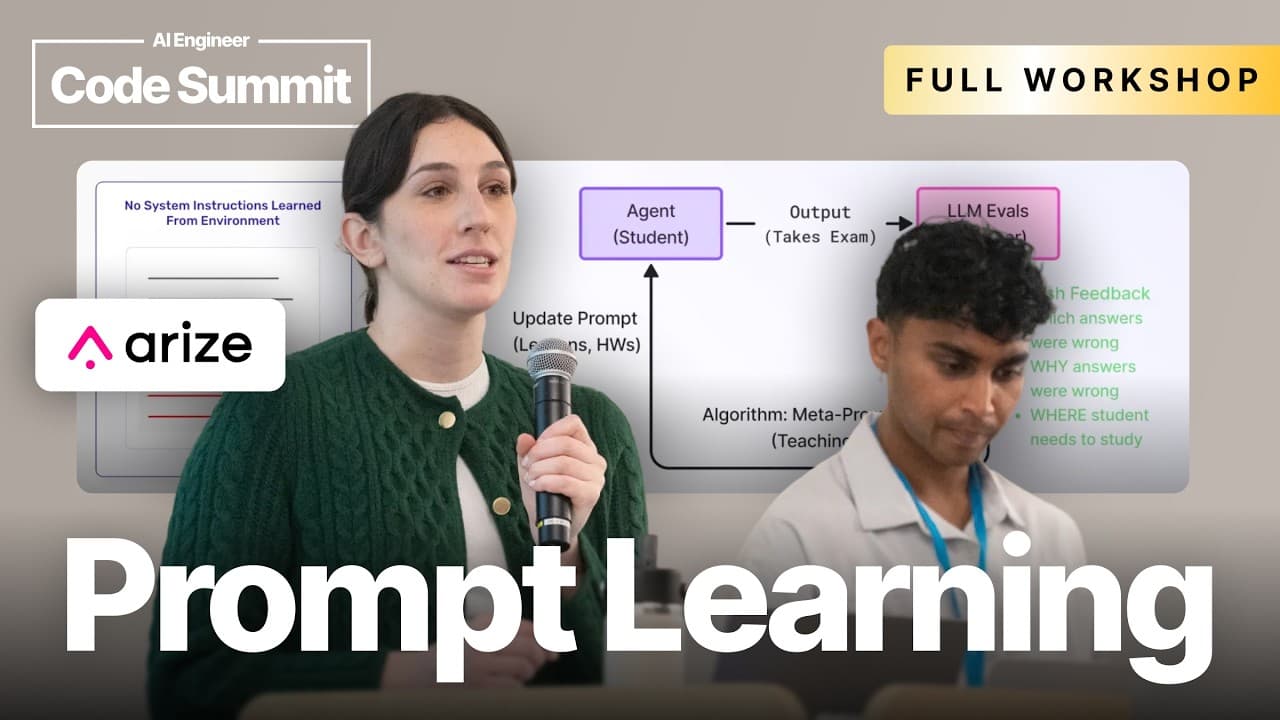
Prompt learning involves creating a feedback loop to improve AI prompts continuously. The process includes identifying failures, collecting feedback, and optimizing prompts based on evaluations. This iterative approach enhances performance without major changes to the model architecture, offering a cost-effective way to improve AI agents.
Transcript
[music] Hey everyone, gonna get started here. Thanks so much for joining us today. Um, I'm Sally. I'm the director of RISE. I'm going to be walking you through some of crowd prompt learning. Uh we're actually going to be building a driven optimization loop for the part of the workshop. Um I come from a technical background and started off in data s... Read More
Key Insights
- Prompt learning is crucial for optimizing AI performance by refining prompts based on feedback.
- Failures in AI agents often arise from weak environments and static planning, not weak models.
- Reinforcement learning, metaprompting, and prompt learning are key strategies in prompt optimization.
- Human instructions and feedback are vital for effective prompt learning and optimization.
- Prompt optimization can yield significant performance improvements without architecture changes.
- Eval engineering is essential for reliable prompt optimization, ensuring accurate evaluations.
- Prompt learning can achieve performance gains similar to state-of-the-art models at reduced costs.
- Successful prompt optimization requires collaboration between technical users and domain experts.
Install to Summarize YouTube Videos and Get Transcripts
Explore YouTube Video Summarizer or Get YouTube Transcript Extractor
Questions & Answers
Q: How does prompt learning improve AI performance?
Prompt learning improves AI performance by creating a feedback loop that continuously refines prompts based on collected feedback and evaluations. This iterative process identifies failures, optimizes prompts, and enhances performance without requiring major changes to the model architecture. It is a cost-effective approach to improving AI agents.
Q: Why do AI agents often fail?
AI agents often fail due to weak environments and static planning rather than weak models. Issues such as missing tools, inadequate instructions, and poor context engineering contribute to these failures. Prompt learning addresses these problems by optimizing prompts and enhancing adaptability and self-learning capabilities.
Q: What strategies are used in prompt optimization?
Strategies used in prompt optimization include reinforcement learning, metaprompting, and prompt learning. Reinforcement learning involves updating weights based on feedback, metaprompting asks AI models to improve prompts, and prompt learning uses human instructions and feedback to refine prompts iteratively.
Q: How important is human feedback in prompt optimization?
Human feedback is crucial in prompt optimization as it provides detailed explanations and instructions that guide the refinement of prompts. This feedback helps pinpoint issues, improve instructions, and enhance the overall performance of AI agents. It is a key component in the iterative process of prompt learning.
Q: What role does eval engineering play in prompt learning?
Eval engineering plays a critical role in prompt learning by ensuring that evaluations are reliable and accurate. It involves optimizing evaluation prompts and using high-quality feedback to guide the optimization process. Reliable evaluations are essential for successful prompt learning and effective AI performance improvements.
Q: Can prompt optimization improve performance without changing model architecture?
Yes, prompt optimization can significantly improve performance without changing the model architecture. By refining prompts based on feedback and evaluations, prompt learning enhances AI agents' capabilities cost-effectively. It offers a low-lift way to achieve performance gains comparable to state-of-the-art models.
Q: What is the benefit of using prompt learning over traditional optimization methods?
The benefit of using prompt learning over traditional optimization methods is that it leverages human feedback and detailed explanations, which are often underutilized in other approaches. This allows for more targeted and effective prompt refinements, leading to substantial performance improvements without extensive model changes.
Q: How does collaboration between technical users and domain experts enhance prompt learning?
Collaboration between technical users and domain experts enhances prompt learning by integrating diverse perspectives and expertise. Technical users manage code and automation, while domain experts provide insights into user experience and success criteria. This collaboration ensures comprehensive prompt optimization and improved AI agent performance.
Summary & Key Takeaways
-
Prompt learning creates a feedback loop to continuously improve AI prompts. It identifies failures, collects feedback, and optimizes prompts based on evaluations. This process enhances performance without major model changes, offering a cost-effective way to improve AI agents.
-
Failures in AI agents often stem from weak environments and static planning rather than weak models. Prompt learning strategies like reinforcement learning and metaprompting are used to address these issues.
-
Human instructions and feedback are critical for prompt optimization. Eval engineering ensures reliable evaluations, which are essential for successful prompt learning. This approach can achieve significant performance gains at reduced costs.
Read in Other Languages (beta)
Share This Summary 📚
Summarize YouTube Videos and Get Video Transcripts with 1-Click
Try YouTube Summary with ChatGPT & Claude or YouTube Transcript Generator
Explore More Summaries from AI Engineer 📚



Summarize YouTube Videos and Get Video Transcripts with 1-Click
Try YouTube Summary with ChatGPT & Claude or YouTube Transcript Generator