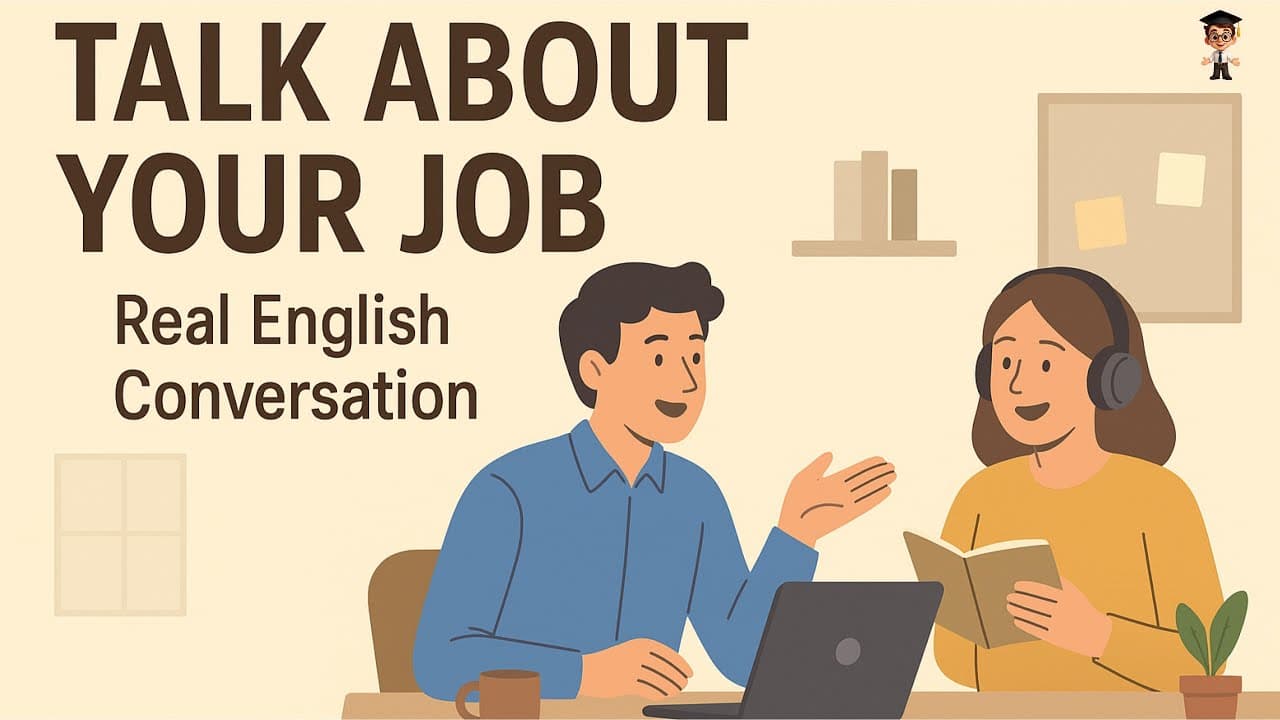
How to Talk About Your Job in English
TL;DR
Answer “What do you do?” with “I am a” plus your job title, then add where and for whom you work. Use “in” or “at” for workplaces, “for” with a company, adjectives such as “stressful” or “creative” for descriptions, and terms such as “full-time,” “part-time,” or “remote” for schedules.
Transcript
Hello everyone and welcome back to Mr. English Channel where learning English is easy and fun. I'm Emily. Hello Emily. And hello to all our fantastic listeners around the world. It is a beautiful day today. It really is, Paul. The sun is shining and I am feeling full of energy. How are you doing today? I am doing very well, thank you. I am a little... Read More
Key Insights
- “What do you do?” is the most natural question presented for asking about someone’s profession. A clear answer follows the pattern “I am a” plus a job title, as in “I am a teacher,” “I am a doctor,” or “I am a driver.”
- “In” identifies the building or room where someone works. Examples include “I work in a school,” “I work in an office,” “I work in a hospital,” and “I work in a restaurant,” all of which provide useful workplace context.
- “At” is another preposition used with workplaces and is described as similar to “in.” The lesson gives “I work at a bank” and “I work at the airport” as examples, while noting that both workplace prepositions are often acceptable.
- “For” introduces the name or type of company that employs someone. A complete description can combine several details: “I am a manager. I work in an office. I work for a big company.” This provides more information than giving only a job title.
- “I am looking for a job” directly describes a current job search, while “I am between jobs” politely indicates that someone finished one job and is seeking the next. Students and parents at home can identify themselves with their current roles.
- Job adjectives communicate how work feels or what qualities it has. “Tiring” means the job makes a person tired, “stressful” describes pressure from many simultaneous demands, and “boring” fits work that feels slow when there is little to do.
- Positive job descriptions include “fun,” “interesting,” and “creative.” Colleagues, also called co-workers, can improve the experience because they are the people someone works with. Paul’s restaurant job was tiring and stressful, but it was also fun because his colleagues were funny.
- Work schedules can be full-time, part-time, or remote. Full-time is presented as usually about 40 hours per week and associated with a Monday-to-Friday 9-to-5 schedule. Part-time involves fewer hours, while remote work means working from home instead of going to an office.
Install to Summarize YouTube Videos and Get Transcripts
Explore YouTube Video Summarizer or Get YouTube Transcript Extractor
Questions & Answers
Q: How do you answer “What do you do?” in English?
Answer with “I am a” followed by your job title, such as “I am a teacher,” “I am a doctor,” or “I am a driver.” You can make the response more informative by adding your workplace and employer. For example, say, “I am a manager. I work in an office. I work for a big company.” Short, clear sentences are appropriate and help build confidence.
Q: What does “What do you do?” mean in a conversation?
“What do you do?” is a natural way to ask about another person’s profession. It is presented as more natural than asking “What is your job?” and is common when people meet for the first time, such as at a party. The expected answer usually identifies a role, for example, “I am a podcast host,” “I am a teacher,” or “I am a writer.”
Q: How do you use “in,” “at,” and “for” when discussing work?
Use “in” to describe a workplace building or room, as in “I work in a school,” “I work in an office,” or “I work in a hospital.” Use “at” similarly for places, as in “I work at a bank” or “I work at the airport.” Use “for” when naming the company or organization, as in “I work for Google” or “I work for Amazon.”
Q: How can you talk about being unemployed in English?
Say “I am looking for a job” when you want to state directly that you are seeking employment. You can also say “I am between jobs,” a polite expression meaning that you finished one job and are looking for the next. If another role better describes your situation, you can say “I am a student,” “I am a stay-at-home mom,” or “I am a stay-at-home dad.”
Q: How can you describe what your job feels like?
Use adjectives that match your experience. A job can be tiring if it makes you tired, stressful if many demands happen at the same time, or boring if there is little to do and time feels slow. Positive descriptions include fun, interesting, exciting, and creative. A simple sentence such as “My job is interesting” clearly communicates your opinion without requiring complicated grammar.
Q: What are colleagues and co-workers?
Colleagues are the people you work with, and the lesson also uses “co-workers” with the same meaning. Good colleagues can make a job much better. Paul describes his former waiter job as tiring and stressful because he walked all day and served demanding customers, but he also calls it fun because his funny colleagues laughed together in the kitchen.
Q: How do you describe a full-time, part-time, or remote schedule?
Full-time work is described as usually involving about 40 hours a week, often from Monday to Friday. A classic 9-to-5 job starts at 9:00 a.m. and finishes at 5:00 p.m. Part-time work has fewer hours, perhaps three days a week or mornings only. Remote work means working from home instead of going to the office, so you can say “I work remotely” or “I work from home.”
Q: How do you ask and talk about a dream job?
Ask “What is your dream job?” to discuss the work someone would love to do if they could choose anything. A useful answer names the role and explains its appeal. Emily chooses travel writer because she would travel to beautiful countries, eat delicious food, and write stories. Paul chooses pilot because he loves flying and wants to see the clouds from above.
Summary & Key Takeaways
-
The natural question “What do you do?” asks about someone’s profession. A simple answer uses “I am a” followed by a job title, such as teacher, doctor, driver, writer, or podcast host. Adding a workplace or company creates a fuller response that gives the listener more useful information.
-
Workplace descriptions require a few useful prepositions. “In” and “at” identify places such as an office, school, hospital, restaurant, bank, or airport. “For” introduces the company or organization employing you. People without a current job can say they are looking for a job or between jobs.
-
Job conversations can include qualities, schedules, and ambitions. Adjectives such as tiring, stressful, boring, fun, interesting, and creative explain how work feels. Full-time, part-time, remote, and working from home describe schedules. Asking about someone’s dream job can also begin a longer, enjoyable conversation about work and personal interests.
Read in Other Languages (beta)
Share This Summary 📚
Summarize YouTube Videos and Get Video Transcripts with 1-Click
Try YouTube Summary with ChatGPT & Claude or YouTube Transcript Generator
Explore More Summaries from Mr. English Channel 📚

Summarize YouTube Videos and Get Video Transcripts with 1-Click
Try YouTube Summary with ChatGPT & Claude or YouTube Transcript Generator