How to Implement Logistic Regression in Python
TL;DR
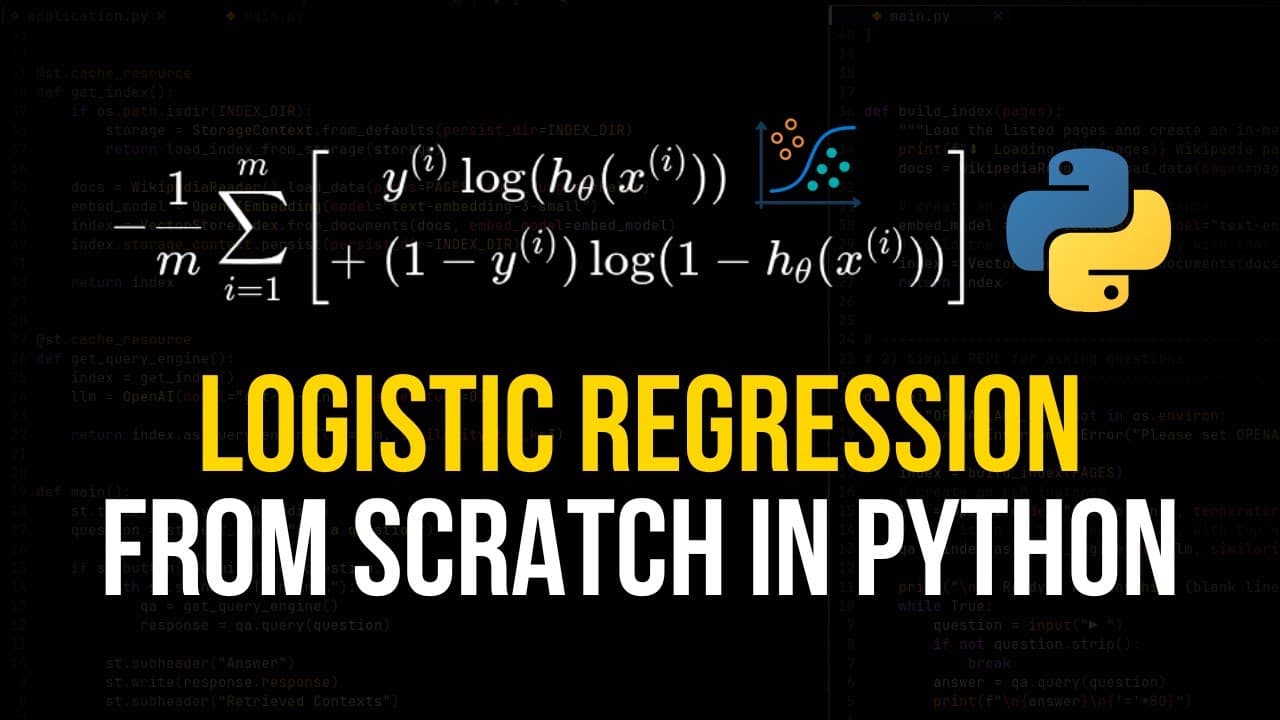
Logistic regression is a classification algorithm that predicts probabilities for binary outcomes. This video demonstrates how to implement logistic regression from scratch in Python, focusing on the mathematics behind it and the coding process. The process involves deriving the necessary formulas, implementing gradient descent, and coding the algorithm without relying on machine learning libraries.
Transcript
Today we're going to implement logistic regression from scratch in Python. And this video is going to be quite technical and mathematical. We're going to not only implement it from scratch in Python, meaning we're not going to rely on any machine learning packages, we're also going to derive the mathematics from scratch. So we're going to start wit... Read More
Key Insights
- Logistic regression is a classification algorithm, not a regression algorithm, despite its name.
- It predicts probabilities for binary outcomes, outputting values between 0 and 1.
- The sigmoid function is used to convert linear regression outputs into probabilities.
- Gradient descent is employed to optimize the parameters of the logistic regression model.
- The cross-entropy loss function is used to measure the difference between predicted and actual values.
- Partial derivatives and the chain rule of calculus are used to compute gradients for optimization.
- The implementation uses only NumPy for efficient vector and matrix operations.
- Preprocessing and evaluation of the model can be done using scikit-learn tools.
Install to Summarize YouTube Videos and Get Transcripts
Explore YouTube Video Summarizer or Get YouTube Transcript Extractor
Questions & Answers
Q: How does logistic regression work?
Logistic regression is a classification algorithm that predicts the probability of a binary outcome. It uses a linear combination of input features, applies the sigmoid function to map the output to a range between 0 and 1, and predicts a class based on a probability threshold.
Q: What is the role of the sigmoid function in logistic regression?
The sigmoid function is crucial in logistic regression as it converts the linear regression output into a probability between 0 and 1. This allows the model to predict the likelihood of an instance belonging to a particular class, facilitating binary classification tasks.
Q: Why is logistic regression considered a classification algorithm?
Logistic regression is considered a classification algorithm because it predicts categorical class labels rather than continuous values. It outputs probabilities that are used to classify instances into binary categories, such as yes/no or true/false, based on a threshold.
Q: What is gradient descent and how is it used in logistic regression?
Gradient descent is an optimization algorithm used to minimize the loss function in logistic regression. It iteratively adjusts the model's parameters in the direction that reduces the loss, allowing the algorithm to find the best-fit parameters for accurate predictions.
Q: What is the cross-entropy loss function?
The cross-entropy loss function measures the difference between predicted probabilities and actual class labels. It is used in logistic regression to quantify the error in predictions, guiding the optimization process to improve model accuracy by minimizing this loss.
Q: How are partial derivatives used in logistic regression?
Partial derivatives in logistic regression are used to compute gradients, indicating how each parameter affects the loss function. By calculating these derivatives, the algorithm can adjust parameters to minimize the loss, improving the model's predictive performance.
Q: Why is logistic regression implemented without machine learning libraries in the video?
The video implements logistic regression without machine learning libraries to provide a deeper understanding of the algorithm's mathematical foundation and coding process. This approach helps viewers grasp the underlying mechanics and logic behind logistic regression.
Q: How is the logistic regression model evaluated in the video?
In the video, the logistic regression model is evaluated using a real dataset from scikit-learn. The model's accuracy is assessed by comparing predictions against actual outcomes, demonstrating its effectiveness in classifying data accurately after being trained from scratch.
Summary & Key Takeaways
-
Logistic regression is used for binary classification, predicting probabilities between 0 and 1. It employs the sigmoid function to convert linear outputs into probabilities. The video explains the mathematical foundation and demonstrates coding the algorithm from scratch using Python.
-
The process involves deriving formulas for gradient descent and implementing them in Python with NumPy. The cross-entropy loss function guides parameter optimization, and the model is tested with a real dataset to validate its performance.
-
The video emphasizes understanding the underlying mathematics and coding without machine learning libraries, providing a comprehensive overview of logistic regression's implementation and testing in Python.
Read in Other Languages (beta)
Share This Summary 📚
Summarize YouTube Videos and Get Video Transcripts with 1-Click
Try YouTube Summary with ChatGPT & Claude or YouTube Transcript Generator
Explore More Summaries from NeuralNine 📚




Summarize YouTube Videos and Get Video Transcripts with 1-Click
Try YouTube Summary with ChatGPT & Claude or YouTube Transcript Generator