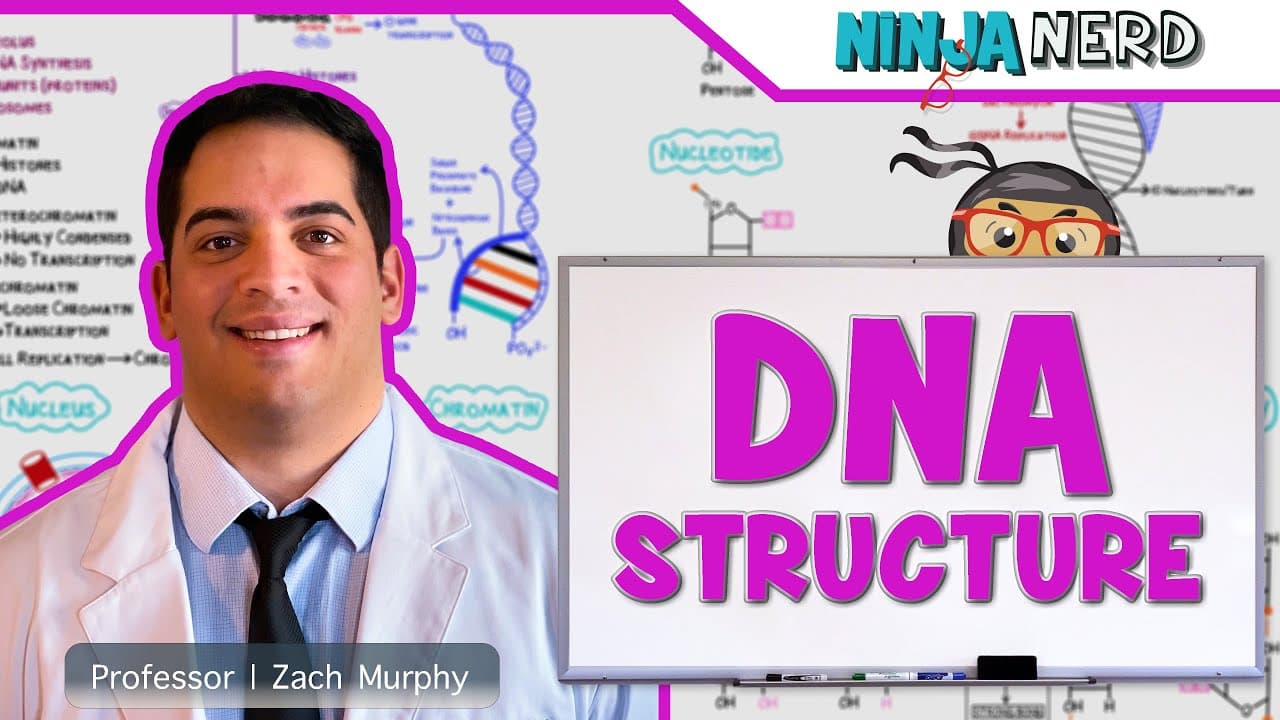
Cell Biology: How Is DNA Structured and Organized in the Nucleus?
TL;DR
DNA is organized in the nucleus as chromatin, with long DNA molecules wrapped around histone octamers and compacted into fibers, loops, and ultimately chromosomes during cell replication. Relaxed euchromatin allows RNA polymerases to access genes, whereas condensed heterochromatin restricts transcription. Read on to understand each packaging level and how the nucleus controls access to genetic material.
Transcript
what's up ninja nerds in this video today we're going to be talking about the structure of dna but before we get started please continue to support us by hitting that like button commenting down the comment section and please subscribe also down in the description box we have links to our facebook and instagram as well as our patreon you guys want ... Read More
Key Insights
- The nuclear envelope is a double-membrane phospholipid structure that surrounds the nucleus and separates its contents from the cytoplasm. Its outer membrane is associated with ribosomes, while its inner membrane provides a framework supported by lamin proteins.
- Nuclear pores are protein complexes that control transport between the nucleus and cytoplasm. Messenger RNA and ribosomal components can leave through these pores, while materials required within the nucleus, such as nucleotides used to make DNA, can enter.
- Lamins are filamentous proteins associated with the inner nuclear membrane that support nuclear structure and interact with chromatin involved in gene expression and replication. A mutation affecting lamin A is associated with progeria, a disease characterized by very rapid aging.
- The nucleolus is the region of the nucleoplasm where ribosomal RNA is synthesized and ribosomal subunits are produced. Ribosomal RNA combines with protein subunits to form ribosomes, which are small enough to be transported through nuclear pores.
- Chromatin is composed of DNA and histone proteins whose attraction permits extensive DNA compaction. This packaging is necessary because DNA is very long and must be condensed sufficiently to fit within the limited space of the cell nucleus.
- Heterochromatin is highly condensed chromatin in which strong association between DNA and histones limits access by transcription enzymes. Because RNA polymerases cannot readily reach the DNA, this tightly packed form does not undergo transcription.
- Euchromatin is loosely organized chromatin with a more relaxed association between DNA and histones. The available space allows RNA polymerases to reach the DNA and produce RNA, making euchromatin the transcriptionally expressed form described in the lecture.
- A histone octamer is formed from two copies each of the histone proteins H2A, H2B, H3, and H4. DNA wraps around this eight-protein structure, creating a fundamental level of chromatin organization that contributes to higher-order DNA compaction.
Install to Summarize YouTube Videos and Get Transcripts
Explore YouTube Video Summarizer or Get YouTube Transcript Extractor
Questions & Answers
Q: How is DNA packaged inside the nucleus?
DNA associates with histone proteins to form chromatin, allowing long DNA molecules to fit inside the nucleus. DNA wraps around histone octamers and is further organized into tightly coiled fibers and continuous loops. During cell replication, chromatin becomes highly condensed into chromosomes.
Q: What is the difference between euchromatin and heterochromatin?
Euchromatin is loosely organized chromatin that allows RNA polymerases to reach DNA and produce RNA. Heterochromatin is highly condensed, so transcription enzymes cannot easily access its DNA. The lecture therefore describes euchromatin as transcriptionally expressed and heterochromatin as not undergoing transcription.
Q: How does chromatin organization regulate transcription?
Chromatin organization determines whether RNA-producing enzymes can physically reach DNA. Relaxed euchromatin provides enough space for RNA polymerases to access genes, while tightly packed heterochromatin restricts that access and prevents transcription.
Q: What proteins form a histone octamer?
A histone octamer contains two copies each of H2A, H2B, H3, and H4, producing a complex of eight histone proteins. DNA wraps around this octamer as a fundamental level of chromatin packaging.
Q: Why does chromatin condense into chromosomes?
Chromatin condenses into chromosomes during cell replication so genetic material can be transferred from the parent cell to daughter cells. This highly compact organization includes DNA wrapped around histone complexes, tightly arranged fibers, and continuous loops.
Q: What does the nuclear envelope do?
The nuclear envelope is a double-membrane phospholipid structure that surrounds the nucleus and separates its contents from the cytoplasm. Its outer membrane is associated with ribosomes, while its inner membrane contains lamin proteins that support nuclear structure and interact with chromatin during gene expression and replication.
Q: What passes through nuclear pores?
Nuclear pores control movement between the nucleus and cytoplasm. Messenger RNA and ribosomal components can leave the nucleus, while materials needed inside it, such as nucleotides used to make DNA, can enter.
Q: What is the function of the nucleolus?
The nucleolus is the region of the nucleoplasm where ribosomal RNA is synthesized and ribosomal subunits are produced. Ribosomal RNA combines with protein components to form large and small ribosomal subunits, which contribute to ribosomes that can pass through nuclear pores.
Summary & Key Takeaways
-
The nucleus houses DNA within a double-membrane nuclear envelope composed of inner and outer membranes. Nuclear pores regulate movement between the nucleus and cytoplasm, including the export of messenger RNA and ribosomal components. The outer membrane carries ribosomes, while inner-membrane lamin proteins provide structural support and interact with chromatin during gene expression and replication.
-
The nucleoplasm contains the nucleolus and chromatin. The nucleolus produces ribosomal RNA and ribosomal subunits, which combine to form ribosomes that can pass through nuclear pores. Chromatin consists of DNA associated with histone proteins, and their attraction condenses extremely long DNA molecules into compact structures that fit within the nuclei of eukaryotic cells.
-
Chromatin exists as highly condensed heterochromatin or relaxed euchromatin. Heterochromatin prevents transcription because enzymes cannot easily access its DNA, while euchromatin permits RNA polymerases to transcribe accessible genes. During cell replication, chromatin condenses into chromosomes, whose layered organization includes continuous loops, tightly coiled fibers, and DNA wrapped around histone octamers containing paired histone proteins.
Read in Other Languages (beta)
Share This Summary 📚
Summarize YouTube Videos and Get Video Transcripts with 1-Click
Try YouTube Summary with ChatGPT & Claude or YouTube Transcript Generator
Explore More Summaries from Ninja Nerd 📚





Summarize YouTube Videos and Get Video Transcripts with 1-Click
Try YouTube Summary with ChatGPT & Claude or YouTube Transcript Generator