How to Read Notre-Dame's Saint Anne Portal
TL;DR
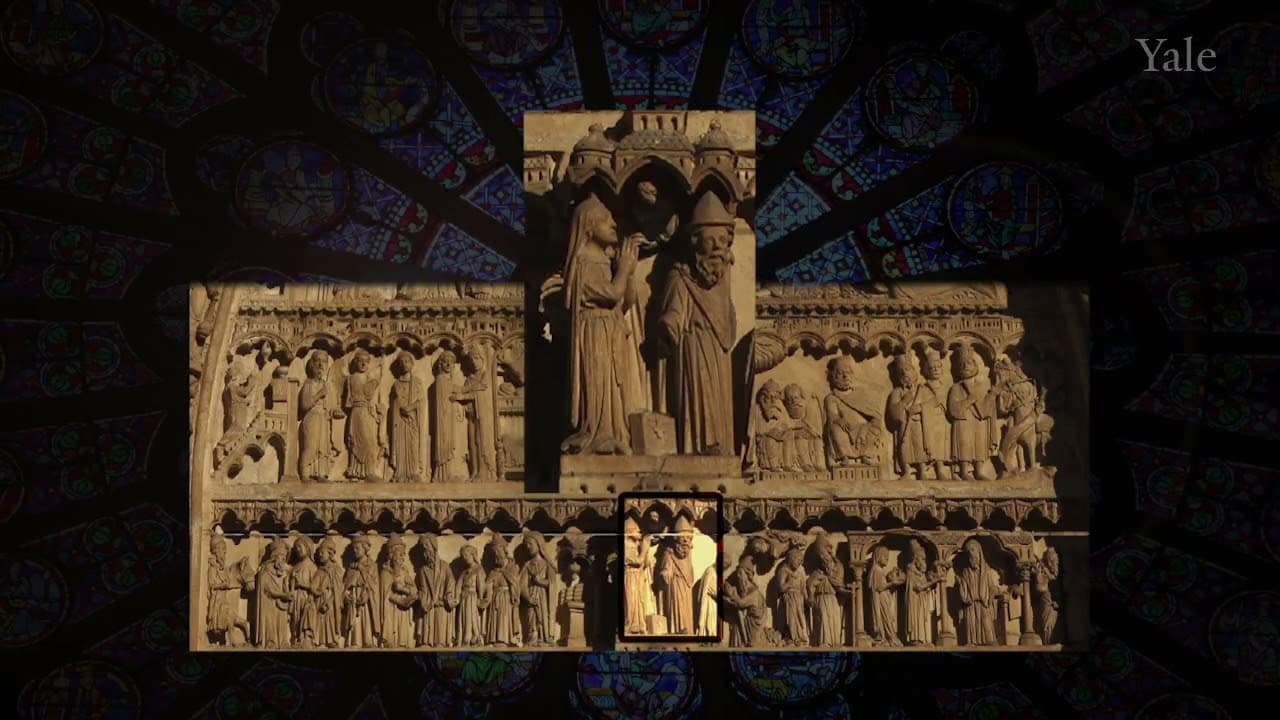
Read the Saint Anne Portal scene by scene, beginning with Anne and Joachim’s childlessness and ending with Christ’s birth and the Virgin in majesty. Its sculpted narrative, interpreted alongside the Golden Legend, connects Mary and Jesus to prophecy, divine intervention, and a royal genealogy that includes David, Solomon, and the ancestors named by Matthew.
Transcript
What is known as the St. Anne Portal lies on the south lateral section of the west facade. We begin with the trompe, which features St. Marcel. St. Marcel was a fifth-century saint who did not die as a martyr, but who, according to legend, vanquished with a blow of his crozier, which he holds in his left hand, a dragon which was terrorizing the pro... Read More
Key Insights
- The Saint Anne Portal is located in the south lateral section of Notre-Dame’s west facade, where its lintels, tympanum, archivolts, trumeau, and jamb statues combine into a layered narrative about Mary, Christ, prophecy, genealogy, and sacred history.
- Saint Marcel is shown on the trumeau holding his crozier, the object he allegedly used to defeat a dragon that was terrorizing the prostitutes of Paris. He was a fifth-century saint who, unlike many saints represented through martyrdom, did not die as a martyr.
- The lower lintel is structured like a sculpted play, presenting Anne and Joachim’s offering at the temple, its rejection by the high priest, Joachim’s departure into the wilderness, angelic messages to both spouses, and their joyful reunion at Jerusalem’s Golden Gate.
- The Golden Gate is a visual metaphor for miraculous conception because it is the opening through which the Messiah is expected to enter Jerusalem. Within the portal’s narrative, its opening also evokes Anne’s previously closed womb bearing Mary, the future mother of the Redeemer.
- Mary’s betrothal is determined through a miraculous sign involving rods placed at the altar. Joseph initially hides his rod because of his old age, but it flowers when produced, and a dove descends upon it, identifying him as the man chosen to marry Mary.
- The upper lintel presents Christ’s birth through connected scenes including Isaiah’s prophecy, Gabriel’s announcement to Mary, Mary’s acceptance, her visit to the pregnant Elizabeth, the Nativity, Herod, the Magi, and three kings carrying scepters.
- The portal’s genealogical program connects Christ with royal and prophetic ancestry. Solomon and David appear among the jamb statues, while the wider west facade includes twenty-six princely ancestors mentioned by Matthew in the Gallery of Kings.
- The surrounding figures extend the portal’s narrative beyond the central family story. Its vaults contain fourteen angels, fourteen patriarchs, sixteen prophets, and sixteen elders of the Apocalypse with musical instruments, while the jambs include Elijah, Peter, Paul, David, Solomon, the Sibyl, and Isaiah.
Install to Summarize YouTube Videos and Get Transcripts
Explore YouTube Video Summarizer or Get YouTube Transcript Extractor
Questions & Answers
Q: How should the Saint Anne Portal be read?
The Saint Anne Portal should be read scene by scene as a narrative staged in sculpture. Begin with Saint Marcel on the trumeau, then follow the lower lintel through Anne and Joachim’s childlessness, rejection, angelic promise, reunion, and Mary’s betrothal. Continue to the upper lintel for the Annunciation, Visitation, Nativity, Herod, Magi, and kings, then examine the Virgin in majesty and surrounding figures.
Q: What story appears on the lower lintel of the Saint Anne Portal?
The lower lintel presents Anne and Joachim entering the temple with an offering, only to have the high priest reject it because they are childless. Joachim leaves for the wilderness, where an angel promises that Anne will bear Mary. An angel also speaks to Anne, the couple reunites at the Golden Gate, and later scenes depict Mary’s miraculous betrothal to Joseph and their marriage.
Q: Why were Anne and Joachim rejected at the temple?
The high priest rejects Joachim’s offering because Anne and Joachim have remained childless after twenty years of marriage. According to the Golden Legend passage used to interpret the sculpture, the priest treats barrenness as grounds for exclusion from those contributing to the growth of God’s people. Ashamed and afraid of further reproach, Joachim avoids returning home and instead goes to his herdsmen in the wilderness.
Q: What did the angel promise Joachim and Anne?
The angel tells Joachim that his prayers and charitable gifts have been heard and that barrenness is not a rightful reproach because it arises from nature, not sin. Anne will bear a daughter named Mary, who will be dedicated to God and filled with the Holy Ghost. The angel also foretells that Mary will miraculously bear Jesus, through whom health will be given to the people.
Q: What does the Golden Gate symbolize in the portal?
The Golden Gate symbolizes both Jerusalem and miraculous opening. It is identified as an opening in Jerusalem’s eastern wall through which the Messiah is expected to enter. In the story of Anne and Joachim, their meeting there becomes a metaphor for Anne’s closed womb opening to bear Mary, who will later become the mother of the Redeemer. The gate therefore joins place, prophecy, and conception.
Q: How was Joseph chosen to marry Mary?
Mary’s prospective husbands from the house of David were commanded to bring rods to the altar. The chosen man’s rod would flower, and the Holy Ghost would rest on it in the form of a dove. Joseph, described as an old man, initially hid his rod because he felt too old for Mary. When ordered to produce it, the rod flowered and a dove descended, identifying him as her husband.
Q: What scenes appear on the upper lintel of the portal?
The upper lintel begins with the prophet Isaiah, who announced the coming of Jesus, and Gabriel’s announcement that Mary would become the mother of the Son of God. It continues with Mary’s acceptance and her visit to Elizabeth, who is pregnant with John the Baptist. The central Nativity shows Jesus in a cradle, Mary, animals, shepherds, angels, and onlookers, followed by Herod, the Magi, and three kings.
Q: How does the Saint Anne Portal express Christ’s genealogy?
The Saint Anne Portal places Christ’s birth within a chain of family, royal, and prophetic history. Its narrative begins before Christ with Anne and Joachim, continues through Mary and Joseph, and culminates in the Nativity and the Virgin with the Christ child. Solomon and David appear among the jamb figures, while the west facade’s Gallery of Kings contains twenty-six princely ancestors mentioned by Matthew.
Summary & Key Takeaways
-
The Saint Anne Portal occupies the southern entrance of Notre-Dame’s west facade. Saint Marcel appears on the trumeau, while the surrounding sculpture presents the conception and birth of Mary, her betrothal to Joseph, and Christ’s birth. These scenes contribute to the facade’s emphasis on Christ’s royal genealogy and sacred ancestry.
-
The lower lintel follows Anne and Joachim through childlessness, rejection at the temple, separation, angelic announcements, and reunion at Jerusalem’s Golden Gate. The gate symbolizes a closed womb opening through divine action. Later scenes show Mary’s suitors, Joseph’s flowering rod, her marriage, and Joseph accepting the divine source of her maternity.
-
The upper lintel moves from Isaiah and Gabriel to the Annunciation, Visitation, Nativity, Herod, the Magi, and the three kings. Above it, the Virgin and Christ child appear in majesty. Angels, patriarchs, prophets, apocalyptic elders, saints, rulers, and biblical figures fill the surrounding vaults and jambs.
Read in Other Languages (beta)
Share This Summary 📚
Summarize YouTube Videos and Get Video Transcripts with 1-Click
Try YouTube Summary with ChatGPT & Claude or YouTube Transcript Generator
Explore More Summaries from YaleCourses 📚




Summarize YouTube Videos and Get Video Transcripts with 1-Click
Try YouTube Summary with ChatGPT & Claude or YouTube Transcript Generator