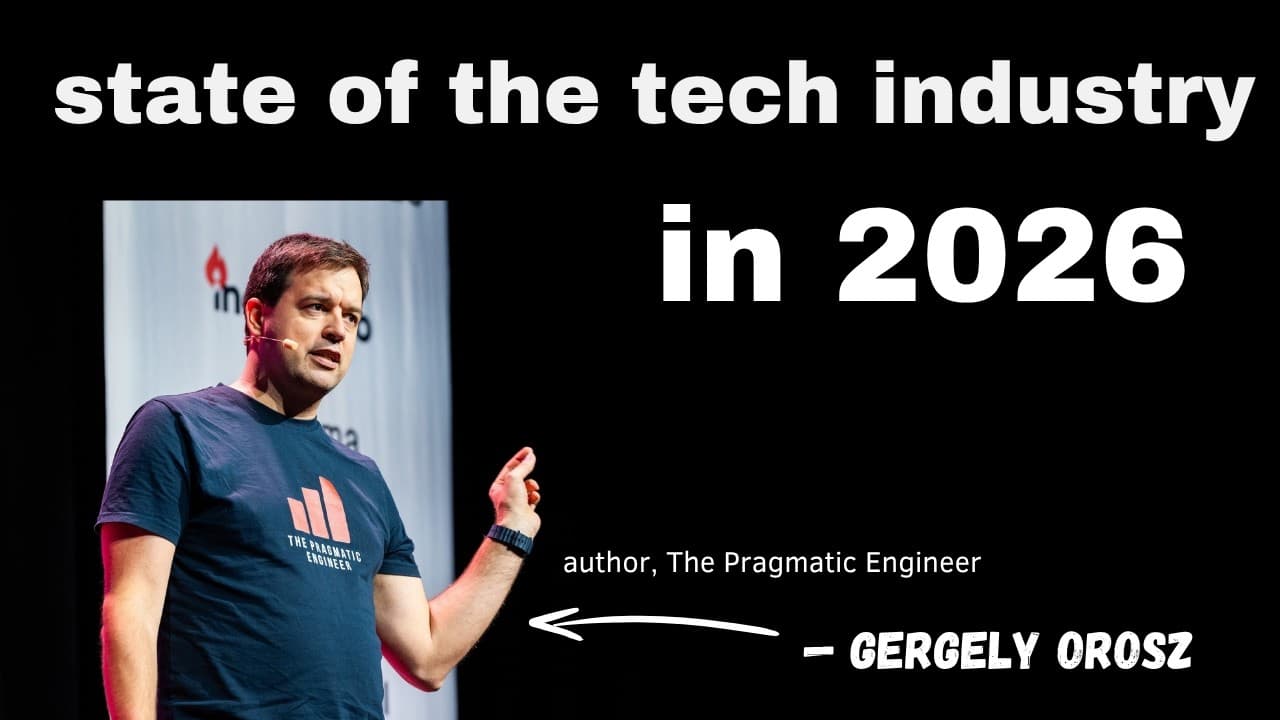
What changed in the tech industry in 2026 AI era?
TL;DR
AI is increasingly driving software work, with near total AI generated code in startups and parallel agent usage becoming the norm. IDEs are fading as teams build agentic harnesses and internal platforms, while migrations accelerate and costs tighten through smarter routing. The industry is adopting agentic software factories and shifting collaboration patterns, with more issues and PRs being created by agents than humans.
Transcript
Good morning. I'm Gergely and thank you for the introduction. I now spend most of my time writing the pragmatic engineer hosting the podcast which is software engineering a big tech from the inside and today I want to bring you into a journey show show you some stories some information that might not be as readily available inside AI labs big tech ... Read More
Key Insights
- AI is dramatically increasing code production speed, with reports of near complete AI generated code in startups.
- Parallel agents are now common, enabling multiple task threads and cognitive overhead managed across five to ten sessions.
- IDE usage is fading as companies pivot to agentic harnesses and integrated AI tooling rather than traditional IDEs.
- Engineering specializations are disappearing because Codex style AI can cover front end, back end and more, enabling broader skill sets.
- Migrations are speeding up, with large scale rewrites completed in weeks rather than years in some cases.
- Agentic generated issues and PRs are rising, sometimes outpacing human created work on platforms like Linear.
- Costs of AI are being controlled through smarter routing and leveraging open models, leading to stabilizing budgets.
- Many organizations build their own AI coding harnesses to integrate internal data sources and optimize workflows.
Install to Summarize YouTube Videos and Get Transcripts
Explore YouTube Video Summarizer or Get YouTube Transcript Extractor
Questions & Answers
Q: What is the current trend in code creation and how is it affecting developers?
The trend is that most code in startups is AI generated, with developers focusing on prompt engineering and harness management rather than hand coding. This shift reduces manual coding effort, increases iteration speed, and changes the role of engineers toward tuning agents, designing workflows, and integrating data sources. It marks a move from writing code to orchestrating AI driven processes.
Q: How are IDEs evolving in the AI driven software landscape?
IDEs are becoming legacy tools for many teams as agentic interfaces and harnesses take the foreground. Companies like Cursor pivoted to agentic interfaces, and big players consider forking or replacing traditional IDE functionality with AI powered environments. Enterprises still need IDEs for certain tasks, but overall usage is declining as agents handle development tasks more efficiently.
Q: What does the rise of agentic software factories imply for production systems?
Agentic software factories indicate that agents monitor production, generate pull requests, and sometimes automate deployments with human review reserved for critical changes. This suggests a shift toward continuous improvement loops where agents detect issues, propose fixes, and push changes, accelerating reliability and uptime while still retaining safety with human oversight.
Q: How are migrations changing with AI assistance?
Migrations that used to take years can now happen in weeks or months with AI assistance. Examples include Uber moving to a new testing framework, AirBnB and Asana performing significant rewrites quickly, and Anthropic migrating code in parallel. This shows AI driven refactoring and tool selection speeding up large scale software transitions.
Q: What is happening with issue tracking and pull requests in AI environments?
Agentic generated issues and agent only pull requests are rising. Data shows more agent created tickets than human ones on Linear, and a notable spike in agent only reviewed PRs. This demonstrates that AI agents are actively surfacing improvements and pushing code, reducing the burden on human reviewers while increasing output.
Q: How are costs and model usage trending in 2026?
Initially, AI was perceived as costly, but now larger companies are controlling costs by optimizing routing and using smarter model usage while keeping costs flat. They also leverage open models and improved processing to stabilize budgets, showing that AI adoption is becoming more scalable but still requires careful cost management.
Q: What is happening to engineering specializations in AI enabled development?
Specializations are disappearing as Codex like capabilities enable engineers to perform multiple roles across front end and back end. Solomon from OpenAI notes that the context has changed, reducing the need for highly specialized roles and allowing generalists to contribute effectively in many projects.
Q: What might a typical AI enabled project team look like in 2026?
Projects are increasingly run by one or two engineers who leverage AI assistants, harnesses, and agent tooling. This reflects a shift toward lean, highly automated teams that rely on AI for most implementation work, with humans focusing on architecture, data integration, and oversight of automated processes.
Summary & Key Takeaways
-
The talk highlights a shift to AI driven development where coding is largely AI generated and teams operate with multiple parallel agents. It notes a move away from traditional IDEs toward agentic harnesses and Slack based workflows. It also covers rapid migrations and the emergence of agent driven issue and PR workflows.
-
Another key point is the rise of agentic software factories in large firms and startups, with cost management and performance improvements through routing and Rust migrations. The discussion includes examples from OpenAI, Anthropic, Uber, Airbnb, and Asana to illustrate practical migrations and tool adoption.
-
The talk also discusses the disappearance of engineering specializations, the reduction in team sizes for projects, and a broader move to one or two engineers per project, enabled by AI tooling and Codex like capabilities.
Read in Other Languages (beta)
Share This Summary 📚
Summarize YouTube Videos and Get Video Transcripts with 1-Click
Try YouTube Summary with ChatGPT & Claude or YouTube Transcript Generator
Explore More Summaries from The Pragmatic Engineer 📚
Summarize YouTube Videos and Get Video Transcripts with 1-Click
Try YouTube Summary with ChatGPT & Claude or YouTube Transcript Generator