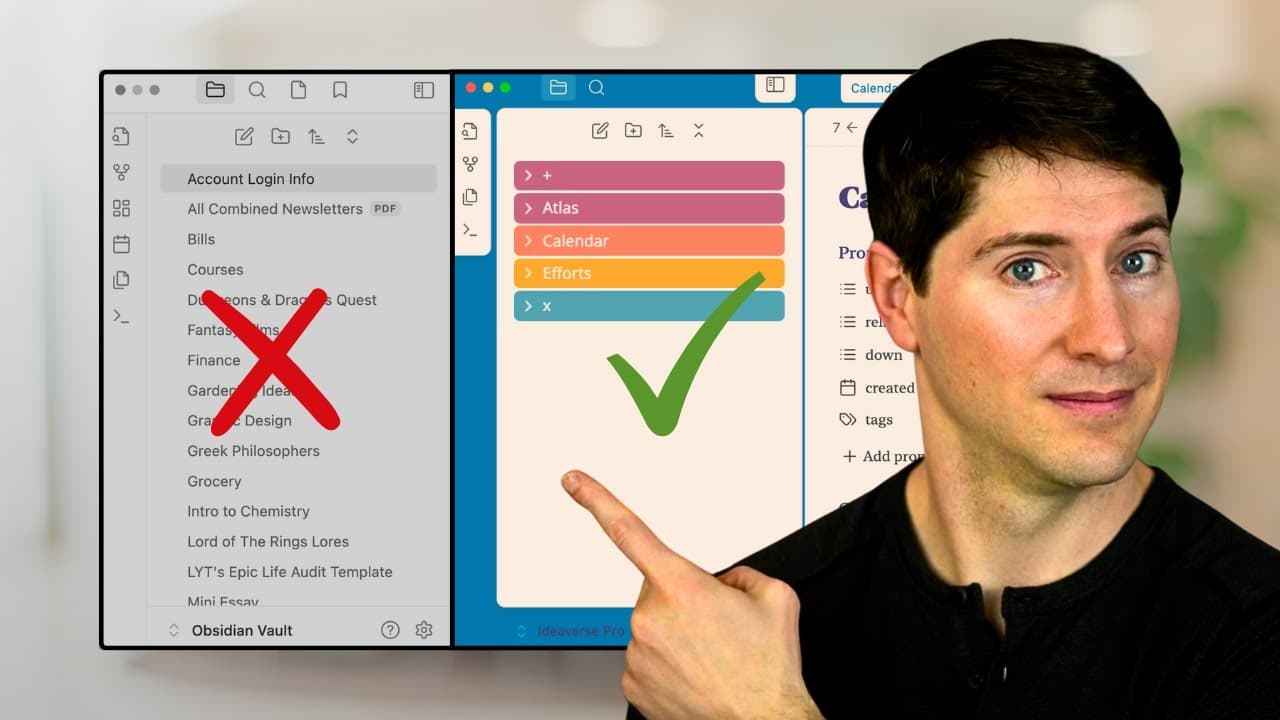
How to Organize Obsidian Folders as Notes Grow
TL;DR
Start an Obsidian vault without folders, then add structure only when accumulating notes creates real difficulty finding or classifying them. Build folders around the note types and activities you actually have, use precise names for clear categories such as projects, and choose deliberately broad names for ambiguous collections of ideas and knowledge.
Transcript
the only way to organize your folders in obsidian is your way but I think I know the best way to get there because I've helped thousands of others get there too and it starts in a really unusual way with no folders at all then we build from the bottom up earning structure every step of the way the reason this works is because it's based on what you... Read More
Key Insights
- Start with no folders because an empty or nearly empty Obsidian vault has not yet demonstrated what structure it needs. Capturing useful thoughts first allows later categories to emerge from real behavior instead of assumptions borrowed from somebody else’s system.
- Folder structure is earned when a growing collection creates noticeable friction. Twenty-two notes may still be manageable, but imagining the same mix at 200 or 2,000 notes reveals where difficulty finding the right item could justify additional organization.
- A useful folder system is personal because different people capture different kinds of material. Daily notes, class notes, journal entries, quotes, book highlights, projects, concepts, and simmering efforts should receive dedicated folders only when they are genuinely part of the vault.
- The number of folders should remain proportionate to the number and variety of notes. Creating ten folders for two notes would produce more categories than content, adding unnecessary decisions before the vault has enough material to reveal recurring patterns.
- Clear categories should use clear folder names because action-oriented material is comparatively easy to classify. Notes about a project due next month can go into a projects or efforts-and-projects folder without requiring the ambiguous judgments common with conceptual material.
- Idea and knowledge notes are difficult to organize by folder because one concept may satisfy several labels at once. A short note about yin and yang can be an atomic note and an idea, while note length alone does not reliably determine its conceptual category.
- Fuzzy collections need equally fuzzy folder names because their contents do not have sharp boundaries. A broad label such as Umami can honestly hold ideas, thoughts, and knowledge that would otherwise force repeated choices among overlapping categories.
- Folders are only one part of managing complexity because links and other mechanisms can also help people retrieve notes. The preferred approach is to avoid spending unnecessary time on folder decisions when that attention could support connections and relationships between ideas.
Install to Summarize YouTube Videos and Get Transcripts
Explore YouTube Video Summarizer or Get YouTube Transcript Extractor
Questions & Answers
Q: How should I start organizing folders in a new Obsidian vault?
Start with no folders and capture the notes you genuinely need, such as a grocery list or a concept discovered while reading. Do not build a large hierarchy before any recurring pattern exists. As the vault grows, observe which note types repeatedly appear and where finding or classifying material becomes difficult. Add each folder only when that real collection demonstrates a need for structure.
Q: When should I add folders to an Obsidian vault?
Add folders when the number or variety of notes begins creating real tension around finding, grouping, or managing them. A collection of two notes does not justify ten folders, and even 22 notes may remain easy to browse. The important question is whether the collection is likely to expand toward hundreds or thousands of notes and whether a recurring category would reduce retrieval friction.
Q: How many folders does an Obsidian vault need?
An Obsidian vault needs only the folders supported by the material and activities it actually contains. Someone who never creates daily notes does not need a daily-notes folder. Someone who records book highlights, projects, or class notes may eventually benefit from categories for those materials. The correct number therefore emerges from use rather than from a universal template or another person’s preferred system.
Q: Why can predefined Obsidian folder systems cause confusion?
Predefined systems can create categories based on somebody else’s needs rather than the contents of your vault. They may ask you to distinguish among atomic notes, evergreen notes, ideas, knowledge, and thoughts before those distinctions are useful or even clear. Building from the bottom up avoids maintaining empty folders and reduces repeated classification decisions that do not help you retrieve or connect your notes.
Q: How should idea and knowledge notes be organized in Obsidian?
Idea and knowledge notes should be placed in a broad container when sharper categories produce overlapping choices. A short note about yin and yang could reasonably qualify as both an atomic note and an idea, while a much longer note may still concern only one idea. Because neither length nor maturity always resolves the category, a deliberately fuzzy folder can represent the material more accurately.
Q: What is the difference between clear and fuzzy Obsidian folders?
A clear folder corresponds to material with an obvious operational identity, such as projects, efforts, source notes, or book highlights. A fuzzy folder holds concepts, thoughts, ideas, and knowledge whose boundaries overlap. The folder label should mirror the certainty of the content: precise names work for distinct activities, while a broad name such as Umami avoids pretending that ambiguous conceptual notes have rigid divisions.
Q: Where should book highlights and project notes go in Obsidian?
Highlights from a book can go into a source-notes folder because they originate from material being read. Notes connected to a project due next month can go into an efforts-and-projects folder because they support action-oriented work. These examples are not mandatory universal categories. They demonstrate how folders can follow recognizable note types that already exist inside a particular vault.
Q: Are folders always necessary for organizing Obsidian notes?
Folders are not always necessary, especially when a vault is new or contains only a small number of notes. Some people can work without them, while others have activities that require folders in obvious or less obvious ways. Links and other mechanisms can also help manage complexity. The practical goal is to use folders where they reduce genuine friction without letting folder maintenance replace thinking and connection-making.
Summary & Key Takeaways
-
Begin with note capture rather than a predefined folder hierarchy. A new vault may contain only a grocery list and an interesting concept from a book, so creating numerous categories would add more structure than the notes require. Folders become useful only after growth introduces meaningful difficulty finding or managing material.
-
The organizing process should reflect the notes a person actually creates. Possible types include book highlights, concepts, journal entries, projects, quotes, class notes, daily notes, and simmering efforts. Someone who does not take daily notes does not need a daily-notes folder, regardless of what another person recommends online.
-
Clear note types support clear folder names, while ambiguous material benefits from deliberately fuzzy containers. Projects can fit naturally inside a projects folder, but ideas about yin and yang or upstream and downstream effects resist rigid distinctions such as atomic, evergreen, knowledge, thought, or idea notes. The folder name should match that uncertainty.
Read in Other Languages (beta)
Share This Summary 📚
Summarize YouTube Videos and Get Video Transcripts with 1-Click
Try YouTube Summary with ChatGPT & Claude or YouTube Transcript Generator
Explore More Summaries from Linking Your Thinking with Nick Milo 📚





Summarize YouTube Videos and Get Video Transcripts with 1-Click
Try YouTube Summary with ChatGPT & Claude or YouTube Transcript Generator