How to perform the 5 longevity exercises for men
TL;DR
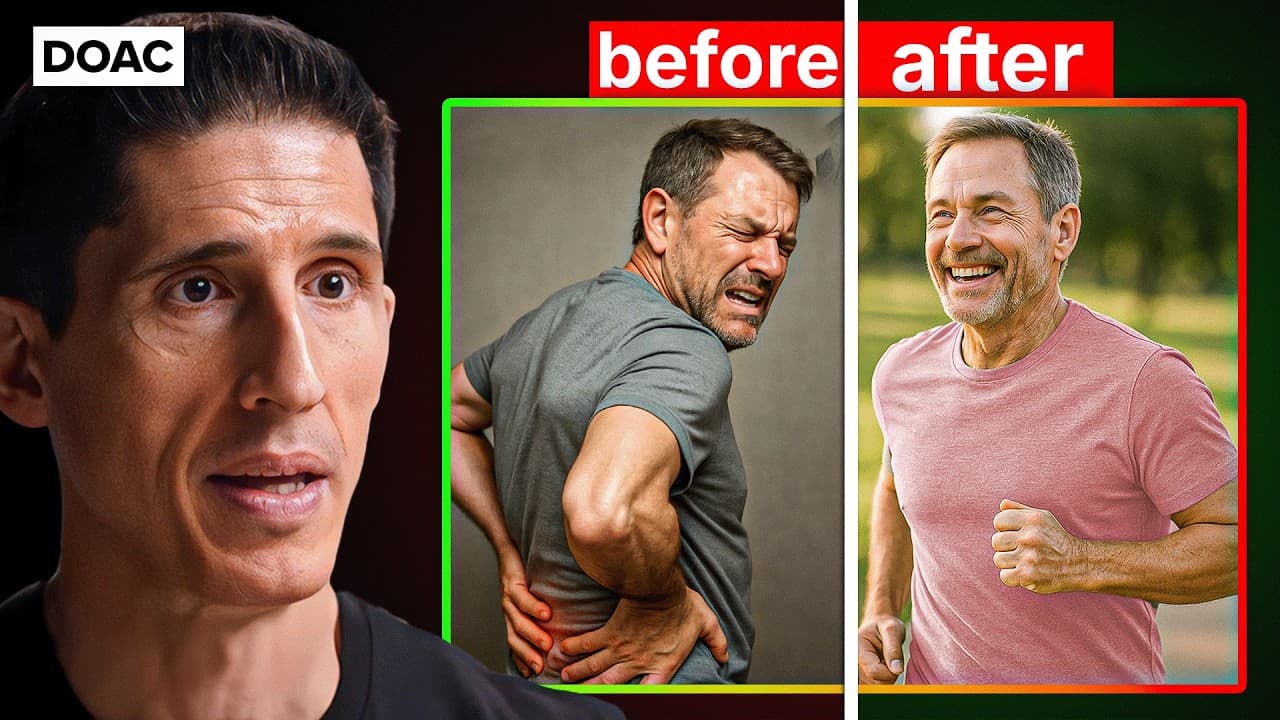
The video shows five core moves that maintain strength, mobility, and injury prevention with age. Start with single leg RDLs to train hip hinge, then progress through a squat and reach, a horse stance hold, a posterior chain push up, and sideline hip abduction to test and build hip stability. Perform them weekly and track balance and range of motion for ongoing improvement.
Transcript
Hey DOAC listeners, it's Jeff Cavalere, physical therapist and strength coach. After my conversation with Stephen on the Diary of a CEO, tons of you wrote in, you wanted to know, how can I do those longevity exercises that you talked about? So, I put together a followalong version of it. You see, these five moves are ones that I want you to be able... Read More
Key Insights
- Single leg RDL teaches hip hinge mechanics
- Squat and reach improves thoracic extension and hip flexion
- Horse stance hold develops hip mobility and stability
- Posterior chain push up trains back, glutes, and core
- Push up with a marine style progression targets posterior chain
- Sideline hip abduction tests and trains glute medius
- Each move reinforces frontal plane hip control
- Consistency and progression are emphasized over intensity
- More videos from this channel:
- More from this channel: The Diary Of A CEO Clips
Install to Summarize YouTube Videos and Get Transcripts
Explore YouTube Video Summarizer or Get YouTube Transcript Extractor
Questions & Answers
Q: A real search query question about the video (e.g. 'How to...', 'What is...', 'Why does...', 'When should...'). Question 1
To stay strong and mobile with age you can use the five foundational movements shown in the video. Start with a single leg Romanian deadlift to learn proper hip hinge and balance. Progress through a squat and reach to improve thoracic extension and hip mobility, then practice the horse stance for hip stability. Add a posterior chain push up to train the back and glutes, and finish with sideline hip abduction to assess and train hip abductor strength. Consistency and gradual progression are the keys to long term benefits.
Q: Question 2
The five exercises are designed to be performed weekly to maintain strength, mobility, and injury resistance as you age. Each move targets a different aspect of joint health and movement quality, from hinge mechanics to thoracic extension, hip mobility, posterior chain strength, and hip abductor control. By sequencing them together you create a balanced program that reduces imbalance risk and supports overall function.
Q: Question 3
The single leg RDL helps address frontal plane hip stability which is often weaker in daily life. It involves hinging with a counterbalance leg lift to challenge balance and control, emphasizing keeping a hinge at the hips rather than rounding the back. This trains the glutes and hamstrings to work in concert, improving functional movement patterns.
Q: Question 4
The squat and reach combines a deep hip and groin stretch with upper body rotation and thoracic extension. Holding the position for up to 60 seconds promotes mobility through the hips, spine, and shoulders, while encouraging stable posture and breath control. It targets flexibility and posture in a functional standing pattern.
Q: Question 5
The horse stance hold emphasizes hip stability and mobility in multiple planes. By maintaining upright posture and gradually increasing hold time, you train leg muscles, core stiffness, and spinal alignment, which supports daily activities such as standing up from a chair and maintaining balance during movement.
Q: Question 6
The posterior chain push up is a progression that extends the traditional push up by sliding the hands forward and lifting into a 'superman' at the top. This sequence trains the entire posterior chain from calves to upper back, improving posture, back strength, and shoulder health while still maintaining core and leg tightness for overall stability.
Q: Question 7
Sideline hip abduction serves as a strength test and training tool for the glute medius. By keeping the toe pointed and lifting the leg, you isolate the hip abductors and feel the glute contraction, which helps identify weaknesses and guide targeted training to improve pelvic stability and gait mechanics.
Q: Question 8
The overarching message is that longevity training is about practical, bodyweight based movements performed consistently over time. By benchmarking deficits, focusing on a hinge, mobility, stability, and posterior chain strength, you maintain athleticism and reduce injury risk without needing machines or complex routines. Progression is built into the reps, holds, and controlled movement.
Summary & Key Takeaways
-
This summary highlights five moves that focus on mobility and strength to support aging bodies, emphasizing balance and hip control. It explains how each exercise contributes to overall function, with guidance on progression and monitoring deficits over time. The approach is practical and movement based rather than equipment dependent.
-
The program includes hinge mechanics, mobility work for hip flexion, thoracic extension, and posterior chain strength, ending with a hip abduction test that doubles as a training cue. The emphasis is on consistency and gradual progression to preserve athleticism and reduce injury risk.
-
The overall goal is sustainable strength and longevity through simple, repeatable movements that can be performed without machines. The sequence supports posture, balance, and hip stability, offering a benchmark to identify weaknesses and address them proactively.
Read in Other Languages (beta)
Share This Summary 📚
Summarize YouTube Videos and Get Video Transcripts with 1-Click
Try YouTube Summary with ChatGPT & Claude or YouTube Transcript Generator
Explore More Summaries from The Diary Of A CEO Clips 📚





Summarize YouTube Videos and Get Video Transcripts with 1-Click
Try YouTube Summary with ChatGPT & Claude or YouTube Transcript Generator