What is the core idea of general relativity explained?
TL;DR
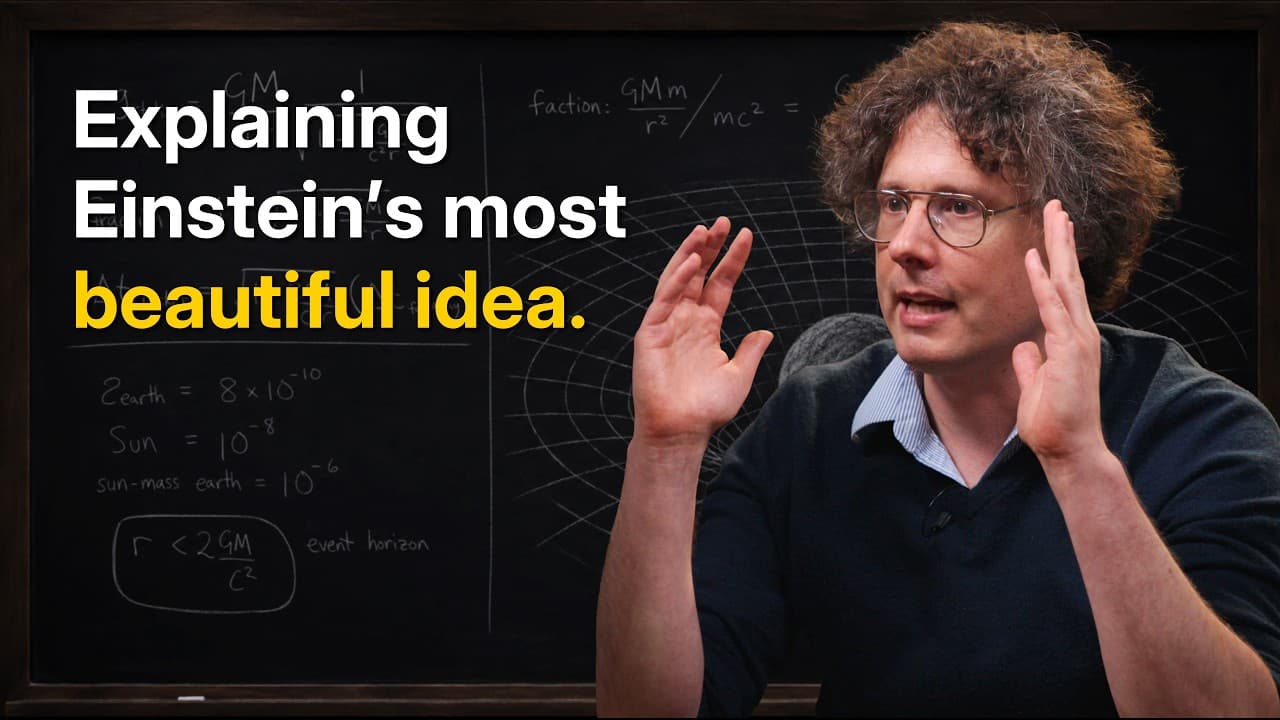
General relativity explains gravity as the curvature of spacetime caused by mass and energy, not as a force. The central insight is that nothing can go faster than light, which leads to a description of motion in gravity as following curved paths rather to a simple force. The theory extends special relativity to include gravity and resolves inconsistencies with instantaneous action at a distance.
Transcript
I'm back with Adam Brown. You currently lead BlueShift at Google DeepMind, which is cracking science and reasoning. In a previous life, Adam was a prolific physicist, taught at Stanford, and did research on everything from cosmology to string theory to general relativity. It's said that general relativity is the most beautiful thing the hu... Read More
Key Insights
- General relativity seeks a single, consistent description of gravity that fits with relativity principles.
- Nothing can travel faster than light, which constrains how gravitational influence can propagate.
- The Newtonian inverse-square law conflicts with relativity and motivates a new framework.
- Gravity cannot be treated as a simple force like electromagnetism but as a manifestation of spacetime geometry.
- Maxwell’s equations inspiring relativistic consistency provide a historical precedent for unifying forces.
- The Lorentz symmetry of electromagnetic theory helps explain why a relativistic theory of gravity is needed.
- Two masses attract in Newtonian gravity due to a force, but general relativity replaces this picture with curvature.
- The shift from force-based gravity to geometry is the central idea Einstein called his happiest thought.
- More videos from this channel:
- More from this channel: Dwarkesh Patel
Install to Summarize YouTube Videos and Get Transcripts
Explore YouTube Video Summarizer or Get YouTube Transcript Extractor
Questions & Answers
Q: What is the central idea behind general relativity as described in the lecture?
The central idea is that gravity is not a force acting at a distance but a manifestation of the curvature of spacetime caused by mass and energy. This geometric view replaces the Newtonian concept of a gravitational force, aligning gravity with the relativistic principle that nothing can travel faster than light and that motion follows curved paths in a curved spacetime.
Q: How does special relativity relate to gravity in this explanation?
Special relativity covers physics where gravity is not involved, establishing the speed of light as a fundamental limit and describing how electromagnetism fits into spacetime. General relativity extends these ideas to include gravity, requiring a broader framework where spacetime can be curved and where the same relativistic constraints apply to gravitational phenomena.
Q: Why can’t we simply extend electrostatics to gravity in the same way?
Extending electrostatics directly to gravity would lead to inconsistencies with the speed-of-light limit, implying instantaneous changes in gravitational influence, which is not allowed by relativity. Einstein therefore sought a different formulation for gravity that preserves relativistic causality while recovering observed gravitational behavior.
Q: What historical precedent supports reformulating forces in a relativistic way?
The history shows that electrostatics, when fully described by Maxwell’s equations, is compatible with special relativity through added magnetic effects. This precedent demonstrates that a force law can be modified into a relativistic theory, inspiring the search for a relativistic gravity theory that avoids instantaneous action and respects the speed of light.
Q: What is the role of the sign difference in gravitational versus electric forces?
The sign difference reflects that gravity is always attractive for masses, whereas like charges repel in electrostatics. This sign change is a clue that gravity cannot be treated as a direct electrostatic analog; gravity must be mediated by a different mechanism, which in the modern view is associated with spacetime curvature rather than a simple inverse-square force.
Q: How does the lecture describe the Newtonian second law in relation to general relativity?
Newton’s second law, F = ma, remains valid in a broader sense, but the interpretation of forces and motion changes under general relativity. Objects move along straight lines when not acted upon by external forces, yet in general relativity the curved geometry of spacetime guides their motion, preserving the essence of inertia in a relativistic context.
Q: What comparison is made between gravity and electromagnetism in the talk?
The talk compares gravity and electromagnetism by noting that gravity cannot be simply treated as an inverse-square force like electromagnetism due to the need to respect relativistic causality. It explains that gravity will be described differently, with the underlying geometry of spacetime providing the correct framework rather than a direct force law.
Q: How does the concept of observers come into play with black holes as discussed?
The discussion suggests that different observers, such as an infalling observer versus a distant bystander, will have radically different experiences near a black hole. This illustrates how general relativity’s curved spacetime and the equivalence of reference frames produce diverse observational realities, highlighting the theory’s profound implications for gravity and spacetime.
Summary & Key Takeaways
-
General relativity is presented as the culmination of Einstein’s ideas, extending special relativity to include gravity and explaining why gravity can be described as geometry. The explanation highlights the historical shift from Newtonian gravity to a relativistic view where spacetime itself is curved by mass and energy. The speaker emphasizes accessibility of the core insight in a short time.
-
The discussion contrasts Newtonian gravity with general relativity, noting that Newtonian force laws imply instantaneous influence, which clashes with the speed of light. It shows how gravity must be reformulated so that causality and relativistic constraints are preserved, leading to a geometric description of spacetime.
-
The episode situates general relativity in the broader context of physics history, including the role of special relativity and electromagnetism. It also hints at black holes and the idea that different observers experience gravity and motion in radically different ways, depending on their frame of reference.
Read in Other Languages (beta)
Share This Summary 📚
Summarize YouTube Videos and Get Video Transcripts with 1-Click
Try YouTube Summary with ChatGPT & Claude or YouTube Transcript Generator
Explore More Summaries from Dwarkesh Patel 📚





Summarize YouTube Videos and Get Video Transcripts with 1-Click
Try YouTube Summary with ChatGPT & Claude or YouTube Transcript Generator