How to Measure Temperature with NTC Thermistors
TL;DR
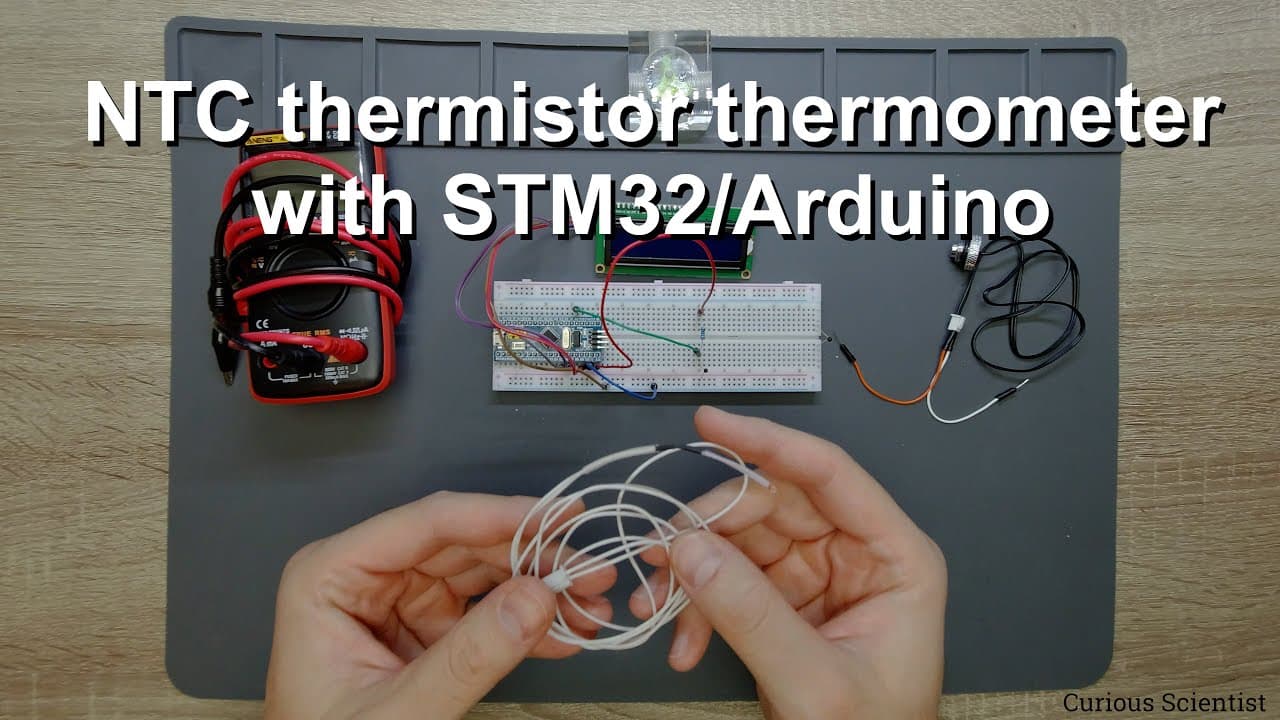
NTC thermistors measure temperature by changing resistance with temperature variations. This method generates a voltage divider circuit using an STM32 microcontroller, allowing for simple and effective temperature readings displayed on an LCD. Their low cost and versatility make them ideal for applications like 3D printers and water cooling systems.
Transcript
welcome everyone in this video i will show you another way of measuring temperature so in my previous videos i showed you i think at least three different kind of measurement techniques this was for example a k-type thermocouple or a digital chip or an analog chip so two of these measurement techniques were based on some kind of semiconductor and t... Read More
Key Insights
- ❓ NTC thermistors are an accessible and efficient option for temperature measurement due to their unique resistance characteristics.
- ⚡ The simplicity of using a voltage divider circuit makes the implementation of thermistors practical for beginners and hobbyists.
- 🏂 The STM32 microcontroller offers better resolution for analog temperature readings compared to traditional Arduino boards.
- 😘 The application of thermistors in consumer electronics, such as 3D printers, demonstrates the widespread practicality of low-cost temperature sensors.
- 🎮 The video emphasizes the importance of calibration and precision in temperature measurement for effective engineering applications.
- ⚡ A clear understanding of the relationships between resistance, voltage, and temperature is crucial for accurate measurements in experimental setups.
- 🫵 The content provides valuable resources for viewers to replicate and adapt the project to their personal needs, promoting learning and experimentation.
Install to Summarize YouTube Videos and Get Transcripts
Explore YouTube Video Summarizer or Get YouTube Transcript Extractor
Questions & Answers
Q: What is an NTC thermistor, and how does it function?
An NTC thermistor is a type of resistor that decreases in resistance when the temperature increases. This negative temperature coefficient behavior allows for measuring temperature changes by monitoring the resistance variations. The output can be calibrated to provide temperature readings in Celsius or other units using simple circuitry.
Q: How does the voltage divider circuit work with the thermistor?
In the voltage divider setup, the thermistor is paired with a resistor of equal value, creating a system where the output voltage changes with temperature fluctuations. When the thermistor’s temperature rises, its resistance drops, lowering the output voltage, which is measured by the microcontroller to calculate the temperature.
Q: Why is the STM32 microcontroller preferred over standard Arduinos for this project?
The STM32 is favored due to its higher resolution ADC (12 bits) compared to the Arduino's 10 bits, enabling more precise temperature measurements. Additionally, STM32 can operate at 3.3V, which is compatible with the thermistor’s output, making it a robust choice for such applications.
Q: What are practical applications of NTC thermistors in electronics?
NTC thermistors are widely used in various applications, such as providing feedback for temperature control in 3D printers, and water cooling systems. Their small size and low cost allow them to be placed in tight spaces where temperature measurement is crucial for system performance.
Q: How can users obtain the coding and schematics for this project?
Viewers can find the source code and circuit schematics on the content creator's website, linked in the video description. The content creator encourages users to check this resource for detailed project guidance.
Q: What safety considerations should users keep in mind while using the thermistors?
Users must ensure that the voltage supplied does not exceed the thermistor’s and microcontroller’s specifications. For the STM32, voltage should typically stay at 3.3V for the ADC input to avoid damaging the board, as most ADC pins are not 5V tolerant.
Q: How does the resistance of the thermistor change with temperature?
The resistance of an NTC thermistor decreases as temperature increases. At 25 degrees Celsius, for example, the resistance is typically around 10 kilo-ohms. When the temperature varies, this resistance change can be leveraged to calculate the corresponding temperature.
Q: What coding environment is recommended for this project?
The video suggests using the Arduino IDE for programming the STM32 or other microcontrollers, as the principles and methods are similar. The creator provides code snippets and highlights the sections that need modification for different hardware setups.
Summary & Key Takeaways
-
The video introduces NTC thermistors as another temperature measurement method, explaining their resistance change with temperature. The main concepts include the thermoelectric effect and semiconductor-based methods previously discussed.
-
A demonstration of a voltage divider circuit using the NTC thermistor with an STM32 microcontroller and displaying the results on an LCD is presented, emphasizing simplicity and effectiveness.
-
Practical applications are highlighted, including the use of thermistors in 3D printers and a water cooling system, showcasing their versatility and affordability.
Read in Other Languages (beta)
Share This Summary 📚
Summarize YouTube Videos and Get Video Transcripts with 1-Click
Try YouTube Summary with ChatGPT & Claude or YouTube Transcript Generator
Explore More Summaries from Curious Scientist 📚



![Building a Peltier cooler-based cooling box - First iteration, improvements [Part 2/6] thumbnail](/_next/image?url=https%3A%2F%2Fi.ytimg.com%2Fvi%2F0YlNw0EGnzI%2Fhqdefault.jpg&w=750&q=75)


Summarize YouTube Videos and Get Video Transcripts with 1-Click
Try YouTube Summary with ChatGPT & Claude or YouTube Transcript Generator