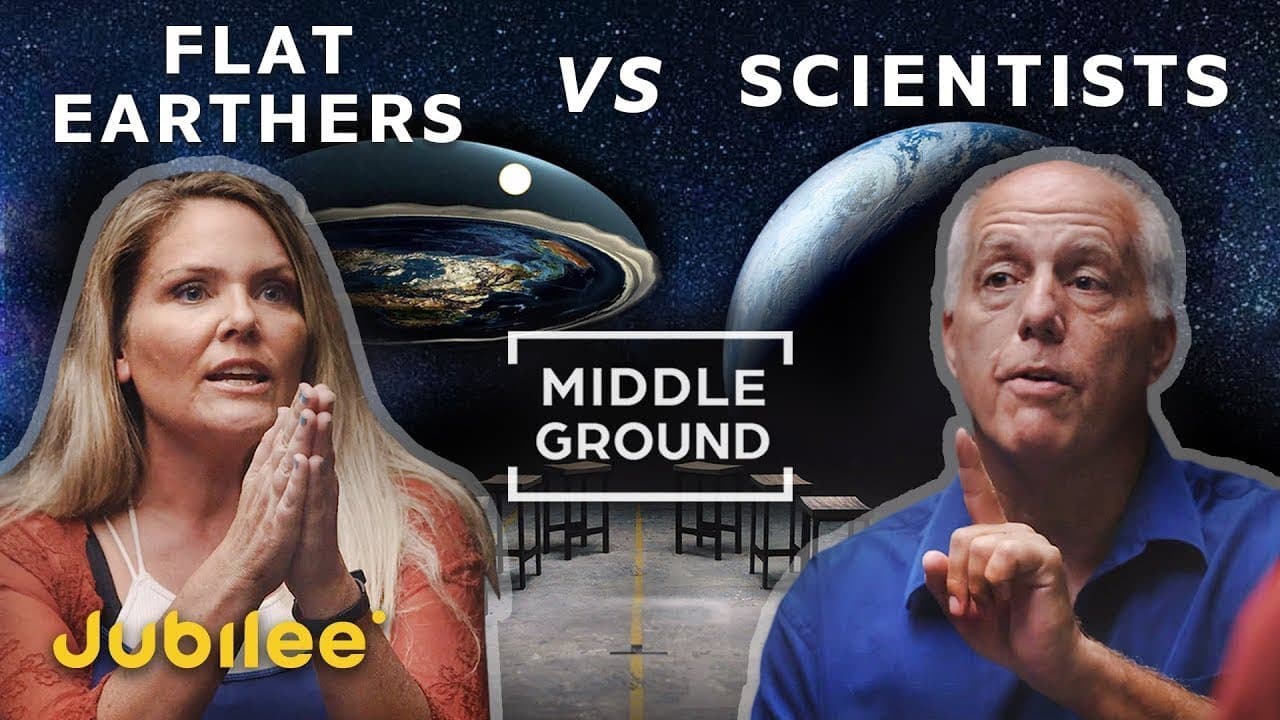
Can We Trust Science Over Flat Earth Beliefs?
TL;DR
Trusting science involves accepting overwhelming evidence that the Earth is round, based on extensive research and rigorous validation. Flat-earthers often cite observations and religious texts, but scientific consensus relies on repeatable results and peer-reviewed methods. Engaging critically with evidence and maintaining an open dialogue are essential for understanding differing beliefs.
Transcript
Hey guys, welcome back to Middle Ground. Before we jump in we've got a huge announcement. A lot of folks have been asking for this for years. We're finally giving you the first-ever Jubilee podcast called 'radical empathy'. That's right, we are really proud and excited to share it with you guys. It actually features an interview with somebody in th... Read More
Key Insights
- 🙃 The belief in a flat earth is a topic of controversy and skepticism, with passionate advocates on both sides.
- 👨🔬 Scientific consensus and evidence-based research provide robust evidence for a spherical earth.
- 🖐️ Media plays a significant role in shaping beliefs and can contribute to the spread of misinformation and skepticism.
- 🤗 The importance of critical thinking, open-mindedness, and the evaluation of reliable sources are essential in examining beliefs.
- 🫵 Dialogue between individuals with different perspectives is crucial for understanding and empathy, even when confronted with opposing views.
- 👨🔬 The challenges of navigating conflicting beliefs and the need for evidence-based research and scientific methodologies are evident in the discussion.
- 🫓 Flat-earthers often rely on personal observations, religious texts, and skepticism towards scientific institutions to support their beliefs.
Install to Summarize YouTube Videos and Get Transcripts
Explore YouTube Video Summarizer or Get YouTube Transcript Extractor
Questions & Answers
Q: What is the evidence provided by flat-earthers to support their belief?
Flat-earthers often highlight observations such as being able to see distant objects, contradictory images from space agencies, and the presence of various religious texts advocating for a flat earth.
Q: How do scientists and skeptics respond to flat earth claims?
Scientists and skeptics argue that there is robust evidence supporting a spherical earth, including the curvature seen in the distance, satellite imagery, moon landings, and scientific consensus among experts.
Q: Is there any room for dialogue between flat-earthers and scientists?
While dialogue is crucial, it is challenging due to the disparity in the levels of evidence presented. Scientists emphasize the importance of critical thinking and relying on established scientific methodologies.
Q: How does the role of media and information dissemination impact beliefs?
The internet and alternative media have provided platforms for various beliefs to proliferate. This has made it both easier to find information and more challenging to verify its credibility, leading to increased skepticism and the spread of misinformation.
Key Insights:
- The belief in a flat earth is a topic of controversy and skepticism, with passionate advocates on both sides.
- Scientific consensus and evidence-based research provide robust evidence for a spherical earth.
- Media plays a significant role in shaping beliefs and can contribute to the spread of misinformation and skepticism.
- The importance of critical thinking, open-mindedness, and the evaluation of reliable sources are essential in examining beliefs.
- Dialogue between individuals with different perspectives is crucial for understanding and empathy, even when confronted with opposing views.
- The challenges of navigating conflicting beliefs and the need for evidence-based research and scientific methodologies are evident in the discussion.
- Flat-earthers often rely on personal observations, religious texts, and skepticism towards scientific institutions to support their beliefs.
- Scientists emphasize the predictability and verifiability of scientific theories and argue for the use of evidence-based reasoning in examining beliefs.
Summary & Key Takeaways
-
Participants engage in a civil discussion about the concept of a flat earth, presenting their beliefs and challenging each other's views.
-
The discussion covers various topics, including religious interpretations, scientific consensus, evidence, and the role of media.
-
The participants emphasize the importance of critical thinking, evidence-based research, and open-mindedness in examining beliefs.
Read in Other Languages (beta)
Share This Summary 📚
Summarize YouTube Videos and Get Video Transcripts with 1-Click
Try YouTube Summary with ChatGPT & Claude or YouTube Transcript Generator
Explore More Summaries from Jubilee 📚





Summarize YouTube Videos and Get Video Transcripts with 1-Click
Try YouTube Summary with ChatGPT & Claude or YouTube Transcript Generator