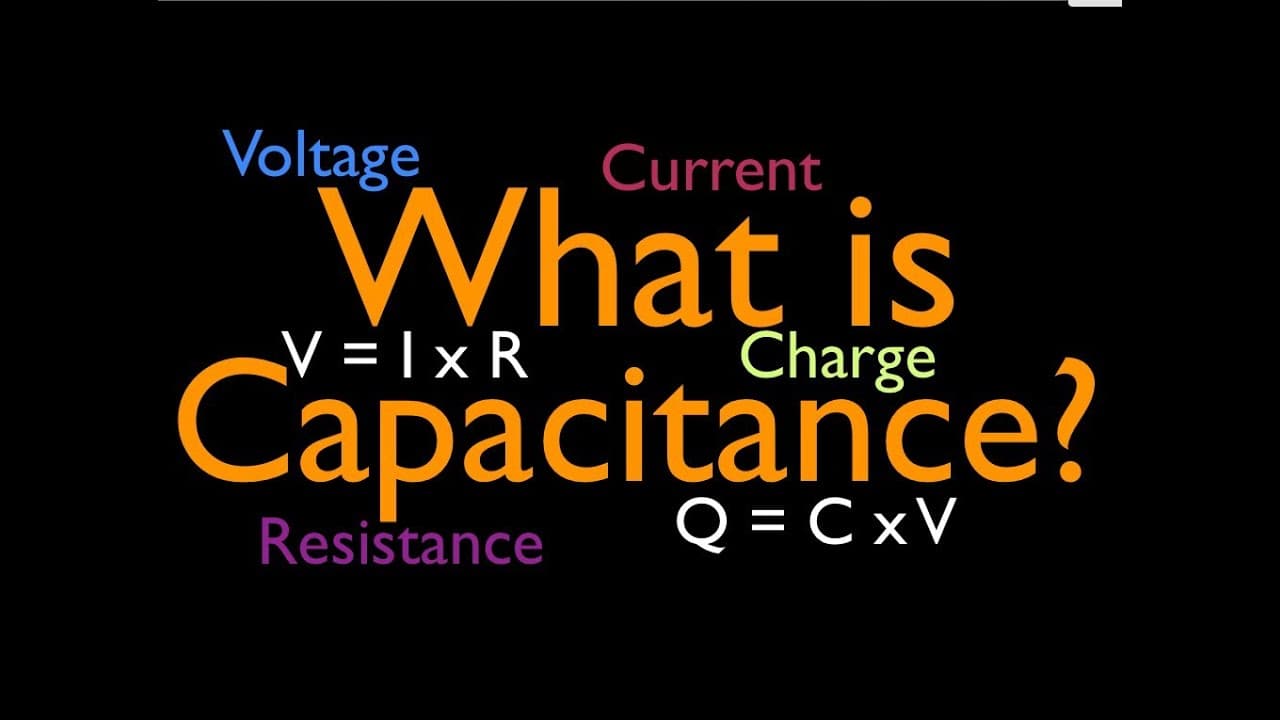
Capacitors (2 of 9) What is Capacitance? An Explanation
TL;DR
Capacitance is an object's ability to store electric charge, and greater capacitance allows more charge to be stored. It is represented by C, measured in farads, and related to charge and voltage by Q = C × V. Most capacitors used in electronics have capacitance below one farad, often expressed in microfarads. Read on to understand the units, symbols, examples, and capacitor equation.
Transcript
okay in today's video I am going to go over what is capacitance now I'm not gonna go over how to calculate the capacitance in circuits or how to calculate the capacitance of a capacitor but I just want to go over a general conceptual review of what capacitance is kind of definition the abbreviations the units how we measure it how we talk about it ... Read More
Key Insights
- 🏪 Capacitance is the ability of objects to store charge, crucial for electronic device functionality.
- 🇦🇪 Farads measure capacitance, with units like microfarads commonly used in electronics.
- ⁉️ The formula Q = C x V represents the relationship between charge, capacitance, and voltage in electronic circuits.
- ✊ Capacitors store charge which can power electronic devices, highlighting the practical importance of capacitance.
- 🦻 Understanding capacitance aids in comprehending circuit calculations and the behavior of circuits with capacitors.
- 🤬 The symbol for capacitance is C, abbreviating farads as F, essential for representing capacitance in electronic equations.
- 💐 In electronics, capacitance impacts the storage and flow of charge, influencing the operation of electronic devices.
Install to Summarize YouTube Videos and Get Transcripts
Explore YouTube Video Summarizer or Get YouTube Transcript Extractor
Questions & Answers
Q: What is capacitance?
Capacitance is the ability of an object to store electric charge. The greater the capacitance, the more charge the object can store.
Q: What is the symbol for capacitance?
The symbol for capacitance is C. This differs from the symbols for current and charge, which are I and Q.
Q: What unit is used to measure capacitance?
Capacitance is measured in farads, abbreviated F. Capacitor values used in electronics are also commonly expressed in microfarads.
Q: What does one farad mean?
One farad means a capacitor can store one coulomb of charge for every volt applied to it. A farad can therefore be expressed as coulombs per volt.
Q: What is the capacitor equation?
The capacitor equation is Q = C × V. In this equation, Q is charge, C is capacitance, and V is voltage.
Q: How do capacitance and voltage determine stored charge?
The amount of charge stored depends on the capacitor's capacitance and the voltage connected to it. This relationship is represented by Q = C × V.
Q: What capacitance values are given as examples?
The video shows capacitors rated at 1,000 microfarads and 10 microfarads. It also demonstrates how to state a capacitance of 47 microfarads.
Q: Do most electronics capacitors have more than one farad of capacitance?
No. Most capacitors bought for use in electronics have a capacitance of less than one farad, because one farad is a large amount of capacitance.
Summary & Key Takeaways
-
Definition: Capacitance is the ability of an object to store electric charge.
-
Definition: Capacitors are electronic devices that store charge for later use in running an electronic device.
-
Tool: C represents capacitance, while F abbreviates its unit, the farad.
-
Number: One farad allows one coulomb of charge to be stored for every volt applied.
-
Compare: Greater capacitance means that more charge can be stored.
-
Number: Most capacitors used in electronics have a capacitance of less than one farad.
-
Number: Example capacitor ratings include 1,000 microfarads and 10 microfarads.
-
Number: A capacitance value can be written and read as 47 microfarads.
-
Tool: The capacitor equation is Q = C × V, meaning charge equals capacitance times voltage.
-
Compare: Current uses I, charge uses Q, and capacitance uses C as their respective symbols.
Read in Other Languages (beta)
Share This Summary 📚
Summarize YouTube Videos and Get Video Transcripts with 1-Click
Try YouTube Summary with ChatGPT & Claude or YouTube Transcript Generator
Explore More Summaries from Step by Step Science 📚
Summarize YouTube Videos and Get Video Transcripts with 1-Click
Try YouTube Summary with ChatGPT & Claude or YouTube Transcript Generator