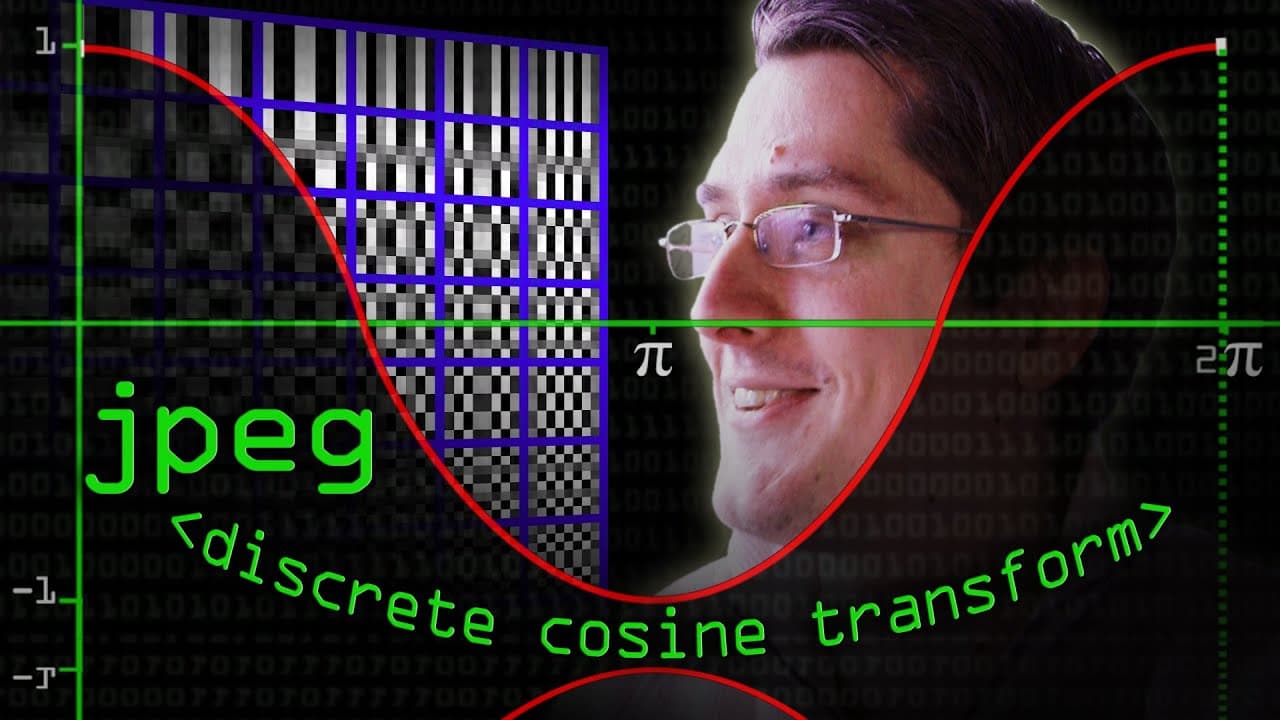
How Does JPEG Use the Discrete Cosine Transform? (JPEG Pt2), Computerphile
TL;DR
JPEG uses the discrete cosine transform to express each 8×8 pixel block as a weighted combination of 64 cosine waves, then reduce less important high-frequency information. Before the transform, RGB data is converted to YCbCr so luminance and chrominance can be handled separately, with optional chrominance downsampling. Read on to understand how frequencies, coefficients, quantization, and decoding work together.
Transcript
In the last video, we talked about the beginnings of JPEG, so what do we do at the beginning of the process to start preparing for the discrete cosine transform, which is really how the lossy compression happens within a JPEG. We start with our RGB image, we convert that into YCbCr color space, which separates illuminance and chrominance. And then ... Read More
Key Insights
- JPEG compression starts by converting an image from RGB to YCbCr color space, separating luminance and chrominance.
- The discrete cosine transform (DCT) represents image data as a sum of cosine waves of varying frequencies.
- In JPEG, each image is divided into 8x8 pixel blocks, and each block is transformed using DCT.
- The DCT coefficients indicate the contribution of each cosine wave to the image block, with low-frequency coefficients having a larger impact.
- Quantization reduces the precision of DCT coefficients, especially high-frequency ones, which are less visible to the human eye.
- Huffman encoding is used to further compress the quantized DCT coefficients by exploiting redundancy.
- The decompression process involves reversing quantization and applying an inverse DCT to reconstruct the image.
- JPEG's compression is lossy but maintains visual quality by focusing on preserving low-frequency information.
Install to Summarize YouTube Videos and Get Transcripts
Explore YouTube Video Summarizer or Get YouTube Transcript Extractor
Questions & Answers
Q: How does JPEG use the discrete cosine transform?
JPEG splits an image into 8×8 pixel blocks and applies the discrete cosine transform to each block separately. The transform calculates coefficients that describe how much each of 64 cosine waves contributes to reconstructing that block.
Q: Why does JPEG divide an image into 8×8 pixel blocks?
An 8×8 block contains 64 pixel positions and can be exactly represented using 64 two-dimensional cosine waves. Encoding each block separately lets JPEG describe its visual content through a corresponding set of coefficients.
Q: What happens before the discrete cosine transform in JPEG compression?
JPEG begins with an RGB image and converts it to YCbCr, separating luminance from chrominance. The chrominance channels can then be downsampled because substantial reduction may not be visible to people.
Q: What do DCT coefficients represent in JPEG?
Each coefficient is a number representing one cosine wave’s contribution to an 8×8 image block. A coefficient of zero means that wave contributes nothing, while a larger weighting gives it more influence on the reconstructed block.
Q: What are low- and high-frequency components in a JPEG image?
Low-frequency components describe gradual changes, such as moving from a dark table to a bright jumper and back again. High-frequency components describe rapid changes, such as the alternating detail within a woolen knit.
Q: Why can JPEG discard high-frequency image information?
JPEG assumes that some high-frequency signals can be removed while preserving the general gist of the image. Quantization reduces the precision of these components, especially where the lost information has less effect on perceived visual quality.
Q: How can cosine waves represent image data?
Cosine waves with different frequencies are added together, with each wave assigned a particular weight. Increasing the number and variety of these weighted waves allows more complex signals and image patterns to be represented.
Q: How is a JPEG image reconstructed during decompression?
The encoded coefficients are recovered through Huffman decoding and reversed quantization. JPEG then applies an inverse discrete cosine transform to rebuild the image blocks, combines those blocks, and converts the YCbCr data back to RGB.
Summary & Key Takeaways
-
JPEG compression begins by converting images to YCbCr color space and applying the discrete cosine transform (DCT) to 8x8 pixel blocks. This process represents image data as a sum of cosine waves, emphasizing low frequencies. Quantization reduces the precision of high-frequency components, which are less perceptible, allowing for significant data reduction.
-
After quantization, JPEG uses Huffman encoding to compress the data further. The resulting coefficients are stored efficiently, and the decompression process involves reversing these steps. This method achieves a balance between compression and visual quality, making JPEG a widely used format for digital images.
-
JPEG compression is effective due to its ability to discard high-frequency information that minimally impacts perceived image quality. By focusing on low-frequency data, JPEG maintains the essential visual characteristics of images while achieving a high compression ratio, making it suitable for various applications.
Read in Other Languages (beta)
Share This Summary 📚
Summarize YouTube Videos and Get Video Transcripts with 1-Click
Try YouTube Summary with ChatGPT & Claude or YouTube Transcript Generator
Explore More Summaries from Computerphile 📚





Summarize YouTube Videos and Get Video Transcripts with 1-Click
Try YouTube Summary with ChatGPT & Claude or YouTube Transcript Generator