What Makes Stable Diffusion Unique in AI Image Generation?
TL;DR
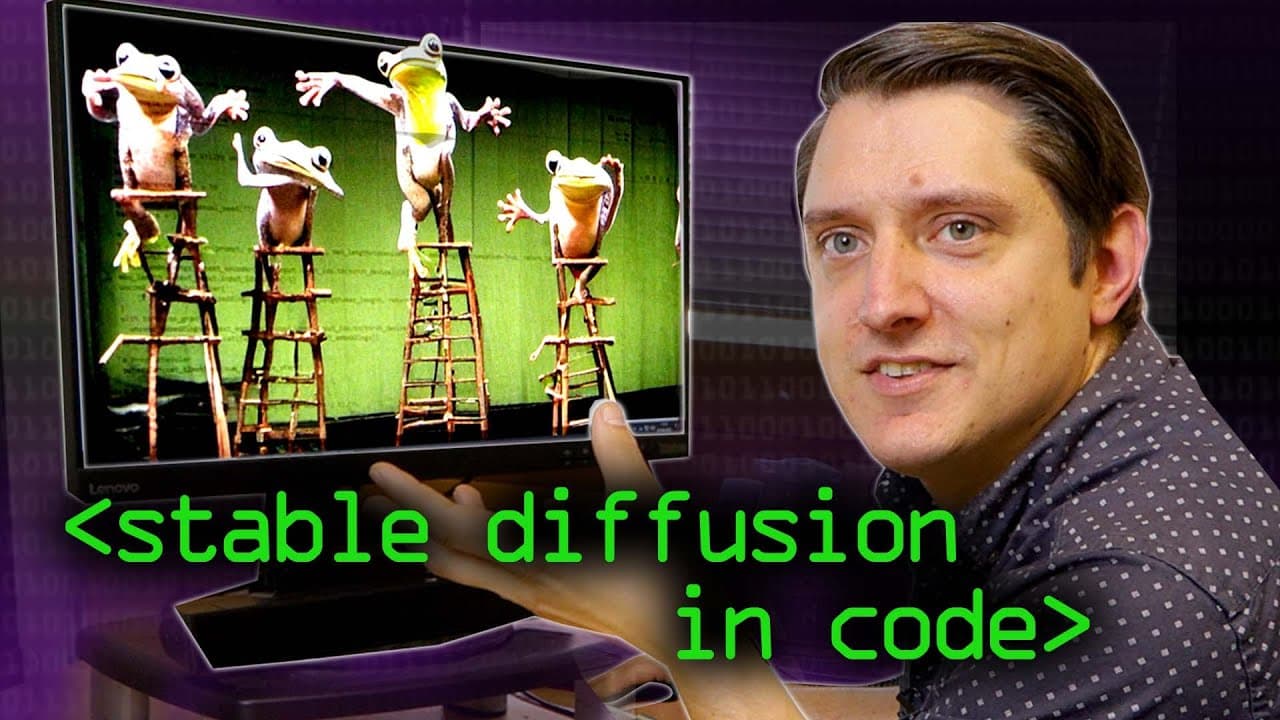
Stable Diffusion stands out in AI image generation by utilising a diffusion process in a latent space, leading to lower-resolution yet potentially more stable outputs. The system employs text embeddings and noise inputs to progressively create higher-quality images, allowing for a range of creative applications, including blending multiple text prompts for unique visual results.
Transcript
last time we talked about how these kind of uh networks and image generation systems work but there are different kinds aren't there there are there's daily two there's Imogen there's stable diffusion and I didn't talk about in the last video because they are for the sake of understanding diffusion models in general essentially the same but actuall... Read More
Key Insights
- ♿ Dali, Imogen, and Stable Diffusion are different image generation techniques with varied accessibility and usage options.
- 😘 Stable diffusion's autoencoder and diffusion process offer potentially more stability in generating images but at lower resolution.
- 🤩 Text embeddings, noise inputs, and up-sampling networks play key roles in the stable diffusion code.
- 👻 Stable diffusion allows for image-to-image guidance by blending different text prompts.
- 👨💻 Customization and experimentation with image generation can be done using accessible code and powerful hardware.
- 🈸 Stable diffusion has the potential for generating unique and customizable images for various applications.
- ❓ Plugins for image editing software like GIMP and Photoshop are available for utilizing stable diffusion.
Install to Summarize YouTube Videos and Get Transcripts
Explore YouTube Video Summarizer or Get YouTube Transcript Extractor
Questions & Answers
Q: What are the differences between Dali, Imogen, and Stable Diffusion in terms of accessibility and usage?
Dali and Imogen rely on APIs, while Stable Diffusion allows users to access and run the code themselves. This makes Stable Diffusion more accessible for those interested in customizing the image generation process for specific applications.
Q: How do clip embeddings work in Dali, and how are they trained?
Clip embeddings in Dali help create meaningful numerical representations of text prompts. They align image and text embeddings through training with image-text pairs, using a contrastive loss method. The goal is to make similar image-text embeddings close together while keeping dissimilar embeddings apart.
Q: What is the purpose of the diffusion process in Stable Diffusion, and how does it differ from other techniques?
In Stable Diffusion, the diffusion process denoises a lower-resolution latent space representation produced by an autoencoder, ultimately leading to the generation of higher-resolution images. This approach, compared to other techniques, offers potentially more stability in the image outputs.
Q: How can image-to-image guidance be achieved using stable diffusion?
Image-to-image guidance can be accomplished in stable diffusion by using a mix of different text prompts that prompt the generation of a combined image. By embedding both prompts and guiding the process towards their midpoint, users can create images that blend attributes from both prompts.
Summary & Key Takeaways
-
There are different image generation systems, such as Dali, Imogen, and Stable Diffusion, each with their own unique approach and advantages.
-
Stable diffusion, in particular, uses an autoencoder and diffusion process in a latent space to generate images, resulting in lower resolution but potentially more stable outputs.
-
The stable diffusion code uses text embeddings, noise inputs, and up-sampling networks to gradually create higher-resolution images guided by text prompts.
Read in Other Languages (beta)
Share This Summary 📚
Summarize YouTube Videos and Get Video Transcripts with 1-Click
Try YouTube Summary with ChatGPT & Claude or YouTube Transcript Generator
Explore More Summaries from Computerphile 📚

Summarize YouTube Videos and Get Video Transcripts with 1-Click
Try YouTube Summary with ChatGPT & Claude or YouTube Transcript Generator