How to Find Equivalent Resistance by Symmetry
TL;DR
Identify a vertical or horizontal plane of symmetry, use it to locate equal-potential points, and remove any resistor whose endpoints have zero potential difference because it carries no current. Redraw the remaining network as simple series and parallel combinations, then calculate the equivalent resistance between the specified terminals.
Transcript
now we are going to understand how to calculate the equivalent resistance using the symmetry of the network and to understand this topic clearly we must know what is a vertical plane of symmetry and the horizontal plane of symmetry and we will begin our discussion with a vertical plane of symmetry in short known as V PS and to understand vertical p... Read More
Key Insights
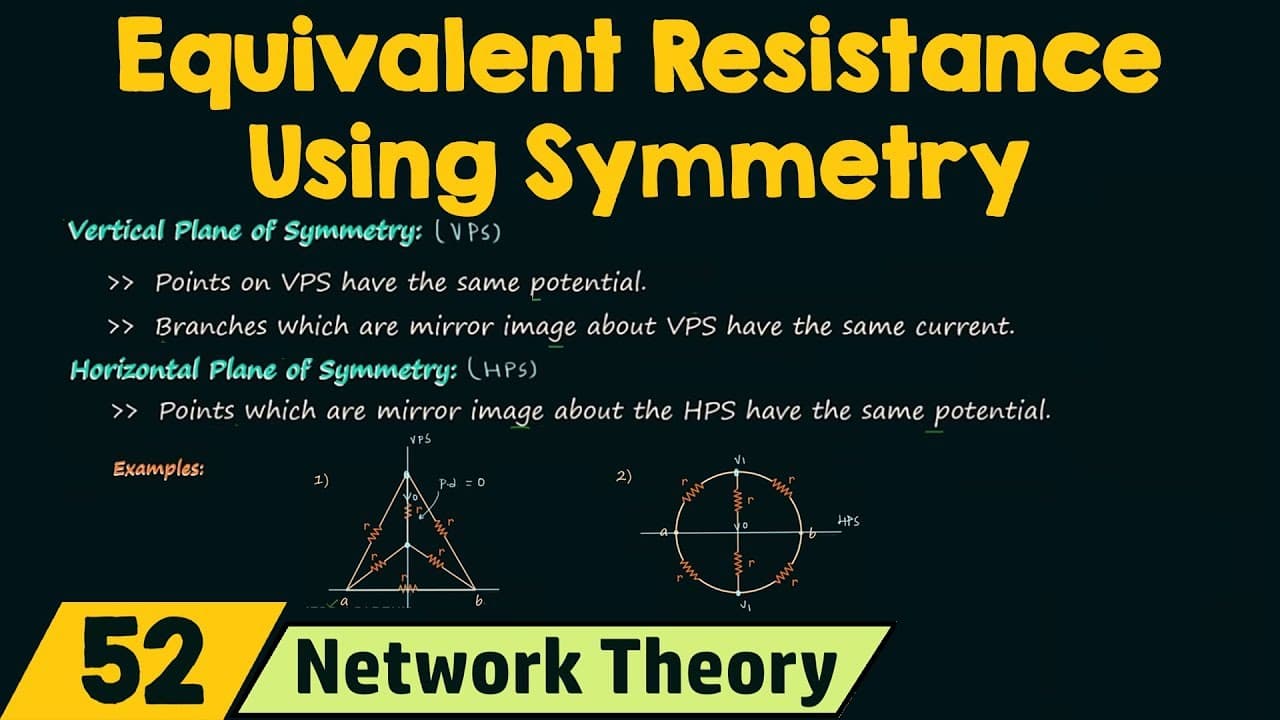
- A vertical plane of symmetry is a plane that bisects the line joining the two measurement terminals at 90 degrees and divides the network into mirrored left and right portions with matching resistor positions and values.
- Every point on a vertical plane of symmetry has the same potential under the network conditions described. Consequently, a resistor connected between two such points has zero potential difference, carries no current, and does not contribute to equivalent resistance.
- Branches that are mirror images across a vertical plane of symmetry carry the same current. This is a separate vertical-symmetry property from the equal-potential rule and is identified as important for simplifying networks in a subsequent problem.
- A horizontal plane of symmetry passes through both measurement terminals and divides the network into mirrored upper and lower portions. A horizontal line through the terminals is not an HPS unless both portions are actually symmetrical about that line.
- Points that are mirror images across a horizontal plane of symmetry have the same potential. Any resistor lying between such equal-potential points has zero voltage and zero current, so it can be excluded when redrawing the effective network.
- The first worked network has vertical symmetry but not horizontal symmetry. Removing the resistor between equal-potential points leaves branches of 2R, 2R, and R connected in parallel, which gives an equivalent resistance of R/2.
- The second worked network has horizontal symmetry. Equal-potential mirror points eliminate two resistors from current flow, leaving two branches that each contain two series resistors, so two equal resistances of 2R remain connected in parallel.
- Two resistors with the same resistance connected in parallel have an equivalent resistance equal to half the resistance of either one. The example applies this shortcut to two 2R branches, obtaining an equivalent resistance of R.
Install to Summarize YouTube Videos and Get Transcripts
Explore YouTube Video Summarizer or Get YouTube Transcript Extractor
Questions & Answers
Q: How do you identify a vertical plane of symmetry in a resistor network?
Join the two terminals between which equivalent resistance must be calculated. Draw a vertical plane that bisects this joining line and meets it at 90 degrees. It qualifies as a vertical plane of symmetry only if the resistor network on its left is the mirror image of the network on its right, including resistor positions and values.
Q: How do you identify a horizontal plane of symmetry in a resistor network?
Draw a plane through the two terminals used for the equivalent-resistance measurement. It is a horizontal plane of symmetry when the portion of the resistor network above that plane is the mirror image of the portion below it. Simply passing a horizontal plane through the terminals is insufficient if the two portions are not symmetrical.
Q: Why can a resistor between equal-potential points be removed?
A resistor connected between points at the same potential has zero potential difference across it. The transcript states that zero voltage produces zero current through that resistor. Equivalent resistance represents the total resistance offered to current flow, so a branch carrying no current does not contribute and can be removed when the network is redrawn.
Q: What rules apply to a vertical plane of symmetry?
Two rules are stated for a vertical plane of symmetry. First, all points located on the symmetry plane have the same potential. Second, branches that are mirror images of one another across that plane carry the same current. The equal-potential rule can identify zero-current resistors, while the mirrored-branch rule supports further network simplification.
Q: What rule applies to a horizontal plane of symmetry?
Points that are mirror images of one another across a horizontal plane of symmetry have the same potential. Therefore, if resistor branches connect those equal-potential points in the arrangement shown, their potential difference is zero and no current flows through them. Removing those inactive branches can expose simpler series and parallel resistor combinations.
Q: How is R/2 obtained in the vertical-symmetry example?
The vertical plane shows that two points on the plane have equal potential, so the resistor between them carries no current and is removed. The redrawn network contains two branches made from two series resistors each, giving 2R per branch, plus one branch of R. Combining 2R, 2R, and R in parallel gives R/2.
Q: How is R obtained in the horizontal-symmetry example?
The horizontal plane identifies mirror-image points with the same potential. Two resistors consequently have zero potential difference and carry no current. After removing them, the network contains two remaining branches, each made of two resistors in series and therefore equal to 2R. Connecting the two equal 2R branches in parallel gives an equivalent resistance of R.
Q: When should symmetry be used to calculate equivalent resistance?
Symmetry should be considered when the network appears mirrored around the terminals used for the resistance measurement. Test whether a horizontal plane through the terminals separates matching upper and lower portions, or whether a perpendicular bisecting plane separates matching left and right portions. Once valid symmetry is confirmed, apply its equal-potential or equal-current property before reducing series and parallel combinations.
Summary & Key Takeaways
-
A vertical plane of symmetry bisects the line joining terminals A and B at 90 degrees and divides the network into mirrored left and right portions. Points on this plane have the same potential, while branches that are mirror images across the plane carry the same current under the stated symmetry conditions.
-
A horizontal plane of symmetry passes through terminals A and B when the network above that line mirrors the network below it. Points that are mirror images across this plane have the same potential. This relationship can reveal resistors with zero voltage, allowing those resistors to be removed from the equivalent-resistance calculation.
-
In the worked examples, symmetry transforms complicated networks into familiar series and parallel arrangements. The vertical-symmetry example becomes three parallel branches with resistances 2R, 2R, and R, producing R/2. The horizontal-symmetry example reduces to two equal 2R series branches in parallel, producing an equivalent resistance of R.
Read in Other Languages (beta)
Share This Summary 📚
Summarize YouTube Videos and Get Video Transcripts with 1-Click
Try YouTube Summary with ChatGPT & Claude or YouTube Transcript Generator
Explore More Summaries from Neso Academy 📚





Summarize YouTube Videos and Get Video Transcripts with 1-Click
Try YouTube Summary with ChatGPT & Claude or YouTube Transcript Generator