What are essential ML and AI concepts explained?
TL;DR
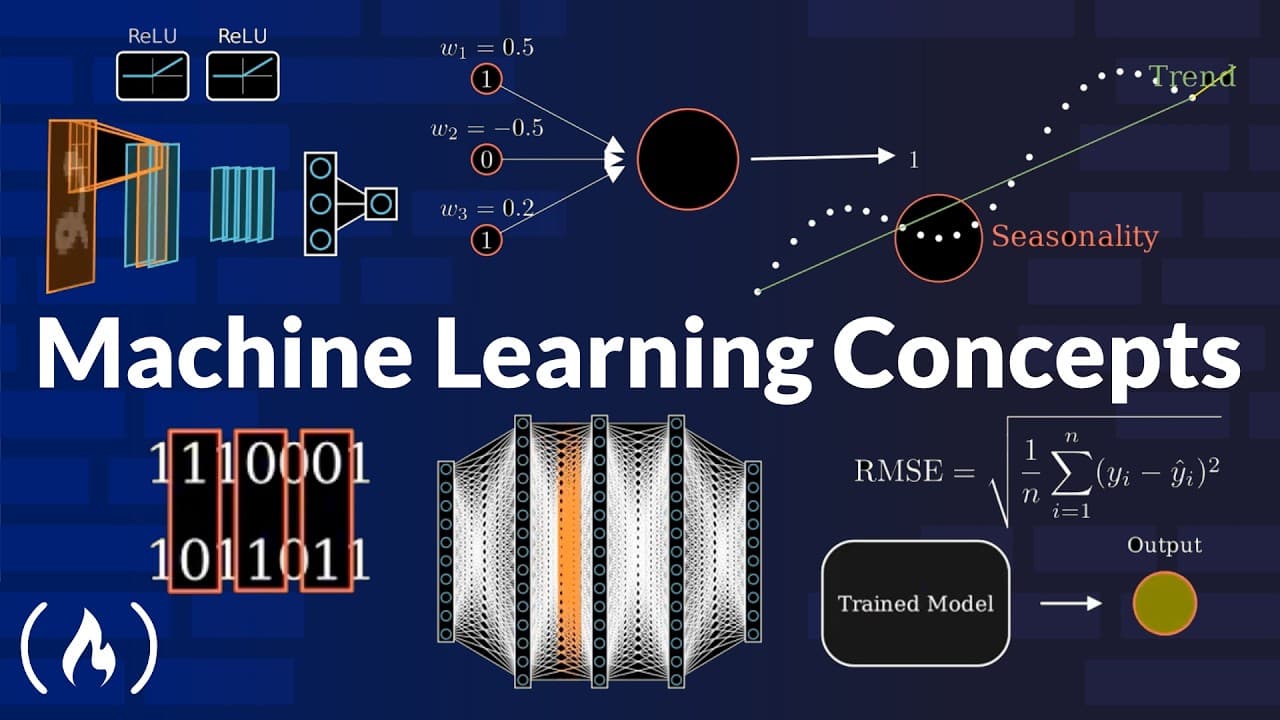
Essential ML and AI concepts are explained with simple visuals and quick definitions. The course covers topics from variance and regression to NLP and GANs, clarifying how supervised, unsupervised, and reinforcement learning differ. Visuals and bite sized explanations help turn complex ideas into clear takeaways that are easy to remember.
Transcript
Learn about all the most important terms and concepts related to machine learning and AI. In this course, Vladimir from Touring Time Machine will give quick and simple explanations with animations for all the machine learning concepts you need to know. So, you love AI, data science, and machine learning, but find it all a bit overwhelming. Wish som... Read More
Key Insights
- X is a measure of dispersion used to understand data distribution in ML.
- The key to unsupervised learning is learning from unlabeled data for clustering or anomaly detection.
- Time series analysis focuses on ordered temporal data for forecasting and trend analysis.
- Transfer learning applies knowledge from one task to a related task to boost performance.
- Gradient descent optimizes a function by moving toward lower values via the gradient.
- Stochastic gradient descent updates parameters using single data points at each iteration.
- Sentiment analysis uses NLP to identify opinions in text.
- Regularization adds a penalty to the loss function to prevent overfitting.
- More videos from this channel:
- More from this channel: freeCodeCamp.org
Install to Summarize YouTube Videos and Get Transcripts
Explore YouTube Video Summarizer or Get YouTube Transcript Extractor
Questions & Answers
Q: How does the video define variance and why is it important in ML?
Variance is described as a statistical measure of the dispersion of a set of values and is used in machine learning to understand data distribution. It helps determine how spread out the data is, which informs model choices and helps assess the potential for overfitting or underfitting. Understanding variance supports better data preprocessing and feature selection.
Q: What are the main learning types illustrated in the video?
The video outlines supervised learning, unsupervised learning, and reinforcement learning as fundamental categories. Supervised learning uses labeled data for tasks like regression and classification, unsupervised learning uses unlabeled data for clustering and anomaly detection, and reinforcement learning trains agents by interacting with an environment to achieve goals. Each type has distinct goals and methods.
Q: How is gradient descent described and what is its role?
Gradient descent is presented as an optimization algorithm used to find the local minimum of a function by iteratively adjusting parameters in the opposite direction of the gradient. Its role is central in training many machine learning models, guiding weight updates to minimize loss functions and improve model accuracy. Variants include stochastic gradient descent for efficiency.
Q: What does the video say about regularization and its purpose?
Regularization is described as a technique to prevent overfitting by adding a penalty term to the loss function. By discouraging overly complex models, regularization helps improve generalization to unseen data. The video highlights common forms like L1 and L2 regularization and their effects on model weights and sparsity.
Q: How is NLP positioned within AI concepts in the video?
NLP, or natural language processing, is defined as a field focusing on the interaction between computers and human language. The video places NLP as a key application area within AI, enabling tasks such as sentiment analysis and other language based understanding, supported by statistical models and machine learning techniques.
Q: What is transfer learning according to the video?
Transfer learning is described as applying knowledge gained from one task to a different but related task to improve model performance. It leverages pre learned representations to speed up learning on new but related problems, often reducing data requirements and training time while maintaining or boosting accuracy.
Q: How does the video differentiate regression methods?
The video distinguishes regression as a statistical method used to model the relationship between dependent and independent variables. It references linear regression as modeling linear relationships and mentions the evaluation of model performance with loss functions that measure prediction errors, guiding improvements through techniques like regularization and feature engineering.
Q: What role do model evaluation and selection play in ML?
Model evaluation involves assessing a machine learning model's performance using specific metrics, ensuring it generalizes well beyond training data. Model selection is the process of choosing the most appropriate algorithm for a given task, balancing accuracy, complexity, and practicality. The video emphasizes understanding both steps to build reliable AI systems.
Summary & Key Takeaways
-
Summary point 1: The video provides quick, bite sized explanations of core machine learning terms with visuals to help understanding without jargon. It covers a broad range from statistical measures to learning paradigms and practical algorithms, making the material feel approachable and memorable.
-
Summary point 2: Key ideas are presented in a logical order, starting with basic statistics and moving through regression, regularization, and classification to more advanced topics like deep learning concepts and model evaluation. The visuals reinforce the core ideas for better retention.
-
Summary point 3: The video emphasizes practical distinctions among learning types, evaluation methods, and common techniques, helping learners connect terms to how they are used in real world tasks across data analysis, prediction, and AI development.
Read in Other Languages (beta)
Share This Summary 📚
Summarize YouTube Videos and Get Video Transcripts with 1-Click
Try YouTube Summary with ChatGPT & Claude or YouTube Transcript Generator
Explore More Summaries from freeCodeCamp.org 📚


Summarize YouTube Videos and Get Video Transcripts with 1-Click
Try YouTube Summary with ChatGPT & Claude or YouTube Transcript Generator