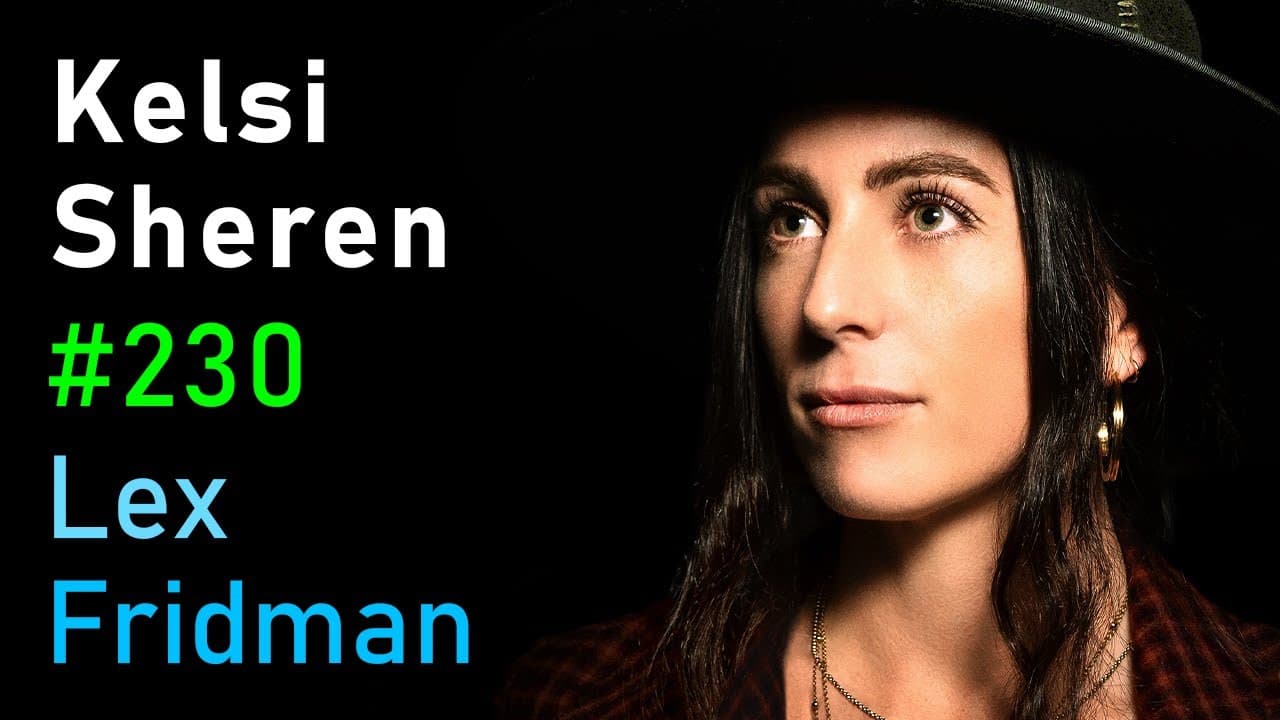
Kelsi Sheren: War, Artillery, PTSD, and Love | Lex Fridman Podcast #230
TL;DR
Kelsey Sheren is a Canadian Forces veteran and artillery gunner who served in Afghanistan at 18, returned with severe PTSD, and founded Brass in Unity. Its unique jewelry helps support the rehabilitation of veterans and first responders. Her conversation on Lex Fridman Podcast #230 explores war, family history, civilian suffering, and the value of preserving veterans’ stories, giving readers compelling reasons to continue.
Transcript
the following is a conversation with kelsey sharon canadian forces veteran artillery gunner who served in afghanistan at 18 years old and came home with severe ptsd she went on to found brass in unity which creates unique jewelry large part of the proceeds from which go to help rehabilitate the lives limbs and mental health of veterans and first re... Read More
Key Insights
- 🫱 The value of studying history and preserving personal stories from war should not be overlooked, as they provide valuable insights and lessons for future generations.
- 🫱 There is a need for greater awareness and support for veterans and first responders who have experienced the mental and physical tolls of war.
- 🫱 Understanding the psychological and emotional impacts of war can contribute to creating more empathetic and compassionate societies.
- 😈 The fascination with World War II may stem from a desire to understand the depths of human nature, including the capacity for evil and the complex relationship between leaders and their followers.
- 🫱 The impact of war on civilian populations is often overlooked, but it can result in immense suffering, loss, and displacement.
- 💩 The role of artillery gunners in warfare is essential, and their ability to accurately and strategically hit targets can have a significant impact on the outcome of a battle.
- 😨 War can elicit a mix of emotions, from fear and anger to excitement and a sense of victory, highlighting the complexities of human nature and the moral dilemmas of armed conflict.
Install to Summarize YouTube Videos and Get Transcripts
Explore YouTube Video Summarizer or Get YouTube Transcript Extractor
Questions & Answers
Q: Who is Kelsey Sheren?
Kelsey Sheren is a Canadian Forces veteran and artillery gunner who served in Afghanistan at 18 years old. She returned with severe PTSD and later founded Brass in Unity, which creates unique jewelry and directs a large part of its proceeds toward helping veterans and first responders.
Q: What is Brass in Unity?
Brass in Unity is an organization founded by Kelsey Sheren that creates unique jewelry. A large part of its proceeds helps rehabilitate the lives, limbs, and mental health of veterans and first responders.
Q: How did serving in Afghanistan affect Kelsey Sheren?
Kelsey served in Afghanistan as an artillery gunner when she was 18 years old. She came home with severe PTSD, and her experience of seeing civilian deaths shaped how she understands war’s impact on communities.
Q: Why did some World War II veterans avoid discussing their experiences?
The conversation suggests that veterans and survivors sometimes stayed silent to protect their families from the suffering and evil they had experienced. That silence also prevented important historical lessons and family stories from being passed down.
Q: Why is preserving personal stories from war important?
Personal stories carry lessons that may be lost when veterans and survivors do not share their experiences. They can also help descendants understand the strength of people in their lineage and how earlier generations overcame suffering.
Q: Why was Kelsey Sheren drawn to World War II history?
World War II was the first historical subject that made Kelsey obsessed with history. She describes a deep pull toward it and considers possible connections including her grandfather’s service and relatives who escaped Hungary after the Soviets arrived.
Q: How does war affect civilian communities?
Kelsey says that even a small number of civilian deaths can have an enormous impact within a local community. Because she witnessed that effect during war, she struggles to comprehend the mass civilian casualties and destruction across Europe and elsewhere during World War II.
Q: What questions about human nature does World War II raise in the conversation?
The discussion examines how leaders such as Hitler and Stalin could produce evil on such a vast scale and persuade people to follow them. Kelsey adds that people may follow blindly when they are given a compelling enough reason, especially when manipulative personality traits are not understood.
Summary
In this conversation with Kelsey Sharon, a Canadian Forces veteran and founder of Brass in Unity, the discussion covers various topics ranging from the impact of World War II on personal history, the fascination with Hitler and human nature, the suffering of civilians in wartime, the power of personal stories, the role of charismatic leaders, the intergenerational trauma, the complex experiences of North Korean defectors, the role of hope in overcoming suffering, the recruiting videos of military forces, the different roles in the military (infantry, artillery, armored), the job of an artillery gunner, the precision and power of artillery, and the impact of artillery on both soldiers and civilians.
Questions & Answers
Q: How did studying history and having a World War II veteran grandfather impact Kelsey's perspective on human stories and sharing them over time?
Kelsey believes that the value of sharing human stories and experiences over time is often underestimated. She mentions that her World War II veteran grandfather and grandmother, who experienced the Ukrainian famine and Nazi occupation, didn't talk much about their experiences to protect their loved ones from the pain and suffering they endured. However, Kelsey thinks that not sharing these stories is a detriment to those individuals as well as to the larger community, as they contain valuable lessons and a sense of strength that can be passed down through generations.
Q: What is Kelsey's perspective on World War II, and why does she feel a deep connection to it?
Kelsey mentions that World War II had a profound impact on her and that she feels a deep connection to it, although she's not sure why. She speculates that it could be because her family had personal experiences related to the war, or because it has been extensively portrayed in film and television, capturing her imagination. Furthermore, Kelsey expressed a fascination with the magnitude of the war and the mass casualties of civilians, which she finds difficult to comprehend, especially after witnessing the impact of a few civilian deaths in war firsthand.
Q: What aspects of World War II intrigue Kelsey, and why does she find it difficult to understand the mass casualties of civilians?
Kelsey is intrigued by the historical, sociopolitical, and psychological aspects of World War II. She reflects on how Hitler and Stalin were able to exert their influence and gain the loyalty of their followers. She wonders if she would have been influenced in a similar way if she had lived during that time. Kelsey also mentions that the scale of civilian casualties and the destruction of homes and cities during the war is hard for her to grasp, as she has personally witnessed the impact of a few civilian deaths on a smaller scale.
Q: How does Kelsey view Hitler and the nature of evil from a psychological perspective?
Kelsey believes that Hitler was legitimately insane and had traits of a sociopath and narcissist. She also notes that there was a lack of understanding about the psychology of sociopaths and psychopaths at that time, making it difficult to fully comprehend why people followed and supported Hitler. Kelsey suggests that Hitler's charisma and ability to resonate with certain individuals may have played a role in his influence over them. She expresses curiosity about why people do what they do and wishes there had been an opportunity to delve deeper into Hitler's mind to gain a better understanding.
Q: Would history unfold similarly without Hitler, and what does Kelsey find more interesting, the charismatic leaders or the people who follow them?
Kelsey believes that charismatic leaders exist throughout history, and history could unfold similarly even without Hitler. She finds the people who follow such leaders more interesting because they are either genuinely terrified, looking for a sense of belonging, or resonating with the leader's message. Kelsey thinks it would be beneficial to examine these individuals' perspectives and gain insights into why they thought and acted the way they did.
Q: How do Kelsey's personal experiences as a soldier and her understanding of war influence her perspective on the suffering of civilians and the impact of conflict?
Kelsey's experiences as a soldier, witnessing small-scale civilian deaths and the profound impact they have on communities, contribute to her struggle in comprehending the mass casualties and widespread devastation of World War II. She acknowledges that the suffering of civilians, their homes being invaded, burned, and bombed, is a significant aspect of most wars, and it highlights the inherent tragedy and injustice within conflicts.
Q: What prompted Kelsey to become a soldier, and why did she choose to be an artillery gunner?
Kelsey's parents had always thought she would be in law enforcement or some other role involving carrying a gun due to her strong personality. Kelsey herself wanted to do something that would have a significant impact and be involved in frontline operations. While she wanted to be in the infantry, her small stature prevented her from pursuing that role. As a result, she chose to be an artillery gunner, believing that it would allow her to make a tangible difference by providing support to the infantry and affecting change.
Q: What are the different roles in the military, such as infantry, artillery, and armored, and how do they differ?
Kelsey explains that infantry is the frontline combat role, involving door-kicking, direct combat, and being on the ground with heavy packs. Artillery provides firepower support to the infantry, often engaging targets from a distance using large-caliber guns. Armored units operate tanks and armored vehicles for offensive and defensive purposes. These different roles each have their unique responsibilities and ways of engaging in warfare.
Q: What does being an artillery gunner entail, and how does it feel to handle and use such powerful weapons?
As an artillery gunner, Kelsey's main responsibility was to operate a 155mm howitzer, which could accurately fire rounds weighing up to 100 pounds over long distances. Artillery is known as the "hand of God" due to its ability to strike targets from afar with immense power. Kelsey explains that the feeling of firing such a weapon is both exhilarating and terrifying. She mentions the precision and accuracy of modern artillery and the impact it can have both on soldiers and civilians, depending on how it is employed.
Q: How does artillery support infantry during warfare, and what is the experience like for soldiers on the receiving end of artillery fire?
Kelsey explains that artillery supports infantry by providing firepower and suppressing enemy positions. Artillery can be called upon by forward observation officers embedded with infantry units, who request artillery fire on specific targets. The experience for soldiers on the receiving end of artillery fire can be terrifying. The shells make a distinctive thunderous sound as they whistle through the air, and the impact can cause immense destruction, making it challenging for soldiers to move or take cover in time.
Q: How are modern artillery guns operated, and what technologies are involved in their functioning?
Modern artillery guns are operated using advanced technologies. They include GPS guidance systems, computer systems, and trajectory calculation tools. The gun crew enters the target coordinates into the system, which then calculates the trajectory and adjusts the aim accordingly. These guns are highly accurate and can hit their targets with precision, guided by GPS. The electronic systems make it more efficient and streamlined for gunners to operate the complex machinery.
Takeaways
This conversation delves into various aspects of war, history, and personal experiences. It highlights the significance of sharing human stories and acknowledging the suffering endured during wartime. The discussion also emphasizes the role of charismatic leaders, the impact of modern technology on warfare, and the complexities of confronting trauma and intergenerational trauma. Additionally, it explores the fascination with World War II, the different roles in the military, and the power and precision of artillery. Overall, this conversation offers insights into the profound and lasting effects of war and the importance of understanding and learning from historical events.
Summary & Key Takeaways
-
Kelsey Sharon, a veteran artillery gunner, discusses the value of studying history and the personal impact of war on individuals and their families.
-
She reflects on the significance of sharing personal stories and the need for understanding and support for veterans and first responders.
-
Kelsey highlights the importance of recognizing the strength and bravery of past generations and the lessons that can be learned from their experiences.
Read in Other Languages (beta)
Share This Summary 📚
Summarize YouTube Videos and Get Video Transcripts with 1-Click
Try YouTube Summary with ChatGPT & Claude or YouTube Transcript Generator
Explore More Summaries from Lex Fridman Podcast 📚





Summarize YouTube Videos and Get Video Transcripts with 1-Click
Try YouTube Summary with ChatGPT & Claude or YouTube Transcript Generator