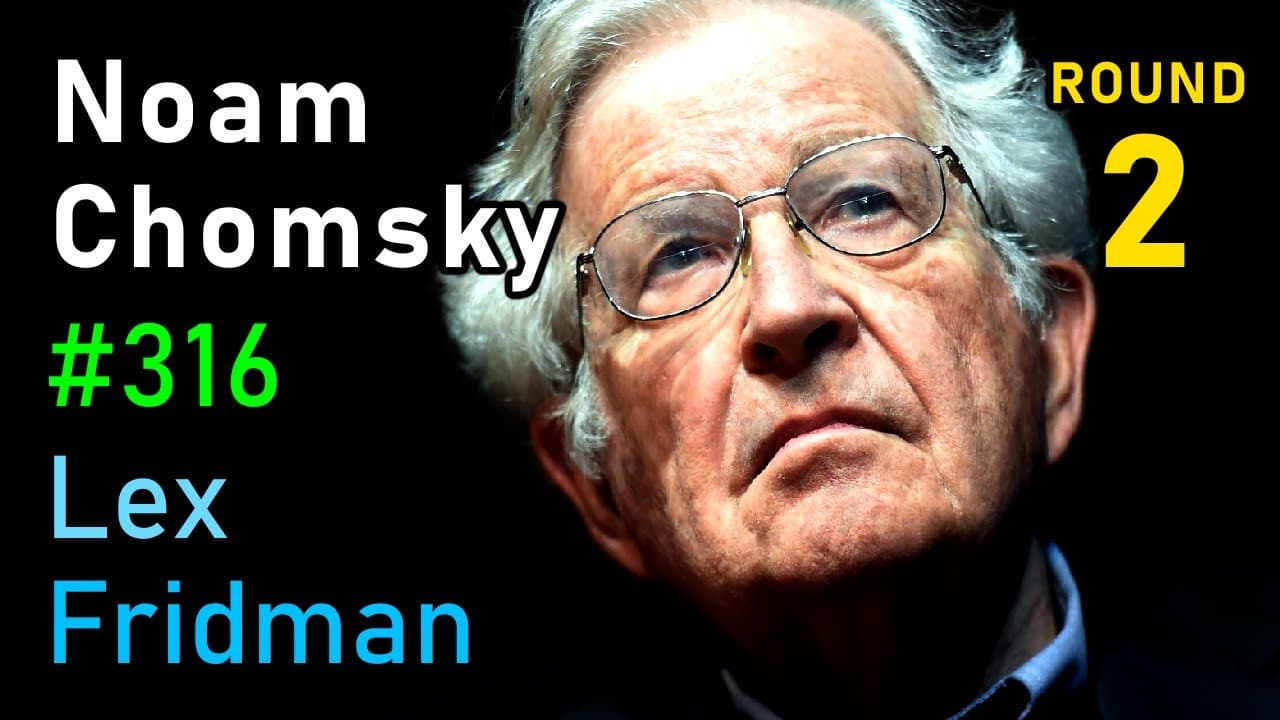
Noam Chomsky: Putin, Ukraine, China, and Nuclear War | Lex Fridman Podcast #316
TL;DR
A war between the US and China would destroy the possibility of organized life on Earth, making it an outcome that must be avoided at all costs. Chomsky argues Putin's invasion of Ukraine is a supreme international crime on par with the US invasion of Iraq, driven by aims to block NATO expansion, restore Russian power, and secure his legacy rather than by madness.
Transcript
- Will there be a war between US and China in the 21st century? - If there is, we're finished. A war between the US and China would destroy the possibilities of organized life on Earth. - The following is a conversation with Noam Chomsky, his second time on the podcast. This episode is focused on the war in Ukraine, and it is a departure from the w... Read More
Key Insights
- A war between the US and China would, in Chomsky's view, destroy the possibilities of organized life on Earth, which is why avoiding great-power conflict is presented as the central stake of 21st-century geopolitics.
- Putin's motivations, according to Chomsky, are visible in his actions over 25 years: restore Russia as a great power, rebuild its economy, control it as a dictatorship, enrich himself and his cronies, and cement a personal legacy.
- Russia held a clear red line before Putin that he adhered to, namely no NATO membership for Ukraine and Georgia, and US diplomats warned from the 1990s that crossing it was reckless and provocative.
- Clinton began expanding NATO eastward in violation of firm, unambiguous promises made to Gorbachev not to do so, a policy later expanded by Bush that Yeltsin and other Russian leaders opposed but accepted.
- Putin's invasion of Ukraine is, in Chomsky's judgment, a supreme international crime on a par with the US invasion of Iraq and the Stalin-Hitler invasion of Poland, and any power that commits aggression is to blame.
- Serious support for Ukraine requires two things: helping defend against aggression, and seeking diplomatic ways to end the war before worse disasters like starvation, reversed climate efforts, or nuclear escalation arise.
- The Pentagon acted as a restraining force by vetoing initiatives that went beyond defensive support toward attacks on Russia, moves Chomsky says would very likely lead to nuclear war and destroy everything.
- Chomsky rejects the Western theory that Putin suddenly became a madman aiming to conquer Europe, calling it internally contradictory with the same analysts' claims that Russia's military is a paper tiger.
Install to Summarize YouTube Videos and Get Transcripts
Explore YouTube Video Summarizer or Get YouTube Transcript Extractor
Questions & Answers
Q: Will there be a war between the US and China in the 21st century?
Chomsky warns that if a war between the US and China occurs, we are finished. He states such a war would destroy the possibilities of organized life on Earth. This framing positions US-China conflict as an existential threat to humanity rather than a conventional geopolitical contest, making its avoidance the paramount concern of the century as our decisions can either help humanity flourish or unleash global destruction.
Q: What does Noam Chomsky think motivates Vladimir Putin?
Chomsky says he has no special insight into Putin's mind and can only judge from 25 years of actions and statements. He concludes Putin's motivations are to restore Russia as a great power, rebuild its economy, control it as a total dictatorship, enrich himself and his cronies, establish a legacy as a major figure in Russian history, and ensure Ukraine does not join NATO, likely with further ambitions over Ukraine.
Q: Why did NATO expansion contribute to the conflict with Russia?
Chomsky explains that Clinton began expanding NATO eastward in violation of firm, unambiguous promises made to Gorbachev not to do so, and Bush expanded this recklessly. Russia had a clear red line, no NATO membership for Ukraine and Georgia, which US diplomats and CIA heads repeatedly warned was reckless and provocative to cross. Yeltsin and other Russian leaders opposed the expansion but accepted it without strong reaction for years.
Q: Who is to blame for Russia's invasion of Ukraine?
Chomsky states clearly that any power which commits aggression is to blame, so Putin is to blame. He describes the invasion as on a par with such acts of aggression as the US invasion of Iraq and the Stalin-Hitler invasion of Poland, calling it a supreme international crime under international law. He has maintained this position for many months without qualification about who bears responsibility.
Q: What was Gorbachev's proposal for Russia and the West after the Cold War?
Gorbachev called for a cooperative enterprise with the West to rebuild what he called a common European home, in which there would be no military alliances, only Russia-Western-US accommodation. It included a move toward social democracy in the former USSR and comparable moves in the United States. Chomsky says this vision was quickly smashed because the United States had no interest in it, and Russia was instead induced to adopt harsh shock therapy.
Q: What did shock therapy do to Russia's economy in the 1990s?
Chomsky describes shock therapy as a harsh, quick market transformation that Russia was induced to adopt in the early 1990s. It devastated the economy, created enormous social disarray, produced a rise of oligarchs and kleptocrats, and created high mortality. This chaos and disarray of the 1990s became the disorder that Putin's first task, upon taking power almost 25 years ago, was to overcome as he reconstructed Russian society.
Q: Should the US keep supporting Ukraine militarily?
Chomsky says the US should continue calibrated support to defend against the invasion, which is legitimate. However, he stresses a second neglected question: how to end the war through diplomacy before worse disasters like worldwide starvation, reversed climate efforts, or nuclear escalation occur. He praises the Pentagon for vetoing initiatives that went beyond defense toward attacking Russia, moves he believes would very likely lead to nuclear war and destroy everything.
Q: How did Putin's position on the Donbas region change before the invasion?
Chomsky notes that for the first time, a few weeks before the invasion, Putin announced recognition of the independence of the Donbas region, a much stronger position than before. Until then, Putin had kept to a longstanding position of some accommodation within a federal structure in which the Donbas would have considerable autonomy. Chomsky sees this recognition as a hardening of Putin's stance in response to changed circumstances rather than a change in the man himself.
Summary
In this podcast episode, Lex Friedman interviews Noam Chomsky about the war in Ukraine and the geopolitical landscape of the 21st century. Chomsky discusses the motivations of Vladimir Putin, the blame for the invasion of Ukraine, the role of propaganda in Russia, Ukraine, and the West, and the possibility of war between the US and China. He also talks about the decline of the United States as a global leader and the challenges facing human civilization.
Questions & Answers
Q: What do you think motivates Vladimir Putin?
I don't have any particular insight into Putin's mind, but based on his actions and statements, it seems that his primary goals are to restore Russia as a world power, prevent Ukraine from joining NATO, and possibly exert control over Ukraine. He wants to establish a legacy as a leader who restored Russia's position and overcame its previous challenges.
Q: Has power corrupted Putin over the years?
I don't think anything has fundamentally changed in Putin's policies over the years. While his strategies may have evolved in response to changing circumstances, his main goals have remained the same. He has strengthened his control over Russia and pursued consistent foreign policies.
Q: Why did Russia invade Ukraine?
Any power that commits aggression is to blame, including Russia in this case. The invasion of Ukraine by Putin is comparable to acts of aggression such as the US invasion of Iraq and the Stalin-Hitler invasion of Poland. The blame lies with Putin and Russia for their aggressive actions.
Q: Should the US continue to support Ukraine militarily?
There are two aspects to consider – supporting Ukraine's defense against the invasion and seeking ways to end the conflict. It is legitimate to provide support for defense, but it is also important to work towards ending the war to prevent further destruction and suffering. The US should continue calibrated support for defense while also exploring avenues for a diplomatic settlement.
Q: Do you worry about nuclear war in the 21st century?
Anyone who doesn't worry about nuclear war doesn't have a functioning mind. Steps can easily be taken that could lead to nuclear war. There are proposals to escalate tensions with Russia, such as establishing a no-fly zone, that would increase the risk of conflict. It is a dangerous gamble to ignore the potential consequences of these actions.
Q: How much propaganda exists in the world today?
Propaganda is present in varying degrees in different regions. In Russia, propaganda is pervasive. In the West, there is also propaganda, although it may not be as extreme. The level of Russophobia in the West is unprecedented, even garnering comments from high-ranking US intelligence officials. Propaganda shapes and limits the information presented, and it is important to be aware of the selection and framing of news.
Q: If the media is a source of inaccuracies, how do we find the truth?
While media may have biases or limitations, it is not necessarily a source of outright lying. Media reporting, overall, is reasonably accurate. However, it is essential to exercise critical thinking, seek alternative sources, examine historical context, and look at the documentary record. It requires effort and consideration to arrive at a reasonable understanding of the truth.
Q: If you could sit down with Vladimir Putin, what would you say?
I wouldn't bother sitting down with Putin or any other leader because I know what he would say – the party line. I already have access to his pronouncements and policies. It wouldn't be productive to ask him why he committed a crime comparable to the US invasion of Iraq. We need to focus on evaluating their actions and policies rather than engaging in a futile conversation.
Q: Will there be a war between the US and China in the 21st century?
If there is a war between the US and China, it would be catastrophic and would destroy the possibilities of organized life on Earth. The fate of human civilization depends on the US and China finding ways to work together and cooperate in dealing with the global crises we face. It is crucial to avoid an escalation that could lead to a conflict with devastating consequences.
Q: Do you think the United States as a global leader may collapse in this century?
The United States has the potential to harm itself severely. Internal divisions, declining life expectancy, failing infrastructure, violence, regressive court decisions, and a political party focused on regaining power rather than serving the country all contribute to the decline of the US. The neoliberal assault of the past 40 years has had a detrimental impact. The future of the United States and human civilization depends on addressing these challenges effectively.
Takeaways
Chomsky emphasizes the urgent need for the US and China to cooperate and work together to overcome the global crises we face. He raises concerns about the prospect of nuclear war and highlights the importance of finding diplomatic solutions to conflicts. Chomsky also criticizes propaganda in Russia, Ukraine, and the West, emphasizing the need for critical thinking and seeking alternative sources of information. He warns of the declining state of the US and the consequences it can have on human civilization. Ultimately, the survival and flourishing of humanity require collective action to address the challenges of our time.
Summary & Key Takeaways
-
Chomsky declines to read Putin's mind and instead reads 25 years of actions and statements, concluding Putin sought to overcome the chaos of the 1990s, rebuild Russia's economy, and restore its standing as a world power under tight authoritarian control.
-
He traces the conflict's roots to NATO's eastward expansion under Clinton and Bush, which violated promises to Gorbachev and crossed Russia's longstanding red line against Ukrainian NATO membership, warnings US diplomats and CIA officials repeatedly raised.
-
Chomsky condemns the invasion as a supreme international crime while arguing the West discusses only military support and refuses diplomacy, warning that avoiding US-China war and nuclear escalation is essential to preventing global destruction.
Read in Other Languages (beta)
Share This Summary 📚
Summarize YouTube Videos and Get Video Transcripts with 1-Click
Try YouTube Summary with ChatGPT & Claude or YouTube Transcript Generator
Explore More Summaries from Lex Fridman Podcast 📚
Summarize YouTube Videos and Get Video Transcripts with 1-Click
Try YouTube Summary with ChatGPT & Claude or YouTube Transcript Generator