What Is Asthma? Pathophysiology, Triggers, and Signs
TL;DR
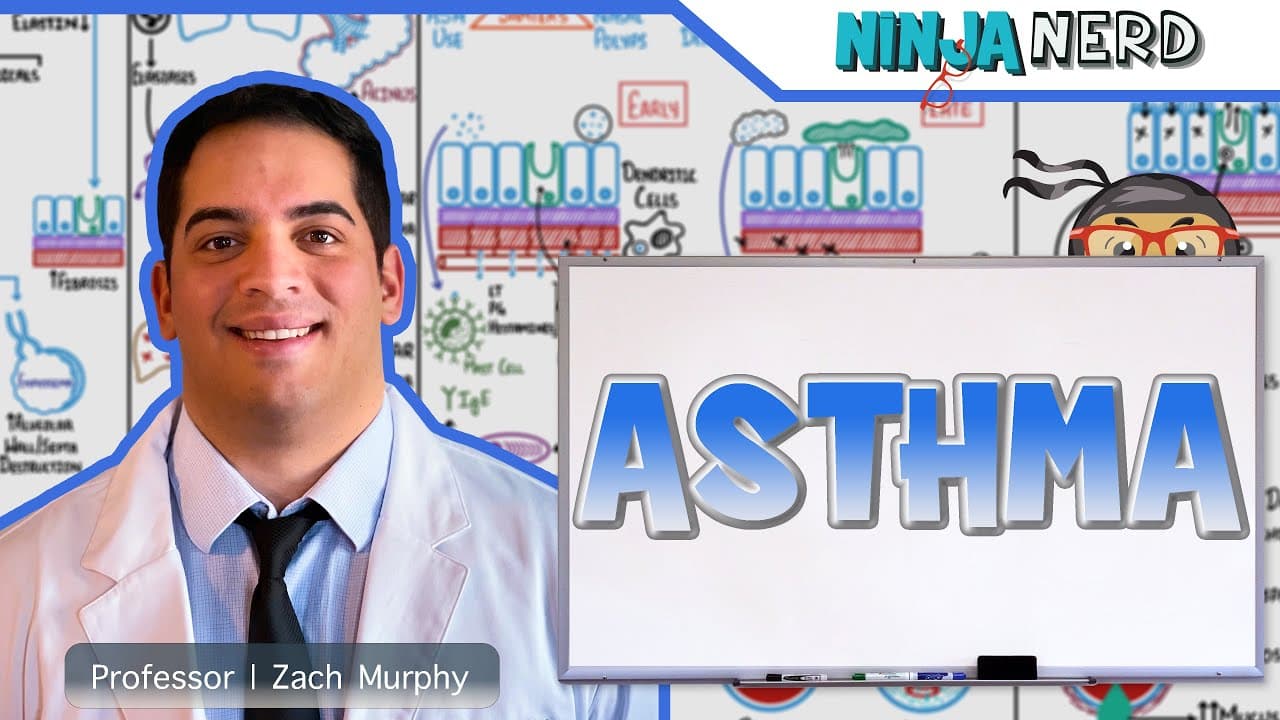
Asthma is an obstructive lung disease driven by three airway changes: bronchial wall edema, excess mucus from goblet cells, and bronchoconstriction of airway smooth muscle. Together these narrow the airway and make expiration much harder than inspiration, causing air trapping and hyperinflated lungs. Patients typically present with dyspnea, wheezing on auscultation, hyper-resonance to percussion, and sometimes cough.
Transcript
foreign what's up Ninja nerds in this video today we're going to be talking about asthma this is a part of our clinical medicine section before we get started if you guys like this video it makes sense it helps you please support us and you can do that by hitting that like button commenting down the comment section also subscribe I really suggest i... Read More
Key Insights
- Asthma is classified as an obstructive lung disease, and its typical presentation combines dyspnea as the historical chief complaint with wheezing heard on auscultation, sometimes accompanied by hyper-resonance to percussion and a cough.
- The pathophysiology of asthma rests on three airway changes: bronchial wall edema from inflammation, excess mucus secreted by goblet cells activated by that inflammation, and bronchoconstriction where bronchial smooth muscle clamps down into the lumen.
- Dyspnea reflects difficulty getting air in, while wheezing and hyper-resonance to percussion reflect difficulty getting air out. Separating the inspiratory and expiratory consequences of obstruction explains why each physical finding appears.
- Air trapping occurs because expiration is much more impaired than inspiration, so air stays within the alveoli and balloons them up. The resulting hyperinflated lungs leave patients unable to take a further deep breath in.
- The atopic triad links allergies, atopic dermatitis, and asthma. It is described as a high-yield item for step two and PANCE style exams, and clinical vignettes may embed all three findings in one patient.
- Samter's triad describes patients who have asthma along with aspirin sensitivity and nasal polyps. Aspirin is thought to affect inflammatory pathways such as the leukotriene pathway, increasing leukotrienes and exacerbating asthma.
- Common asthma triggers include allergies, aspirin, beta blockers, infections (most commonly viral upper respiratory tract infections), and cold air or exercise, with allergies and infections singled out as the highest yield of these.
- The immune cascade runs from dendritic cells presenting the trigger to T helper cells, which become T helper 2 cells releasing interleukin-4 and interleukin-5, stimulating eosinophils and plasma cells, whose IgE and IgG antibodies trigger mast cell degranulation of histamines and leukotrienes.
Install to Summarize YouTube Videos and Get Transcripts
Explore YouTube Video Summarizer or Get YouTube Transcript Extractor
Questions & Answers
Q: What is asthma and what type of lung disease is it?
Asthma is an obstructive lung disease. It is characterized by bronchial wall edema from inflammation, excess mucus production from goblet cells, and bronchoconstriction of bronchial smooth muscle. These three processes narrow the airway and produce airway obstruction, which impairs both moving oxygen into the alveoli and moving carbon dioxide out. Patients typically present with dyspnea, wheezing on auscultation, sometimes hyper-resonance to percussion, and sometimes a cough.
Q: What are the main symptoms and physical exam findings of asthma?
The common historical chief complaint is dyspnea, the sensation that you feel short of breath. On physical exam, auscultation with a stethoscope commonly reveals wheezing. If percussion is performed, hyper-resonance to percussion may be heard. A cough may also be part of the presentation. When a patient shows dyspnea, wheezing on auscultation, and possibly hyper-resonance to percussion, asthma should be considered as a diagnosis.
Q: Why does asthma cause wheezing and dyspnea?
Bronchial wall edema, mucus, and bronchoconstriction all narrow the airway. Difficulty getting air in precipitates dyspnea, the sensation of shortness of breath. Difficulty getting air out causes air trapping, which produces wheezing and hyper-resonance to percussion. So the two groups of findings map to the two directions of impaired airflow: inspiratory difficulty gives dyspnea, and expiratory difficulty gives wheezing and hyper-resonance.
Q: What is air trapping in asthma and why does it happen?
Air trapping happens because the expiration process is much more difficult than inspiration in obstructed airways. When air cannot be pushed out due to bronchoconstriction and inflammation, it stays within the alveoli and balloons them up. This leads to hyperinflated lungs. The lecture likens the sensation to taking a deep breath in, holding it at full inspiration, and then trying to take another deep breath on top of that.
Q: What is the atopic triad?
The atopic triad is the association of allergies, atopic dermatitis, and asthma in the same patient. It is highlighted as important for step two and PANCE style exams, since clinical vignettes may embed all three findings together as a clue. If a patient has allergies, they probably also have some type of atopic dermatitis and asthma, which is why recognizing the triad in a vignette helps identify asthma quickly.
Q: What is Samter's triad and how does aspirin affect asthma?
Samter's triad describes patients who have asthma together with aspirin sensitivity and nasal polyps. Aspirin is listed among medications that can trigger asthma because it may affect inflammatory pathways such as the leukotriene pathway. Increasing the amount of leukotrienes can exacerbate patients who have asthma. Recognizing the combination of asthma, aspirin sensitivity, and nasal polyps is presented as an exam-relevant pattern.
Q: What triggers an asthma attack?
Triggers include allergies, which are a major one, certain medications such as aspirin and beta blockers, infections, and cold air or exercise. Infections are described as probably one of the most common triggers, and viral upper respiratory tract infections are the usual culprits. Among all the triggers listed, allergies and infections are singled out as the highest yield. These triggers set off the wall edema, mucus production, and bronchospasm.
Q: How does the immune system cause asthma symptoms?
After exposure to a trigger, dendritic cells sense it, express a piece of it on their cell membrane, and present it to a T helper cell. That cell becomes a T helper 2 cell and releases cytokines including interleukin-4 and interleukin-5. These stimulate eosinophils, which act directly on bronchial smooth muscle to cause bronchospasm, and B cells that become plasma cells releasing IgE and some IgG antibodies. Those antibodies activate mast cells to degranulate histamines and leukotrienes, which increase bronchial wall edema, secretion, and bronchospasm.
Summary & Key Takeaways
-
Asthma belongs to the obstructive lung diseases. The usual historical chief complaint is dyspnea, the sensation of shortness of breath, and physical examination commonly reveals wheezing on auscultation. Percussion may produce hyper-resonance, and some patients also present with a cough. This combination of findings should prompt consideration of asthma.
-
Three processes inside the bronchial wall explain the findings: massive inflammation causing bronchial wall edema, goblet cell activation producing large amounts of mucus, and smooth muscle bronchoconstriction encroaching into the lumen. All three narrow the airway and produce a common end result, airway obstruction, which impairs moving oxygen in and carbon dioxide out.
-
Expiration becomes far more difficult than inspiration, so air stays within the alveoli and balloons them up, a process called air trapping that leaves the lungs hyperinflated. The lecture compares it to holding a deep breath in and then trying to inhale further on top of it.
-
Triggers include allergies, aspirin, beta blockers, infections (most commonly viral upper respiratory tract infections), and cold air or exercise. Two named triads matter for exams: the atopic triad of allergies, atopic dermatitis, and asthma; and Samter's triad of asthma, aspirin sensitivity, and nasal polyps.
-
The immune cascade begins when dendritic cells sense a trigger and present it to a T helper cell, which becomes a T helper 2 cell releasing interleukin-4 and interleukin-5. These stimulate eosinophils and plasma cells, which release IgE and some IgG antibodies that activate mast cells to degranulate histamines and leukotrienes, driving edema, secretion, and bronchospasm.
Read in Other Languages (beta)
Share This Summary 📚
Summarize YouTube Videos and Get Video Transcripts with 1-Click
Try YouTube Summary with ChatGPT & Claude or YouTube Transcript Generator
Explore More Summaries from Ninja Nerd 📚






Summarize YouTube Videos and Get Video Transcripts with 1-Click
Try YouTube Summary with ChatGPT & Claude or YouTube Transcript Generator