How Do Fatty Acids Enter Mitochondria?
TL;DR
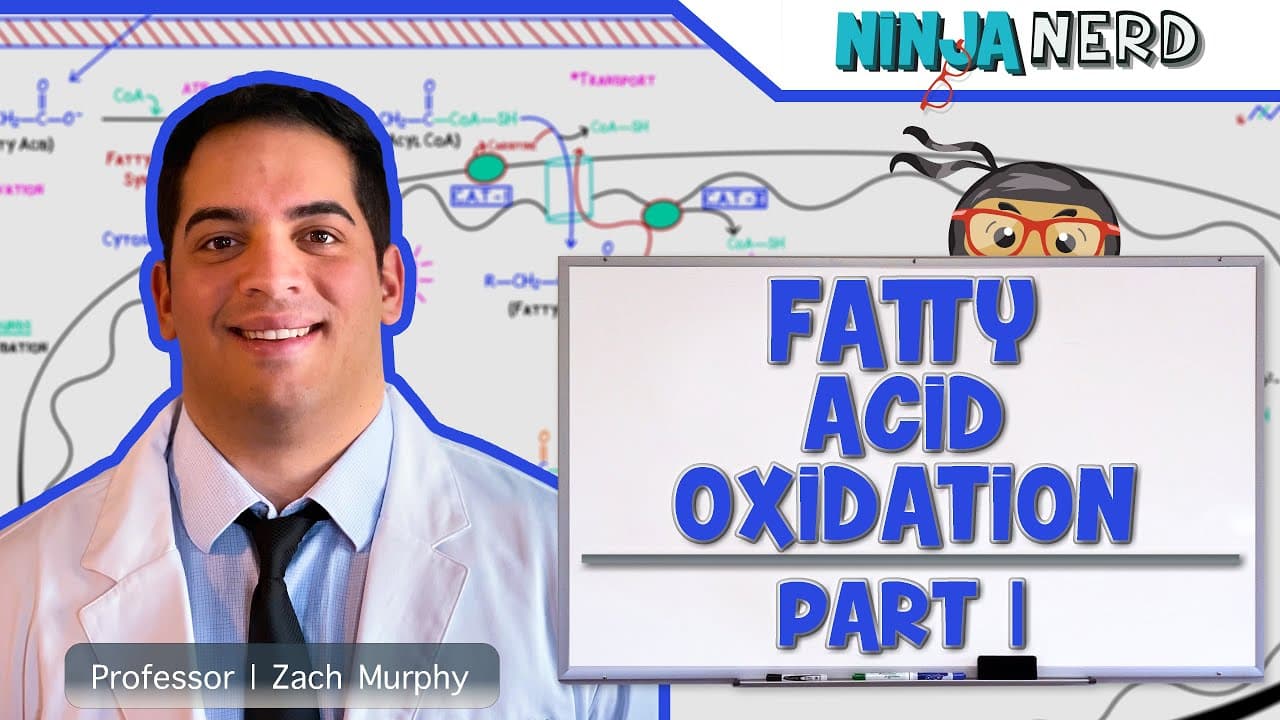
Long-chain fatty acids must first be activated into fatty acyl-CoA, then transported into the mitochondrial matrix through the carnitine shuttle. CPT-1 replaces CoA with carnitine, translocase carries fatty acyl-carnitine across the membrane, and CPT-2 restores CoA before beta oxidation begins its repeating sequence of oxidation, hydration, oxidation, and thiolytic cleavage.
Transcript
all engineers in this video we're going to talk about fatty acid oxidation so if you guys have already watched our video on the mobilization of fat that's going to really help you understand where we're going from here so we said in the mobilization of uh specifically the fats where we were breaking down the triglyceride into its components glycero... Read More
Key Insights
- Fatty acids are used for energy by multiple tissues, with heart muscle, skeletal muscle, and liver identified as especially important examples. The liver also has significance because it can generate structures called ketone bodies, although their production is not developed in this part of the lecture.
- Palmitic acid is presented as a 16-carbon long-chain fatty acid. Its carboxyl carbon is followed by the alpha carbon and then the beta carbon, terminology that becomes important because the later breakdown pathway is called beta oxidation.
- Fatty acid activation is the conversion of a free fatty acid into fatty acyl-CoA. Fatty acyl-CoA synthetase catalyzes the addition of coenzyme A, and the described reaction uses energy by converting ATP into ADP and inorganic phosphate.
- Fatty acyl-CoA cannot enter the mitochondrial matrix directly because its attached coenzyme A creates a transport problem. The cell therefore temporarily replaces coenzyme A with carnitine, creating a transportable intermediate called fatty acyl-carnitine.
- CPT-1 is the outer mitochondrial membrane component that adds carnitine to fatty acyl-CoA and releases coenzyme A. The lecture also identifies it as carnitine acyltransferase type 1 or, for the palmitic acid example, carnitine palmitoyltransferase type 1.
- Translocase transports fatty acyl-carnitine into the mitochondrial matrix and is described as bidirectional. Because the intermediate could travel back out, its carnitine must be removed after entry and replaced with coenzyme A to retain the fatty acyl group in the matrix.
- CPT-2 converts fatty acyl-carnitine back into fatty acyl-CoA inside the mitochondrial matrix. It removes carnitine, adds coenzyme A, and allows the released carnitine to return through translocase for recycling.
- Beta oxidation consists of four repeating steps introduced as oxidation by acyl-CoA dehydrogenase, hydration by enoyl-CoA hydratase, oxidation by hydroxyacyl-CoA dehydrogenase, and thiolytic cleavage by beta-ketothiolase. The transcript begins the first oxidation with FAD accepting removed hydrogen and electrons.
Install to Summarize YouTube Videos and Get Transcripts
Explore YouTube Video Summarizer or Get YouTube Transcript Extractor
Questions & Answers
Q: How are long-chain fatty acids prepared for beta oxidation?
Long-chain fatty acids are prepared through two major stages before beta oxidation. First, fatty acyl-CoA synthetase activates a free fatty acid by attaching coenzyme A, using energy as ATP is converted into ADP and inorganic phosphate. Second, the carnitine shuttle transports the fatty acyl group into the mitochondrial matrix, where fatty acyl-CoA is restored and becomes ready for beta oxidation.
Q: What is fatty acid activation?
Fatty acid activation is the conversion of a free fatty acid into fatty acyl-CoA. The enzyme fatty acyl-CoA synthetase attaches coenzyme A to the fatty acid. According to the lecture, this requires energy supplied by converting ATP into ADP and inorganic phosphate. Activation helps prevent the fatty acid from leaving the cell and prepares it for mitochondrial transport.
Q: Why is carnitine needed for long-chain fatty acid oxidation?
Carnitine is needed because long-chain fatty acyl-CoA cannot enter the mitochondrial matrix while coenzyme A remains attached. CPT-1 removes the coenzyme A and attaches carnitine, forming fatty acyl-carnitine. That intermediate can pass through translocase. Inside the matrix, CPT-2 removes carnitine and adds coenzyme A again, restoring fatty acyl-CoA for beta oxidation.
Q: How does the carnitine shuttle move fatty acids into mitochondria?
The carnitine shuttle begins when CPT-1 converts fatty acyl-CoA into fatty acyl-carnitine by adding carnitine and releasing coenzyme A. Translocase then transports fatty acyl-carnitine into the mitochondrial matrix. CPT-2 removes the carnitine and adds another coenzyme A, producing matrix fatty acyl-CoA. The released carnitine travels back through translocase and can be reused.
Q: What does CPT-1 do during fatty acid transport?
CPT-1 acts on the cytosolic side of the outer mitochondrial membrane. It transfers the fatty acyl group from coenzyme A to carnitine, producing fatty acyl-carnitine and releasing coenzyme A. This change solves the transport problem created by fatty acyl-CoA. The lecture also calls the component carnitine acyltransferase type 1 or carnitine palmitoyltransferase type 1.
Q: What does CPT-2 do in the mitochondrial matrix?
CPT-2 reverses the carnitine attachment after fatty acyl-carnitine reaches the mitochondrial matrix. It removes carnitine from the fatty acyl group and attaches coenzyme A, recreating fatty acyl-CoA. This conversion also helps prevent the transported fatty acyl group from simply moving back out through the bidirectional translocase. The released carnitine is returned and recycled.
Q: What are the four repeating steps of beta oxidation?
The four repeating steps are oxidation by acyl-CoA dehydrogenase, hydration by enoyl-CoA hydratase, oxidation by hydroxyacyl-CoA dehydrogenase, and thiolytic cleavage by beta-ketothiolase. The transcript starts describing the first oxidation step, in which hydrogen and electrons are removed from the fatty acyl-CoA structure and FAD enters the reaction to accept them.
Q: Which tissues use fatty acids for energy?
Many tissues can use fatty acids for energy, but the lecture emphasizes heart muscle, skeletal muscle, and liver. The myocardium and skeletal muscles are described as major users after fatty acids are delivered into their cells. The liver is also important because it uses fatty acids and can generate structures called ketone bodies, a topic reserved for later discussion.
Summary & Key Takeaways
-
Fatty acids released during fat mobilization can enter tissues such as heart muscle, skeletal muscle, and liver for energy use. The lecture follows a long-chain fatty acid, using the 16-carbon example of palmitic acid, from its arrival inside a general cell through activation and mitochondrial transport.
-
Activation converts a free fatty acid into fatty acyl-CoA. Fatty acyl-CoA synthetase catalyzes the attachment of coenzyme A, while ATP is converted into ADP and inorganic phosphate to supply energy. This modification helps retain the fatty acid inside the cell but creates a transport problem at the mitochondrion.
-
The carnitine shuttle solves mitochondrial transport through CPT-1, translocase, and CPT-2. CPT-1 forms fatty acyl-carnitine, translocase moves it into the matrix, and CPT-2 restores fatty acyl-CoA while carnitine is recycled. The resulting molecule can begin beta oxidation through four repeating reaction steps.
Read in Other Languages (beta)
Share This Summary 📚
Summarize YouTube Videos and Get Video Transcripts with 1-Click
Try YouTube Summary with ChatGPT & Claude or YouTube Transcript Generator
Explore More Summaries from Ninja Nerd 📚





Summarize YouTube Videos and Get Video Transcripts with 1-Click
Try YouTube Summary with ChatGPT & Claude or YouTube Transcript Generator