How Well Can Triplets Identify Real Twins?
TL;DR
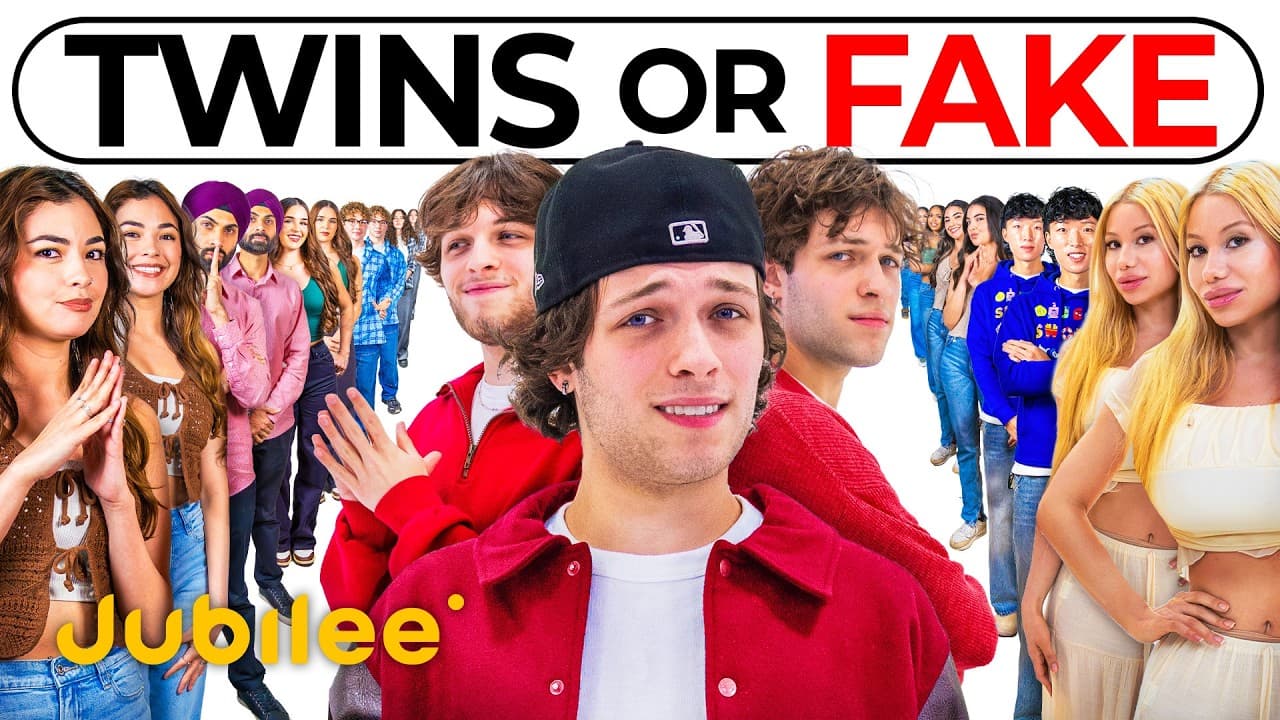
Real twins cannot be identified reliably through appearance, matching clothes, or synchronized answers alone. The Sturniolo triplets test their instincts by questioning pairs about parents, school years, teachers, shared interests, and childhood experiences, but convincing friends repeatedly expose the limits of those clues. Personal chemistry can suggest a close relationship without proving that two people are twins.
Transcript
Okay, twins. We're not Okay, let's see. If I'm wrong, strike me with lightning. Seriously, do it. Hey guys, my name's Nick. I'm Matt. I'm Chris. And we are together the Sternola triplets. How would you describe our content, Matt? Man, how would you describe it? you if you can't describe it, that's a really really bad sign. No, I can't. Brotherly ba... Read More
Key Insights
- Appearance is an unreliable test of twinship because fraternal twins may not look alike. Michael and Carrie are revealed as fraternal twins even after their matching fandom hoodies and different presentation convince all three triplets that they are simply friends trying to appear related.
- Matching accessories can support several competing explanations. Sierra and Tiana wear similar watches in different colors, but one watch also matches its wearer's outfit, allowing the triplets to interpret the choice as either sisterly coordination or deliberate styling for the challenge.
- Contradictory biographical answers can be intentional misdirection rather than proof of deception. Sierra and Tiana give different high school graduation years and describe an age difference before revealing that they are twins, demonstrating how participants can manipulate seemingly decisive family clues.
- Shared style is not proof of a biological relationship. Forest and Jack both wear real glasses and present a similar vibe, yet they are friends who met at a coffee shop, confirming that appearance and compatible personalities can make unrelated people seem like twins.
- Awkward or incomplete knowledge does not disprove twinship. Brianna and Renee give different ages, say they did not wake up in the same place, and struggle to identify a favorite movie, but the reveal confirms that they are twins who are two minutes apart.
- Family questions are useful only when answers can be independently interpreted. Asking for a parent's name, graduation year, or school history can expose inconsistencies, but siblings and close friends may know the same information, while actual twins can deliberately provide misleading answers.
- Close friends can reproduce behaviors commonly associated with twins. Tyler and Llaya coordinate answers about graduation and a father's name, discuss different teachers, share clothing, and persuade some judges that they are twins before revealing that they met in college.
- Confidence is not the same as accuracy in a deception challenge. The triplets frequently announce strong instincts, construct detailed stories about each pair, and sometimes reverse their opinions during questioning, showing that persuasive narratives can form from ambiguous evidence rather than verified facts.
Install to Summarize YouTube Videos and Get Transcripts
Explore YouTube Video Summarizer or Get YouTube Transcript Extractor
Questions & Answers
Q: How do the Sturniolo triplets try to identify real twins?
The Sturniolo triplets begin by focusing on looks, attitude, and body language. They then ask pairs about parents' names, graduation years, ages, teachers, favorite activities, childhood experiences, and secret handshakes. They also examine matching clothes and accessories. The reveals show that none of these clues works consistently because both twins and close friends can coordinate their behavior or deliberately mislead the judges.
Q: Why is physical resemblance unreliable for identifying twins?
Physical resemblance is unreliable because the challenge includes fraternal twins who do not necessarily look alike and unrelated friends who share a similar style. Michael and Carrie are real fraternal twins despite convincing the judges otherwise, while Forest and Jack appear visually compatible but are friends. The challenge therefore shows that similar clothing, glasses, hairstyles, or general appearance cannot establish a biological relationship by themselves.
Q: What questions reveal whether two people share a family history?
Questions about a mother's or father's name, birth year, graduation year, age difference, childhood teachers, and school placement can test whether two people share family experiences. The triplets use several of these prompts. However, the answers remain inconclusive because participants may lie for the game, siblings may know identical family facts, and close friends may study or naturally know detailed information about each other.
Q: Can matching clothes and accessories prove that two people are twins?
Matching clothes and accessories cannot prove that two people are twins. Carrie and Michael wear fandom hoodies that make the judges suspect a shared interest rather than a family connection, although they are real twins. Forest and Jack both wear genuine glasses but are friends. Tyler and Llaya also share clothing, showing that coordinated style may reflect friendship, convenience, or deliberate misdirection.
Q: How do real twins mislead the judges during the challenge?
Real twins mislead the judges by giving answers that sound inconsistent with a shared birth or upbringing. Sierra and Tiana report different graduation years and initially describe an age gap, encouraging suspicion that they are ordinary sisters. Brianna and Renee give different ages and do not provide polished answers about shared activities. These tactics exploit the expectation that twins should respond identically and know everything about each other.
Q: How do friends successfully pretend to be twins?
Friends succeed by coordinating basic facts, presenting a shared style, and behaving comfortably together. Tyler and Llaya answer questions about graduation and a father's name in a way that sounds natural, discuss their teachers, and wear shared clothing. Forest and Jack have similar glasses and an easy rapport. These details create a plausible impression of long-term familiarity even without an actual twin relationship.
Q: What mistakes do the triplets make when judging each pair?
The triplets often treat ambiguous details as decisive evidence and create elaborate explanations before enough facts are available. They interpret hoodies as proof of a fandom friendship, different graduation years as evidence against twinship, and shared clothing as evidence for it. They also change their conclusions after individual answers, showing how one striking clue can outweigh contradictory information and produce an incorrect guess.
Q: What is the main lesson of the twins-or-friends challenge?
The main lesson is that no single visible or conversational clue reliably distinguishes twins from close friends. Real twins may look different, live separately, disagree, or know surprisingly little about each other's preferences. Friends may share clothes, memories, interests, and personal facts. Accurate judgment therefore requires several follow-up questions, careful comparison of answers, and recognition that participants may intentionally create contradictions.
Summary & Key Takeaways
-
The Sturniolo triplets, Nick, Matt, and Chris, participate in a social guessing challenge involving pairs who may be twins or unrelated friends. Before meeting them, the brothers predict their own performance and propose judging each pair through looks, attitude, and body language, while also expecting their individual strategies to produce different answers.
-
Each pair answers questions intended to reveal a shared family history, including their mother's or father's name, graduation year, schoolteachers, age difference, and favorite activities. The triplets also inspect clothing, glasses, watches, naming patterns, conversational timing, and secret handshakes, although several apparently revealing details lead them toward incorrect conclusions.
-
The revealed relationships show that surface similarity and coordinated behavior are weak evidence of twinship. Fraternal twins can look different, live separately, graduate in different years, or answer awkwardly, while close friends can share clothes, glasses, interests, memories, and confident responses. The challenge rewards skepticism, follow-up questions, and attention to contradictions.
Read in Other Languages (beta)
Share This Summary 📚
Summarize YouTube Videos and Get Video Transcripts with 1-Click
Try YouTube Summary with ChatGPT & Claude or YouTube Transcript Generator
Explore More Summaries from Jubilee 📚





Summarize YouTube Videos and Get Video Transcripts with 1-Click
Try YouTube Summary with ChatGPT & Claude or YouTube Transcript Generator