Is Astrology a Science or a Belief System?
TL;DR
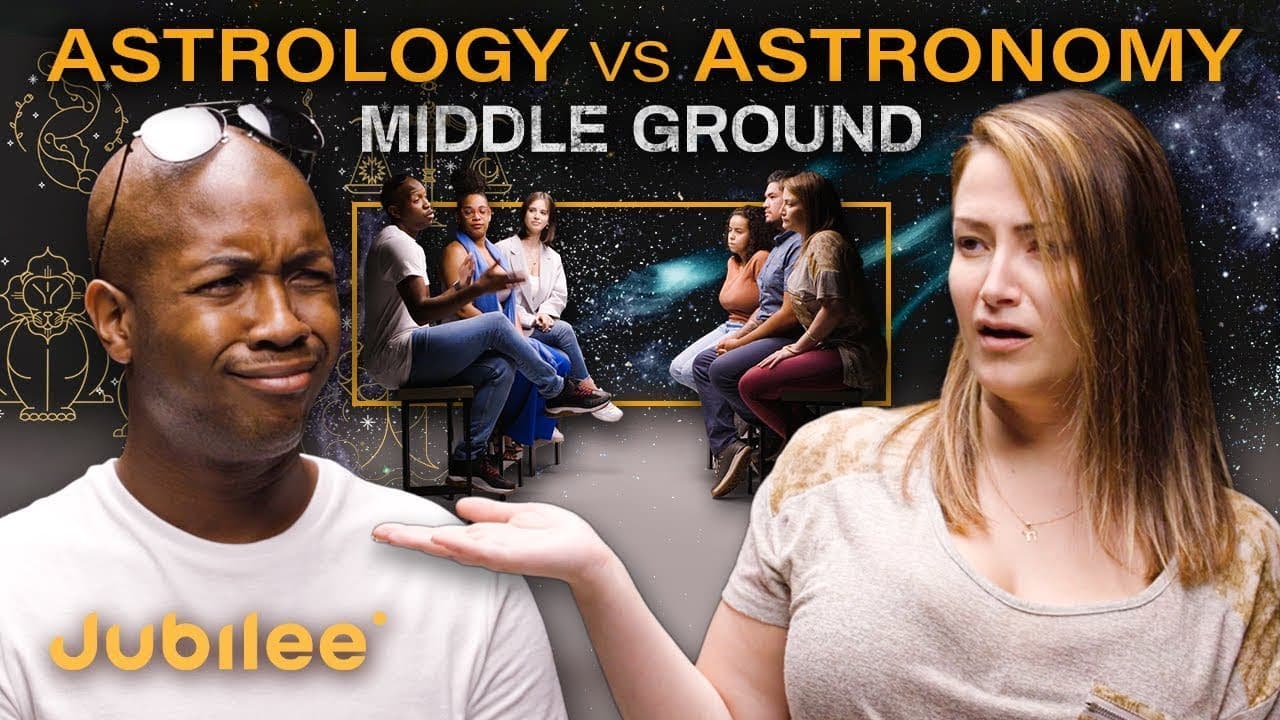
Astrology is presented as an interpretive belief system that may support self-reflection, but the astronomers argue that it does not satisfy scientific requirements such as rigorous testing, reproducibility, and falsifiability. The discussion reveals deeper disagreements about evidence, energy, celestial influence, and whether client validation can reliably distinguish an accurate interpretation from one that is repeatedly revised.
Transcript
- Hey y'all do you love Middle Ground? I know I do. Did you know that every purchase made at the Jubilee shop helps fund this show? If you're looking for ways to support Jubilee and watch more episodes of Middle Ground, make sure you check out our mech at shop.jubileemedia.com Honestly every single one of your purchases goes such a long way and we'... Read More
Key Insights
- Astrology is treated by the astronomers as an interpretive belief system because its readings cannot consistently reproduce the same results. They argue that science requires rigorous testing, evidence, and outcomes that can distinguish a correct claim from an incorrect one.
- Western tropical astrology is based on a chart divided into twelve equal sections associated with equinoxes and solstices. Its practitioners say signs are not identical to physical constellations, which addresses some astronomical criticism about constellation sizes and shifting positions.
- Astronomical criticism focuses partly on the changing relationship between Earth and the constellations over time. One astronomer argues that traditional categories established about 2,000 years ago do not account for axial movement or the unequal sizes of constellations.
- Astrological charts are described as symbolic maps rather than claims that planets directly transmit personality traits. One practitioner compares chart positions to clock hands, which represent time without being time itself, and says placements represent possible ways that personal tendencies may appear.
- Scientific energy and spiritual energy are different concepts in the discussion. The astronomers object when conservation of energy is used to support astrological influence, arguing that technical scientific language can be applied in ways that do not match its scientific meaning.
- Mathematics alone does not make a practice scientific, according to the astronomers. Although astrologers calculate degree placements and construct charts, the critics maintain that using scientific or mathematical tools is different from producing hypotheses and reproducible evidence through the scientific method.
- Client feedback is presented as a way astrologers assess readings, but interpretations can be revised when a client disagrees. The astronomers argue that this flexibility prevents clear falsification because an unsuccessful statement can be replaced by another possible interpretation.
- Self-knowledge is presented as astrology's primary personal benefit. Practitioners say charts can validate feelings, identify possible personality patterns, and provide a map for reflection, even when they acknowledge that the practice lacks the kind of proof demanded by scientific research.
Install to Summarize YouTube Videos and Get Transcripts
Explore YouTube Video Summarizer or Get YouTube Transcript Extractor
Questions & Answers
Q: Why do astronomers say astrology is not a science?
The astronomers say astrology is not a science because its interpretations are not rigorously tested or reliably reproducible. A reading may produce different meanings for different people, and an interpretation can be changed when a client disagrees. They argue that scientific claims require evidence, repeatable results, and a clear way to determine whether a prediction or explanation is wrong.
Q: What is the difference between tropical and sidereal astrology?
The astrologers identify tropical and sidereal astrology as two separate systems divided by 23.4 degrees. They describe Western tropical astrology as a system based on equinoxes, solstices, and twelve equal sections of a chart rather than the literal boundaries of constellations. They also suggest that people may choose a system according to whether it resonates with their goals and interests.
Q: How does Western tropical astrology use zodiac signs?
Western tropical astrology uses a wheel divided equally into twelve parts. A person's rising sign depends on which tropical sign is located on the eastern horizon, and that rising position begins the first of twelve houses. Practitioners emphasize that these signs are chart divisions, not physical constellations, and that planetary placements symbolically represent possible energies and patterns of expression.
Q: What astronomical objections are raised against zodiac categories?
The astronomers argue that Earth's axis changes its orientation over time, so the Sun's apparent relationship to constellations is not identical to what it was when categories were established about 2,000 years ago. They also note that constellations have unequal sizes, so the Sun does not spend an equal period in each one, despite charts using equal divisions.
Q: How do astrologers determine whether a reading is accurate?
One astrologer says accuracy is evaluated by speaking directly with clients. Rather than presenting every statement as certain, the practitioner offers a possible indication and asks whether it fits. If the client disagrees, the placement may be interpreted differently. Astronomers see this process as a weakness because revising meanings makes results difficult to reproduce or prove wrong.
Q: Why is the word energy disputed in the astrology debate?
Astrologers use energy to describe spiritual qualities, personal tendencies, and connections within the universe. Astronomers use the term in a more narrowly scientific sense and object when conservation of energy is presented as support for astrological effects. They warn that scientific terms, including language associated with quantum physics, can be used in ways that do not preserve their technical meanings.
Q: Does using mathematics make astrology a science?
Astrologers argue that creating charts requires mathematics, degree placements, and other basic scientific skills, which makes the practice practical and systematic. The astronomers respond that a field can use mathematics or scientific tools without becoming a science. In their view, scientific status depends on testable claims, rigorous methods, factual evidence, and results that can be reproduced independently.
Q: What benefits do astrologers claim their practice provides?
Astrologers say their practice gives people self-knowledge by offering a symbolic map of personality, feelings, possible actions, and patterns of behavior. Some distinguish prediction-focused traditions from approaches centered on understanding and affirmation. Even a practitioner who admits having no scientific proof says years of study and professional client work have made astrology personally reliable and useful.
Summary & Key Takeaways
-
Astronomers challenge astrology because they see no reproducible evidence that celestial positions predict personalities or life events. They also question equal zodiac divisions, the enormous number of people placed into limited categories, and whether distant objects can affect someone at birth. For them, scientific claims must survive rigorous testing and possible disproof.
-
Astrologers describe multiple traditions, including Western tropical and sidereal systems. Tropical astrology uses divisions associated with equinoxes and solstices rather than treating zodiac signs as literal constellations. Practitioners interpret planets and chart placements as representations of possible energies, personality patterns, actions, and paths toward greater self-knowledge rather than simple physical causes.
-
The central disagreement concerns standards of knowledge. Some astrologers call their practice a science because it uses mathematics, degree placements, research, and practical application. Others admit their beliefs lack scientific proof but regard astrology as a useful interpretive practice. Astronomers respond that flexible interpretations and client agreement cannot replace controlled, reproducible evidence.
Read in Other Languages (beta)
Share This Summary 📚
Summarize YouTube Videos and Get Video Transcripts with 1-Click
Try YouTube Summary with ChatGPT & Claude or YouTube Transcript Generator
Explore More Summaries from Jubilee 📚





Summarize YouTube Videos and Get Video Transcripts with 1-Click
Try YouTube Summary with ChatGPT & Claude or YouTube Transcript Generator