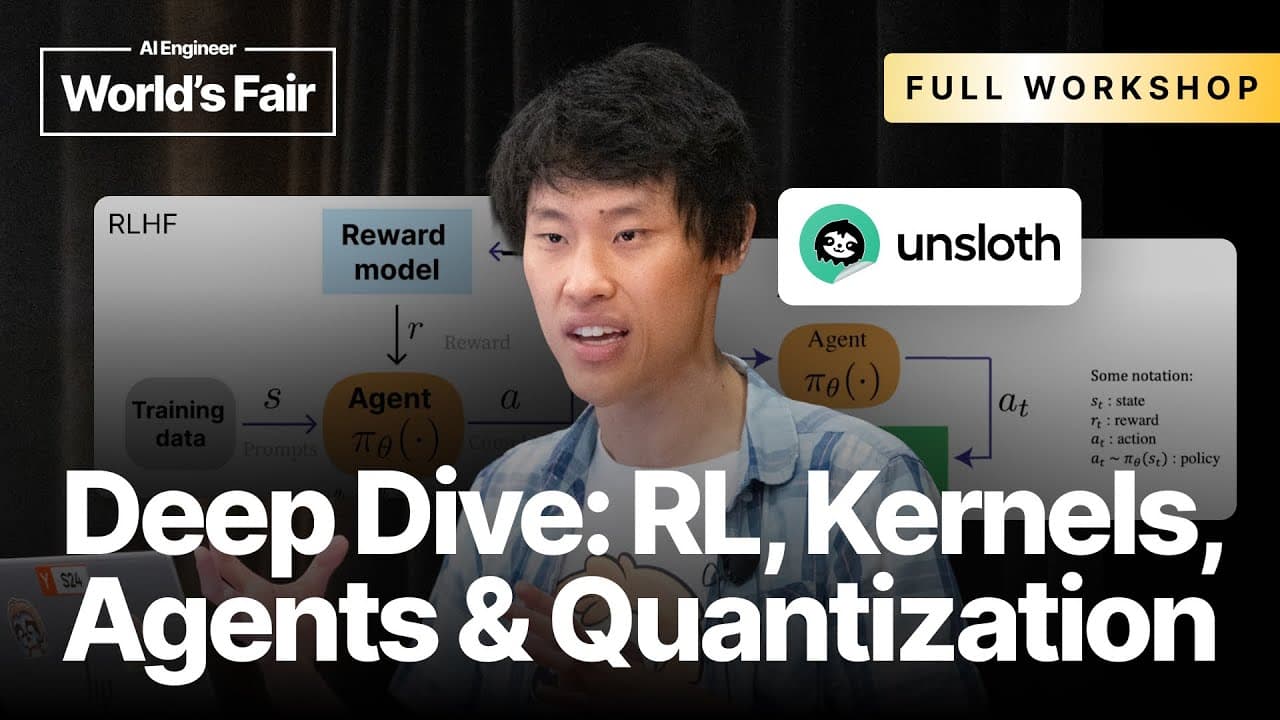
How to Use Reinforcement Learning for AI Agents
TL;DR
Reinforcement Learning (RL) is crucial for enhancing AI agent capabilities by maximizing rewards through iterative actions. Effective RL requires well-designed reward functions and can be applied to various tasks, from simple arithmetic to complex coding challenges. By leveraging RL, AI models can learn to perform tasks more efficiently, even with limited data.
Transcript
Hello guys. Hello. Hello. Hello. Yes. Sorry for being a bit late. There's a lot of traffic. But um hello. Um welcome to AI engineers worldfare. Thanks for coming to my session. Um, and yes, today we're going to talk about the deep dive into RL kernels, agents, and quantization. Um, you might know me or you might not know me, but I'm Daniel. Uh, my ... Read More
Key Insights
- Reinforcement Learning (RL) is a method used to improve AI models by maximizing rewards through iterative actions.
- Effective reward functions are essential for RL, as they dictate how models learn and optimize their actions.
- RL can be applied to a wide range of tasks, from simple arithmetic to complex coding challenges.
- The evolution of large language models (LLMs) involves stages like pre-training, supervised fine-tuning, and RL.
- Quantization allows AI models to perform efficiently on low-resource devices by reducing bit precision while maintaining accuracy.
- GRPO is an advancement over PPO, removing the value model to enhance efficiency in RL training.
- Open-source contributions and collaboration are key to advancing AI technology and making it more accessible.
- The future of AI involves balancing model capabilities with computational efficiency, especially in resource-constrained environments.
Install to Summarize YouTube Videos and Get Transcripts
Explore YouTube Video Summarizer or Get YouTube Transcript Extractor
Questions & Answers
Q: How does Reinforcement Learning improve AI models?
Reinforcement Learning (RL) improves AI models by maximizing rewards through iterative actions, allowing models to learn optimal behaviors over time. By designing effective reward functions, RL guides models in refining their actions to achieve specific goals, making them more efficient and capable in various tasks.
Q: What is the role of reward functions in Reinforcement Learning?
Reward functions are crucial in Reinforcement Learning as they determine how models learn and optimize their actions. A well-designed reward function provides clear signals for desired outcomes, guiding models to improve performance by reinforcing successful actions and discouraging ineffective ones.
Q: How are large language models trained?
Large language models are trained through stages like pre-training, where they learn from vast datasets, followed by supervised fine-tuning to refine specific tasks. Reinforcement Learning is used to further enhance capabilities by maximizing rewards for optimal actions, leading to more efficient and intelligent models.
Q: What is quantization in AI models?
Quantization in AI models involves reducing the bit precision of model parameters to decrease computational requirements while maintaining accuracy. This technique allows models to run efficiently on low-resource devices, making AI more accessible and practical in resource-constrained environments.
Q: How does GRPO differ from PPO in Reinforcement Learning?
GRPO differs from PPO by removing the value model, which estimates average rewards, to enhance efficiency in training. This simplification reduces computational overhead, allowing for faster and more efficient reinforcement learning without compromising the model's ability to learn optimal actions.
Q: Why is open-source collaboration important in AI development?
Open-source collaboration is important in AI development as it fosters innovation, accelerates advancements, and democratizes access to cutting-edge technology. By sharing resources and knowledge, the AI community can address challenges collectively, leading to more robust and accessible AI solutions.
Q: What challenges do AI models face in resource-constrained environments?
AI models in resource-constrained environments face challenges like limited computational power and memory. Techniques like quantization and efficient training algorithms, such as GRPO, are essential to optimize performance while minimizing resource usage, ensuring models remain effective and accessible.
Q: What is the future focus of AI development?
The future focus of AI development will likely involve balancing model capabilities with computational efficiency. As models become more complex, optimizing resource usage without sacrificing performance will be crucial, especially in applications requiring deployment in resource-limited settings.
Summary & Key Takeaways
-
Reinforcement Learning (RL) enhances AI by maximizing rewards through iterative actions, crucial for developing intelligent agents. Effective RL requires well-designed reward functions to guide models in optimizing their actions. This approach is applicable to tasks ranging from basic arithmetic to complex coding.
-
The development of large language models (LLMs) involves multiple stages, including pre-training, supervised fine-tuning, and reinforcement learning. Quantization techniques allow these models to perform well even on low-resource devices by reducing bit precision while maintaining accuracy.
-
GRPO improves upon PPO by removing the value model, increasing efficiency in RL training. Open-source collaboration is vital for advancing AI technology and making it accessible. The future of AI will focus on balancing model capabilities with computational efficiency in resource-limited settings.
Read in Other Languages (beta)
Share This Summary 📚
Summarize YouTube Videos and Get Video Transcripts with 1-Click
Try YouTube Summary with ChatGPT & Claude or YouTube Transcript Generator
Explore More Summaries from AI Engineer 📚





Summarize YouTube Videos and Get Video Transcripts with 1-Click
Try YouTube Summary with ChatGPT & Claude or YouTube Transcript Generator