How to Build a Credible Personal Brand Strategy
TL;DR
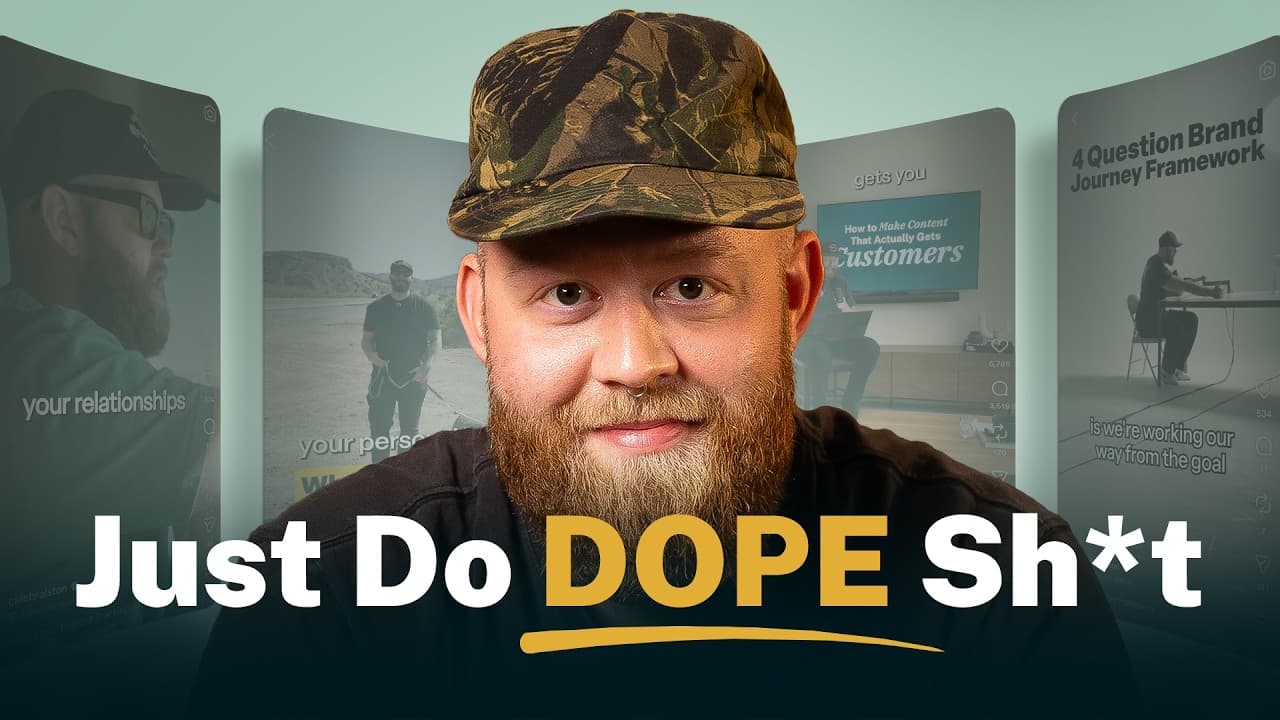
Build a credible personal brand by defining your desired outcome, then reverse engineering the reputation, actions, and knowledge needed to achieve it. The four-question brand journey framework turns that process into a measurable road map, while your accomplishments, failures, experience, and expertise reveal the right niche to compete in. Read on to choose an honest position and build on a stronger foundation than formats or hooks.
Transcript
Most people who are building their personal brand right now are being flooded with advice everywhere [music] they look. Copy these formats. Steal this hook. And on the surface, it seems like good advice. But after 17 years of building personal brands, I can tell you none of that [ __ ] matters if you don't [music] have a strong foundation. So here ... Read More
Key Insights
- A desired outcome is the starting point for personal-brand strategy because it determines direction and provides a standard for measuring progress. A strong reason for building the brand also makes persistence more likely when the work demands significant time, money, privacy, and effort.
- The brand journey framework is a four-question reverse-engineering process: identify the desired outcome, determine the reputation needed to achieve it, list the actions required to earn that reputation, and identify what must be learned before those actions can be performed.
- Reputation is a practical bridge between personal-brand activity and career or life outcomes. Asking what you must be known for clarifies the specific perception your content and real-world work need to establish, instead of treating publishing itself as the final objective.
- Personal-brand decisions are measurable when every action can be tested against the desired outcome. An activity is strategically useful if it moves the creator closer to that destination, while activities that move away from it can be reconsidered or removed.
- The appropriate competitive pond is determined by accomplishments, successes, failures, experience, and expertise. A creator with strong results in one narrow business category can provide credible value there, even if that creator cannot yet compete convincingly across the broader business field.
- A focused pond gives a new creator room to build traction, trust, notoriety, and awareness among a relevant audience. Moving into a broader lake or ocean should happen only as experience, skills, and expertise grow enough to support credible discussion of wider subjects.
- Credibility is rooted in completed work, accumulated experience, and lessons from both successes and failures. Content formats and hooks cannot replace this foundation, and creators who merely repeat experienced people’s advice have little meaningful basis for differentiation.
- Expert and student positioning are both valid when they accurately reflect reality. An expert teaches from having achieved the audience’s desired result, while a student operates like a scientist by pursuing that result and sharing experiments, hypotheses, lessons, and outcomes along the journey.
Install to Summarize YouTube Videos and Get Transcripts
Explore YouTube Video Summarizer or Get YouTube Transcript Extractor
Questions & Answers
Q: How do you create a personal brand strategy?
Start with the outcome you want your personal brand to achieve, then reverse engineer the path back to your current position. Determine what you must be known for, what actions would earn that reputation, and what you need to learn before taking those actions.
Q: What is the brand journey framework?
The brand journey framework is a four-question planning method that starts with the end in mind. It asks what outcome you want, what you must be known for, what you must do, and what you must learn to reach that outcome.
Q: Why does a personal brand need a desired outcome?
A desired outcome gives you a destination, helps you select a route, and lets you measure whether your actions move you closer to or further from your goal. It also provides a strong reason to persist despite the time, money, privacy, and other investments involved in building a personal brand.
Q: How does reputation support a personal brand?
Reputation connects personal-brand activity with the results you want in your career or life. Asking what you must be known for clarifies the reputation your work and content need to establish.
Q: How should you choose a niche for your personal brand?
Choose your niche by examining what you have accomplished and done, including your successes, failures, experience, and expertise. These factors reveal the pond, lake, or ocean in which you can currently provide credible value.
Q: Why should a new personal brand start in a focused pond?
A focused pond lets you compete where your actual experience is relevant instead of entering a broad ocean against people with deeper or more varied backgrounds. For example, a founder whose only business experience is in e-commerce may offer strong value in that lane without yet being qualified to compete across business as a whole.
Q: How can you measure progress when building a personal brand?
Use your desired outcome as the standard for evaluating every personal-brand action. Ask whether each action moves you closer to that destination or further away from it.
Q: Why are content formats and hooks not enough to build a strong personal brand?
Formats and hooks do not matter without a strong foundation, according to the speaker’s 17 years of building personal brands. That foundation begins with a defined outcome and is supported by actions, learning, experience, and a reputation earned through actually doing the work.
Summary & Key Takeaways
-
The brand journey framework begins with a desired outcome and works backward through four questions. Define what you want the brand to achieve, what you must be known for, what actions would create that reputation, and what you need to learn before taking those actions. This produces a measurable road map.
-
A new personal brand should compete in a focused pond based on genuine accomplishments, successes, failures, experience, and expertise. Starting too broadly places the creator against people with deeper qualifications. The brand can later expand into broader subjects, but that expansion should follow growing capability rather than boredom with the original topic.
-
Credibility depends on what a creator has actually done. Experts can teach from accomplishments that their audiences want to replicate. Students can document the same journey their audiences are pursuing by sharing experiments, hypotheses, and results. Honest positioning creates a defensible reason to listen, while unsupported expert posturing amounts to misrepresentation.
Read in Other Languages (beta)
Share This Summary 📚
Summarize YouTube Videos and Get Video Transcripts with 1-Click
Try YouTube Summary with ChatGPT & Claude or YouTube Transcript Generator
Explore More Summaries from Caleb Ralston 📚
Summarize YouTube Videos and Get Video Transcripts with 1-Click
Try YouTube Summary with ChatGPT & Claude or YouTube Transcript Generator