How to use quantum kernels for classification
TL;DR
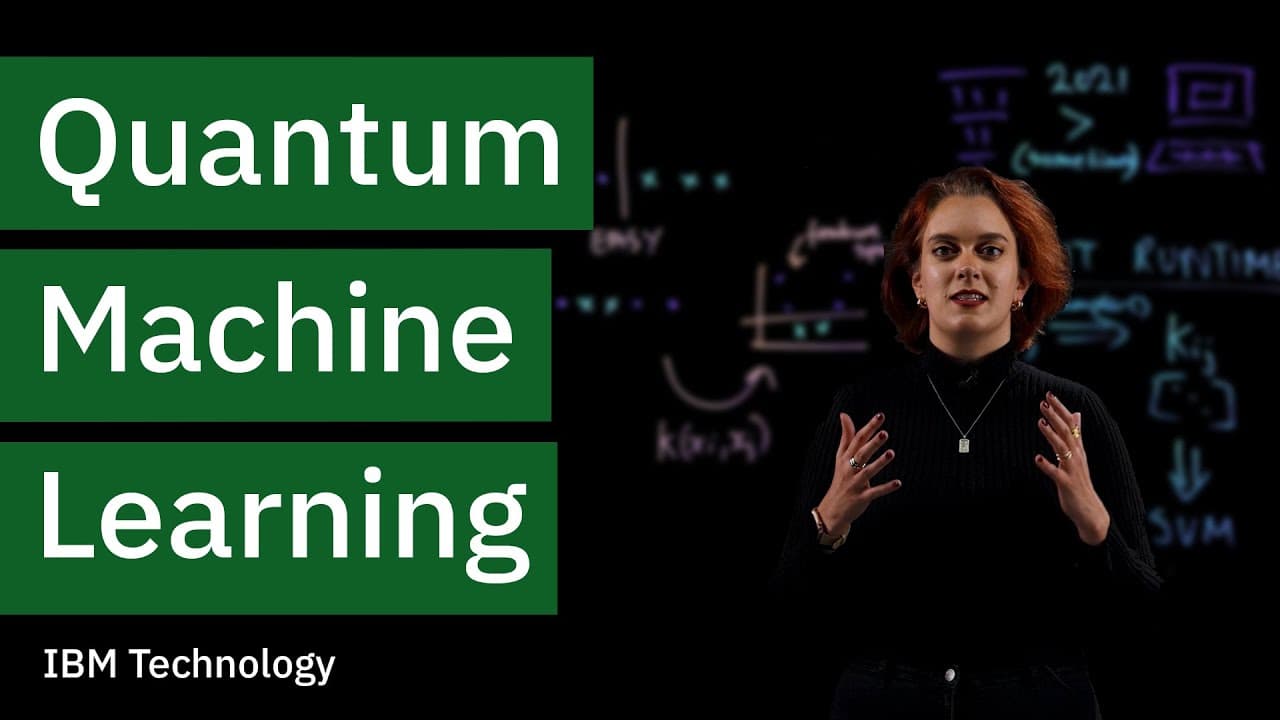
Quantum kernels map data into a higher dimensional feature space using kernel functions encoded in quantum circuits, which can make some classifications easier than in lower dimensions. They offer potential speedups for certain problems and can be evaluated with Qiskit Runtime using the sampler primitive to produce quasi-probabilities and a kernel matrix for classical classifiers.
Transcript
Today, I'm going to talk to you about quantum computing applications and machine learning. This is a very exciting area of quantum computing research and lots of classical machine learning developers are understandably excited about the potential applications within their own field. So to get started, let's talk about a classical machine ... Read More
Key Insights
- Quantum kernels expand the feature space beyond classical limits, allowing more complex decision boundaries to be learned.
- Kernel functions work by mapping underlying features to a high dimensional feature space via quantum circuits.
- Quantum computers can access more complex feature spaces than classical systems, potentially enabling faster classification for certain problems.
- IBM researchers showed that quantum kernels can provide an exponential speed up for some classification problems, highlighting a potential advantage for QML.
- Qiskit Runtime includes sampler primitives to efficiently run quantum workflows and obtain quasi-probabilities for kernel matrices.
- Data can be encoded into quantum circuits to create kernel matrices that feed into classical ML models like SVMs.
- Time series and data with strong correlations may benefit more from quantum kernel approaches due to richer feature representations.
- The field of quantum machine learning is active with ongoing research on structure, data, and kernel alignment to improve performance.
Install to Summarize YouTube Videos and Get Transcripts
Explore YouTube Video Summarizer or Get YouTube Transcript Extractor
Questions & Answers
Q: How does quantum kernel learning differ from classical kernel methods?
Quantum kernel learning differs in that the data is encoded into quantum circuits to form a kernel matrix representing quasi probabilities that reflect relationships in a high dimensional feature space. This can yield kernel values that are difficult or impossible to reproduce classically, potentially enabling more powerful classification boundaries for certain datasets.
Q: What problem do kernel functions help solve in machine learning?
Kernel functions help solve the problem of separating data that is not linearly separable in its original space by mapping it into a higher dimensional feature space where a linear separator, such as a hyperplane, can distinguish the classes. This approach is especially useful for complex and highly correlated data.
Q: Why are quantum kernels potentially faster for some tasks?
Quantum kernels are potentially faster because quantum circuits can represent and manipulate very high dimensional feature spaces in ways that are not easily replicated by classical computations. For certain classification problems, this can lead to exponential speedups in computing the kernel and evaluating the model.
Q: What is the role of the sampler primitive in Qiskit Runtime?
The sampler primitive in Qiskit Runtime is used to obtain quasi-probabilities that encode relationships between data points. These quasi-probabilities populate the kernel matrix, which is then used by a classical pipeline such as a support vector machine to predict new labels.
Q: How can one apply quantum kernels to a linear classification problem?
One can encode the data into a quantum circuit, use a quantum kernel to map points into a high dimensional space, construct a kernel matrix from the quasi-probabilities, and feed this matrix into a classical classifier like an SVM to predict new labels.
Q: What evidence supports the potential of quantum kernels?
In 2021 IBM researchers demonstrated that quantum kernels can provide an exponential speed up over classical counterparts for certain classification problems, indicating a concrete instance where quantum approaches may outperform classical methods for specific datasets.
Q: What tools are mentioned for getting started with quantum machine learning?
The video mentions Qiskit Runtime as a platform to build quantum machine learning algorithms, with built in tools such as the sampler primitive. It also points to the Qiskit textbook and a quantum machine learning course for structured learning and practical implementation.
Q: What is the overall trajectory of quantum machine learning research according to the video?
The video portrays quantum machine learning as a highly active field with extensive research into improving quantum kernel methods, data encoding, and kernel alignment, aiming to leverage quantum hardware to enhance classical ML workflows and expand the range of solvable problems.
Summary & Key Takeaways
-
Quantum kernels enable mapping data into high dimensional spaces to ease classification tasks in some cases.
-
Quantum machine learning can leverage kernel functions that are hard to reproduce classically, potentially giving advantages for complex data.
-
Qiskit Runtime provides tools like the sampler primitive to compute kernel matrices and integrate with classical classifiers.
Read in Other Languages (beta)
Share This Summary 📚
Summarize YouTube Videos and Get Video Transcripts with 1-Click
Try YouTube Summary with ChatGPT & Claude or YouTube Transcript Generator
Explore More Summaries from IBM Technology 📚




Summarize YouTube Videos and Get Video Transcripts with 1-Click
Try YouTube Summary with ChatGPT & Claude or YouTube Transcript Generator