NEAPOLITAN - A Language of Southern ITALY
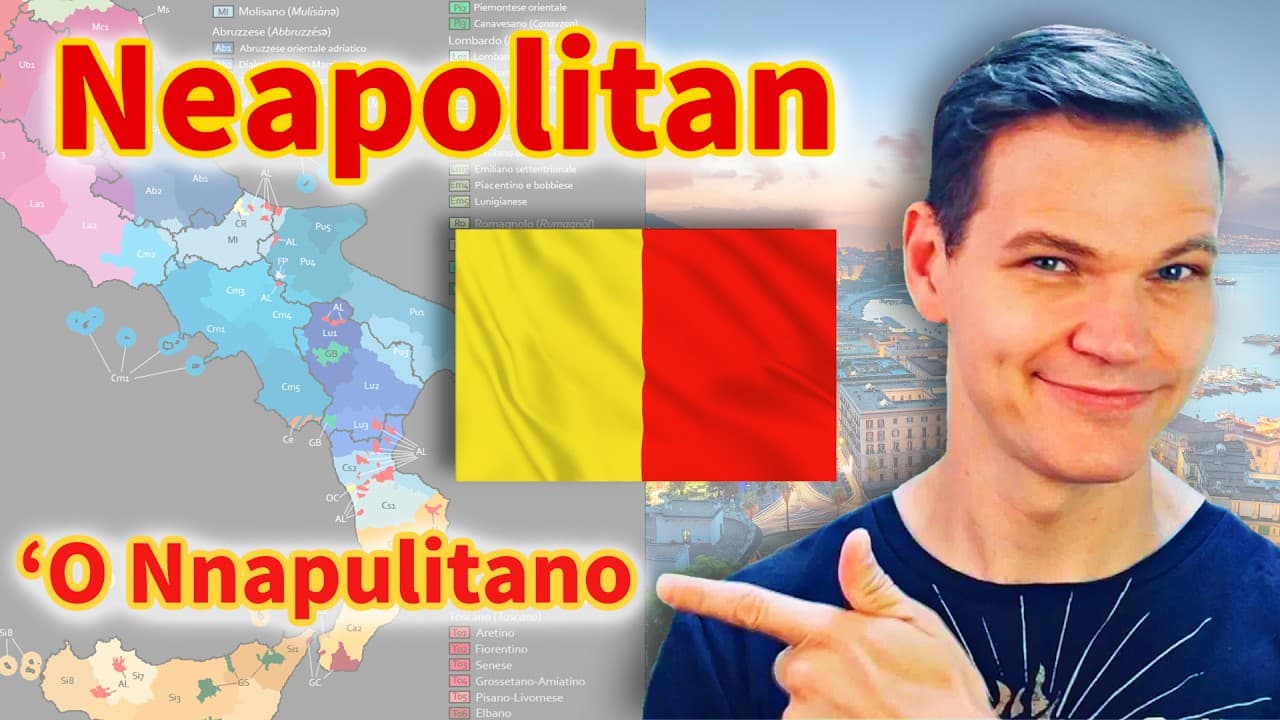
TL;DR
Neapolitan is a distinct regional language with unique features.
Transcript
note that this video is not about a type of ice cream that kind of looks like a flag it's about one of the languages of Italy one of them what do you mean one of them well the official language of Italy is Italian as in standard Italian but all over the country there are different forms of speech known as dialetti meaning dialects one example is Ne... Read More
Key Insights
- Neapolitan is a regional language of Italy, distinct from standard Italian, with its own phonology, grammar, and vocabulary.
- The language is spoken by approximately 7.5 million people, primarily in the Campania region and surrounding areas.
- Neapolitan shares many features with other Romance languages, such as SVO word order and pro-drop characteristics.
- Unique phonological traits include the rhodic pronunciation of 'd' and the reduction of unstressed final vowels.
- Neapolitan grammar includes the use of possessive suffixes for family members and a neuter gender, unlike Italian.
- The vocabulary is heavily influenced by Latin, with additional Greek, Spanish, and French elements due to historical influences.
- Neapolitan's pronunciation and spelling make it challenging for standard Italian speakers to understand without related dialect knowledge.
- The language is not officially recognized as distinct, often being referred to as a dialect, which can diminish its perceived legitimacy.
Install to Summarize YouTube Videos and Get Transcripts
Explore YouTube Video Summarizer or Get YouTube Transcript Extractor
Questions & Answers
Q: What is the primary focus of the video?
The video primarily focuses on the Neapolitan language, a regional language of Italy, examining its features, similarities, and differences with standard Italian and other Romance languages. It highlights Neapolitan's unique phonology, grammar, and vocabulary, and discusses its status and perception as a dialect.
Q: How does Neapolitan differ from standard Italian in terms of grammar?
Neapolitan grammar differs from standard Italian by using possessive suffixes for family members and having a neuter gender, unlike Italian, which only has masculine and feminine genders. Additionally, Neapolitan employs different verb tenses and constructions, such as the imperfect subjunctive instead of the conditional tense used in Italian.
Q: What are some phonological features unique to Neapolitan?
Unique phonological features of Neapolitan include the rhodic pronunciation of 'd' as an 'r' sound at the beginning of words and between vowels. Additionally, unstressed final vowels are often reduced to a schwa or disappear entirely, which is reflected in the spelling with apostrophes replacing the final vowel.
Q: How is Neapolitan vocabulary influenced by other languages?
Neapolitan vocabulary is primarily derived from Latin but is significantly influenced by Greek, Spanish, and French due to historical interactions. Greek influence dates back to ancient Greek colonies in Southern Italy, while Spanish and French elements entered through various historical periods of rule and cultural exchange.
Q: What challenges do standard Italian speakers face when understanding Neapolitan?
Standard Italian speakers face challenges in understanding Neapolitan due to its distinct phonology, including different pronunciation and spelling conventions. Without knowledge of related Southern dialects, the differences in vowel reduction, consonant changes, and unique vocabulary can make comprehension difficult.
Q: Why is Neapolitan often referred to as a dialect?
Neapolitan is often referred to as a dialect because it is not officially recognized as a distinct language, which can diminish its perceived legitimacy. The term 'dialect' suggests it is merely a variant of standard Italian, despite its distinct linguistic features and historical development alongside Italian.
Q: What role does Ground News play in the video?
Ground News is the sponsor of the video, providing a global news aggregator and comparison app that helps users identify biases in news reporting. The video highlights the importance of reading news from multiple sources to develop a more nuanced and critical understanding of current events.
Q: What is the significance of Neapolitan's historical influences?
Neapolitan's historical influences are significant as they have shaped its vocabulary and linguistic characteristics. Greek influence stems from ancient colonies, while Spanish and French elements reflect periods of foreign rule and cultural exchange. These influences contribute to Neapolitan's distinct identity within the Romance language family.
Summary & Key Takeaways
-
Neapolitan, spoken by millions in Southern Italy, is a distinct regional language with its own unique characteristics, separate from standard Italian. It shares many features with other Romance languages but also has unique phonological, grammatical, and vocabulary differences.
-
While Neapolitan has many similarities with standard Italian, such as SVO word order, it also has distinct features like possessive suffixes for family members and a neuter gender. Phonological traits include the rhodic pronunciation of 'd' and vowel reduction.
-
The language's vocabulary is primarily Latin-based, with significant Greek, Spanish, and French influences. Neapolitan is not officially recognized as a distinct language, often being labeled as a dialect, which affects its perceived legitimacy.
Read in Other Languages (beta)
Share This Summary 📚
Summarize YouTube Videos and Get Video Transcripts with 1-Click
Try YouTube Summary with ChatGPT & Claude or YouTube Transcript Generator
Explore More Summaries from Langfocus 📚


Summarize YouTube Videos and Get Video Transcripts with 1-Click
Try YouTube Summary with ChatGPT & Claude or YouTube Transcript Generator