How Does Circular AI Financing Create Bubble Risk?
TL;DR
AI financing may inflate demand because major firms invest in companies that then spend the money on their investors’ chips, cloud services, and infrastructure. These arrangements can secure supply and align incentives, but they also obscure underlying demand and create dependence on continued capital inflows. With projected data center spending far exceeding current AI revenue, weak monetization could leave costly infrastructure underused.
Transcript
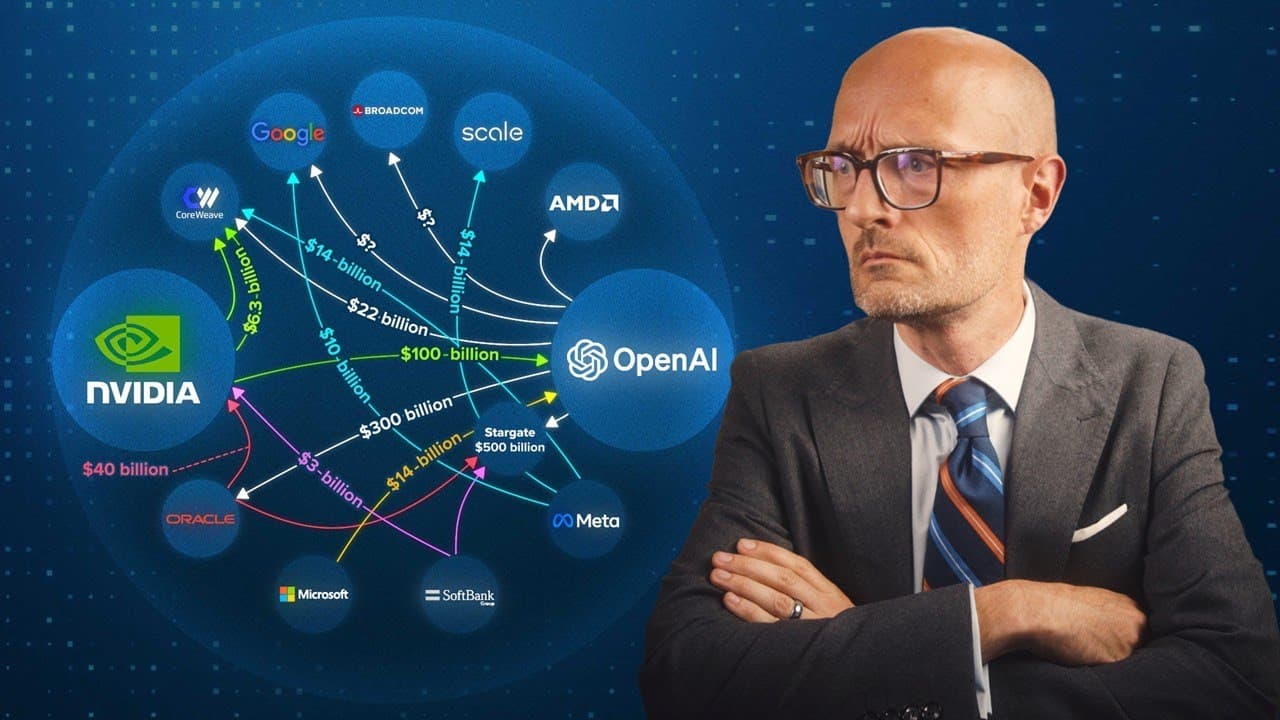
The companies at the center of the AI boom have been busy investing billions of dollars in each other. I'm sure you've seen the spaghetti diagrams in the media recently showing how companies like OpenAI are investing in their chip suppliers or how chip manufacturers like Nvidia are investing in their customers, enabling them to buy more chips. I fi... Read More
Key Insights
- Circular AI financing is a structure in which companies invest in suppliers or customers that subsequently purchase their products and services. The arrangement can coordinate the ecosystem, but it may also blur the distinction between independently generated demand and demand supported by strategic capital.
- Nvidia’s CoreWeave relationship illustrates the circularity concern. Nvidia owned about 5% of the chip-rental company and offered to anchor its public offering with a $250 million order at $40 per share when investor interest appeared tepid.
- OpenAI’s infrastructure strategy is built around exceptionally large commitments. Its announced relationships include a $300 billion cloud infrastructure agreement with Oracle, a $10 billion custom-chip partnership with Broadcom, memory commitments representing half of current global capacity according to UBS analysts, and major purchases from Nvidia and AMD.
- The AMD agreement links chip deployment to equity incentives. OpenAI agreed to purchase tens of billions of dollars in AMD chips, while AMD granted it rights to buy 10% of the company’s stock for one cent per share if deployment and share-price conditions are met.
- Amazon’s Anthropic investment creates a commercial loop. Amazon invested more than $8 billion, while Anthropic committed to AWS as its primary cloud provider, using Amazon’s custom AI chips, renting its computing capacity, and integrating Claude into the Bedrock enterprise platform.
- Anthropic’s multicloud strategy connects it financially and operationally with the three largest US cloud providers. Google invested $3 billion and agreed to provide access to as many as one million TPUs, while Amazon pledged $8 billion and Nvidia remains part of the broader infrastructure ecosystem.
- AI infrastructure spending is far ahead of current industry revenue. McKinsey forecasts $5.2 trillion in spending on AI chips, data centers, and energy over five years, while Bain estimates that AI companies would need $2 trillion in annual revenue to justify that investment.
- Electricity is a direct limit on AI expansion. OpenAI says its combined commitments involve 23 gigawatts of new data center capacity costing well over $1 trillion, while some Texas operators are installing on-site gas turbines and exploring nuclear partnerships to avoid delays in obtaining grid connections.
Install to Summarize YouTube Videos and Get Transcripts
Explore YouTube Video Summarizer or Get YouTube Transcript Extractor
Questions & Answers
Q: What is circular financing in the AI industry?
Circular AI financing occurs when companies invest in businesses that use the resulting capital to buy the investors’ products or services. Examples include chipmakers supporting customers that purchase chips and cloud providers investing in AI developers that commit to their infrastructure. These arrangements can align incentives and secure supply, but they can also obscure whether demand is independent, sustainable, and supported by end-user revenue.
Q: Why could circular AI financing inflate a bubble?
Circular financing could inflate a bubble because investment capital may return to the investor as revenue through chip purchases, cloud contracts, or infrastructure commitments. This can make commercial demand appear stronger even when the customer depends on continued external funding. If AI monetization falls short of expectations, interconnected companies could face weaker orders, falling valuations, and costly infrastructure that generates insufficient returns.
Q: How are Nvidia and OpenAI financially connected?
Nvidia pledged up to $100 billion of investment in OpenAI, while OpenAI plans to buy millions of Nvidia AI graphics cards. The relationship gives Nvidia exposure to a major customer while helping that customer finance infrastructure purchases. It also demonstrates the circularity under scrutiny because the chip supplier’s investment can support demand for the same chips that generate its revenue.
Q: How does the OpenAI and AMD agreement work?
OpenAI agreed to purchase tens of billions of dollars of AMD chips. In return, AMD gave OpenAI the right to buy 10% of AMD’s stock for one cent per share, subject to AMD reaching specified share-price targets and OpenAI deploying the chips. The structure connects product purchases, operational deployment, and equity value, giving OpenAI a financial interest in AMD’s market performance.
Q: Why is Amazon’s investment in Anthropic considered circular?
Amazon invested more than $8 billion in Anthropic, and Anthropic committed to using Amazon as its primary cloud provider. Anthropic trains and runs models on Amazon’s custom AI chips, rents computing capacity from AWS, and integrates Claude into Amazon Bedrock. Amazon is therefore funding a company that purchases its infrastructure services, uses its chips, and helps support its enterprise AI platform.
Q: How much infrastructure spending could the AI boom require?
McKinsey estimates that chips, data centers, and energy for projected AI workloads will require $5.2 trillion in capital expenditure over five years. Traditional information technology data centers are expected to require another $1.5 trillion, bringing projected total data center spending close to $7 trillion. Bain says AI companies would need $2 trillion in annual revenue to justify the investment.
Q: Why is electricity a major constraint on AI data centers?
AI expansion requires data centers with power needs measured in gigawatts. OpenAI’s announced commitments total 23 gigawatts of new capacity, which it says will cost well over $1 trillion to develop. In Texas, rapidly rising electricity demand has led some operators to install on-site gas turbines and explore nuclear partnerships because conventional grid connections may not become available quickly enough.
Q: What happens if AI revenue does not justify the planned spending?
If AI revenue and profitability remain too low, companies may be unable to earn adequate returns on chips, data centers, cloud capacity, and energy infrastructure. OpenAI currently has about $13 billion in revenue, while Bain estimates that the industry needs $2 trillion annually to justify planned spending. A shortfall could reduce orders, expose financial interdependencies, and leave expensive infrastructure underused or stranded.
Summary & Key Takeaways
-
OpenAI, Nvidia, Amazon, Google, Anthropic, AMD, Oracle, Broadcom, and CoreWeave are linked through investments, chip purchases, cloud commitments, and infrastructure agreements. These relationships can strengthen supply chains and distribute risk, but they can also make customer demand appear stronger when suppliers or investors are helping finance the purchases.
-
The infrastructure ambitions are enormous. OpenAI has committed to 23 gigawatts of new data center capacity that it says will cost well over $1 trillion, while McKinsey forecasts $5.2 trillion of AI-related spending on chips, data centers, and energy over five years. Electricity availability is becoming a central constraint.
-
The core risk is that AI revenue and profitability may not grow quickly enough to support the planned investment. Bain estimates that AI companies need $2 trillion in annual revenue to justify the spending, while OpenAI currently has about $13 billion. If expectations disappoint, interconnected financing could amplify losses and create stranded assets.
Read in Other Languages (beta)
Share This Summary 📚
Summarize YouTube Videos and Get Video Transcripts with 1-Click
Try YouTube Summary with ChatGPT & Claude or YouTube Transcript Generator
Explore More Summaries from Patrick Boyle 📚






Summarize YouTube Videos and Get Video Transcripts with 1-Click
Try YouTube Summary with ChatGPT & Claude or YouTube Transcript Generator