Why Is OpenAI's GPT-o1 a Game-Changer? 10 Must-Know Uses (OpenAI Demo)
TL;DR
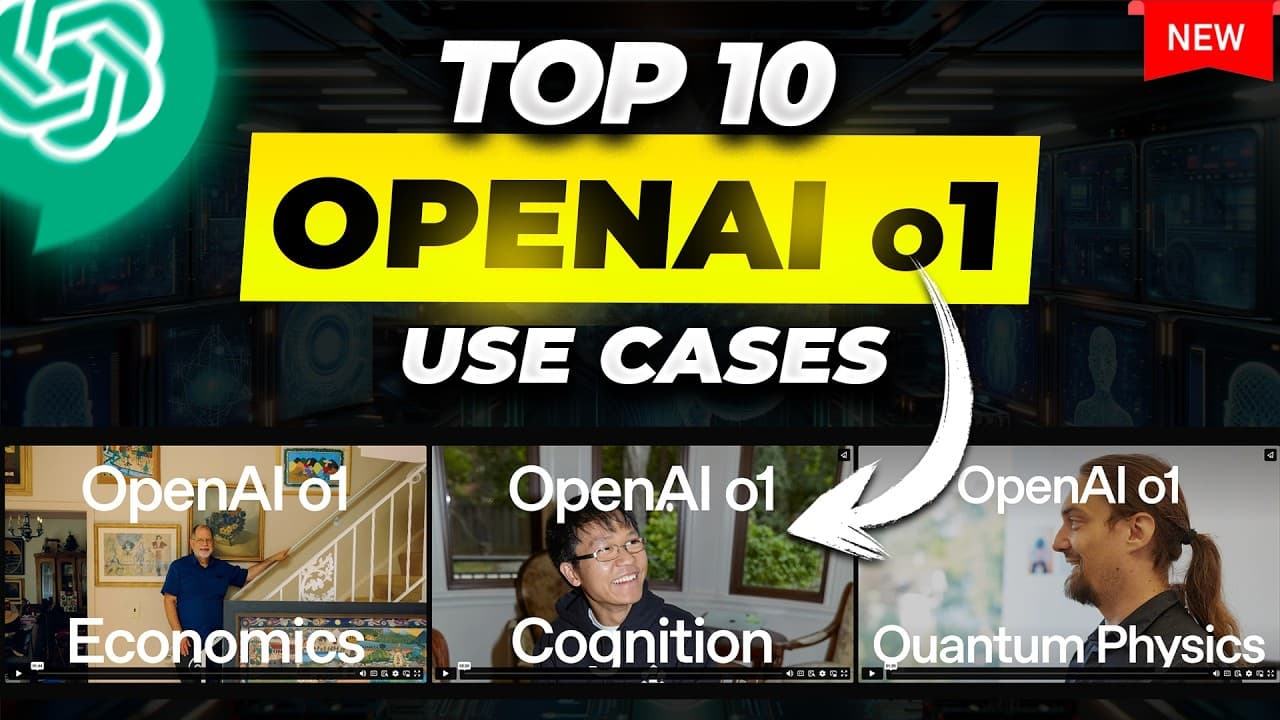
OpenAI o1 improves complex reasoning by thinking before answering, which helps it plan solutions, check constraints, and reconsider errors. In the demonstrations, o1 correctly counts three Rs in “strawberry,” plans a working Squirrel Finder game after thinking for 21 seconds, and helps Devin adapt when browser retrieval fails. Read on to see how the same reasoning supports programming, research, and language decoding.
Transcript
open AI just released two brand new models inside of chat GPT that are great at reasoning they're going to be good at math much better than any model that's ever been released and they're also good at programming and in this video I wanted to show you all the different examples that open AI actually published on their website I pulled them out and ... Read More
Key Insights
- OpenAI o1 is a reasoning model that thinks before presenting its final answer. The demonstrations suggest that this additional processing helps the model plan solutions, review details, fit stated constraints, and avoid mistakes that can occur when a model responds without an explicit reasoning phase.
- Character counting is difficult for models that process text as subword units rather than directly as individual characters or complete words. GPT-4o incorrectly reports two instances of the letter R in “strawberry,” while o1 preview reviews the task and correctly identifies three.
- Code generation benefits from planning the program before writing the final output. For the Squirrel Finder game, o1 preview thinks for 21 seconds, organizes the layout and instructions, then produces code with a controllable koala, bouncing strawberries, a squirrel objective, and working win and loss behavior.
- Autonomous programming requires more than generating code line by line. A software agent must also interpret logs, navigate systems, run commands, use external services, and make decisions when conditions change, which makes humanlike reasoning valuable for completing tasks from start to finish.
- Devin adapts its plan when an initial method fails. During a sentiment-analysis task, the agent encounters trouble retrieving a tweet through the browser, switches to an API, uses multiple machine-learning services, and ultimately identifies happiness as the tweet's predominant emotion.
- Reasoning-assisted chat can accelerate genetic research by synthesizing information that would otherwise require reviewing multiple articles separately. A Boston Children's Hospital geneticist uses it to investigate rare cases, connect genetic and phenotypic observations, and increase the proportion of research paths that produce useful information.
- Genetic variant analysis can require consideration of opposing biological effects. In the bladder-pain case, the reasoning response notes that a variant could decrease an activity or cause too much activity, giving the researcher both possibilities to evaluate instead of assuming only one mechanism.
- Corrupted Korean translation works when the model recognizes decoding as the underlying task. O1 preview examines unnatural transformations of vowels and consonants, reconstructs decipherable portions, and then translates the recovered message, while GPT-4o responds that it cannot understand the invalid-looking text.
Install to Summarize YouTube Videos and Get Transcripts
Explore YouTube Video Summarizer or Get YouTube Transcript Extractor
Questions & Answers
Q: What is OpenAI o1 designed to do?
OpenAI o1 is designed to reason through problems before producing a final answer. The demonstrations show it handling mathematics, programming, careful text analysis, scientific research, and language decoding by examining details and planning its approach.
Q: How does OpenAI o1 improve complex reasoning?
O1 spends time thinking before answering, allowing it to plan a solution, inspect details, and check whether its response satisfies the stated constraints. This process helps it avoid mistakes and recognize underlying tasks, such as decoding corrupted text before translating it.
Q: Why did GPT-4o miscount the letter R in “strawberry”?
The transcript explains that models like GPT-4o process text as units between characters and words, sometimes called subwords, rather than inspecting every character directly. GPT-4o reported two Rs, while o1 preview reviewed the spelling and correctly identified three.
Q: How does o1 improve code generation?
O1 plans the structure of a program before providing the final code and checks the prompt’s constraints during that process. For the Squirrel Finder game, it thought for 21 seconds and produced a playable game with a controllable koala, bouncing strawberries, instructions, and win-and-loss behavior.
Q: What happens in the Squirrel Finder demonstration?
The player moves a koala with the arrow keys while strawberries spawn every second and bounce around the screen. A squirrel appears after 3 seconds, and the player must reach it without being hit by a strawberry.
Q: How can reasoning help an autonomous software agent?
Reasoning helps an agent plan, select tools, interpret results, and change its approach when an obstacle appears. When Devin could not retrieve a tweet through the browser, it switched to an API, used multiple machine-learning services, and identified happiness as the predominant emotion.
Q: How can o1 support rare-disease research?
O1 can synthesize research and help connect genetic findings with patient characteristics. In the example, a Boston Children’s Hospital geneticist uses reasoning-assisted chat to investigate rare cases, consider information across about 20,000 genes, and pursue more useful research paths.
Q: How did o1 translate the corrupted Korean sentence?
O1 recognized that the sentence needed to be decoded before it could be translated. It examined altered vowels and consonants, reconstructed decipherable parts of the Korean text, and produced an accurate English interpretation after thinking for 15 seconds.
Summary & Key Takeaways
-
OpenAI introduced two reasoning-focused models in ChatGPT for tasks involving mathematics, programming, and careful analysis. Unlike GPT-4o in the demonstrations, o1 preview spends time thinking before answering. That process helps it inspect details, plan its approach, satisfy constraints, and reduce errors on problems that initially appear simple or unrelated to formal reasoning.
-
Programming demonstrations show o1 planning code structure before generating a complete game and improving the decisions made by Devin, Cognition's autonomous software agent. Devin creates plans, uses tools, interprets results, and changes its approach after obstacles. In one example, it switches from a browser to an API while analyzing a tweet's sentiment.
-
Scientific and language demonstrations highlight broader applications of deliberate reasoning. A geneticist uses reasoning-assisted chat to synthesize research and consider multiple effects of a genetic variant. In another test, o1 recognizes that corrupted Korean requires decoding before translation, reconstructs the altered text, and returns an accurate English interpretation after thinking for 15 seconds.
Read in Other Languages (beta)
Share This Summary 📚
Summarize YouTube Videos and Get Video Transcripts with 1-Click
Try YouTube Summary with ChatGPT & Claude or YouTube Transcript Generator
Explore More Summaries from Skill Leap AI 📚





Summarize YouTube Videos and Get Video Transcripts with 1-Click
Try YouTube Summary with ChatGPT & Claude or YouTube Transcript Generator