How Are College Students Using AI on Campus?
TL;DR
Students use AI most effectively when it reinforces their own thinking, such as clarifying lecture slides, giving assignment feedback, supporting research, or turning ideas into prototypes. The central risk is allowing AI to complete quizzes and assignments without meaningful engagement, especially while university policies remain inconsistent and students must often decide for themselves where useful assistance becomes overreliance.
Transcript
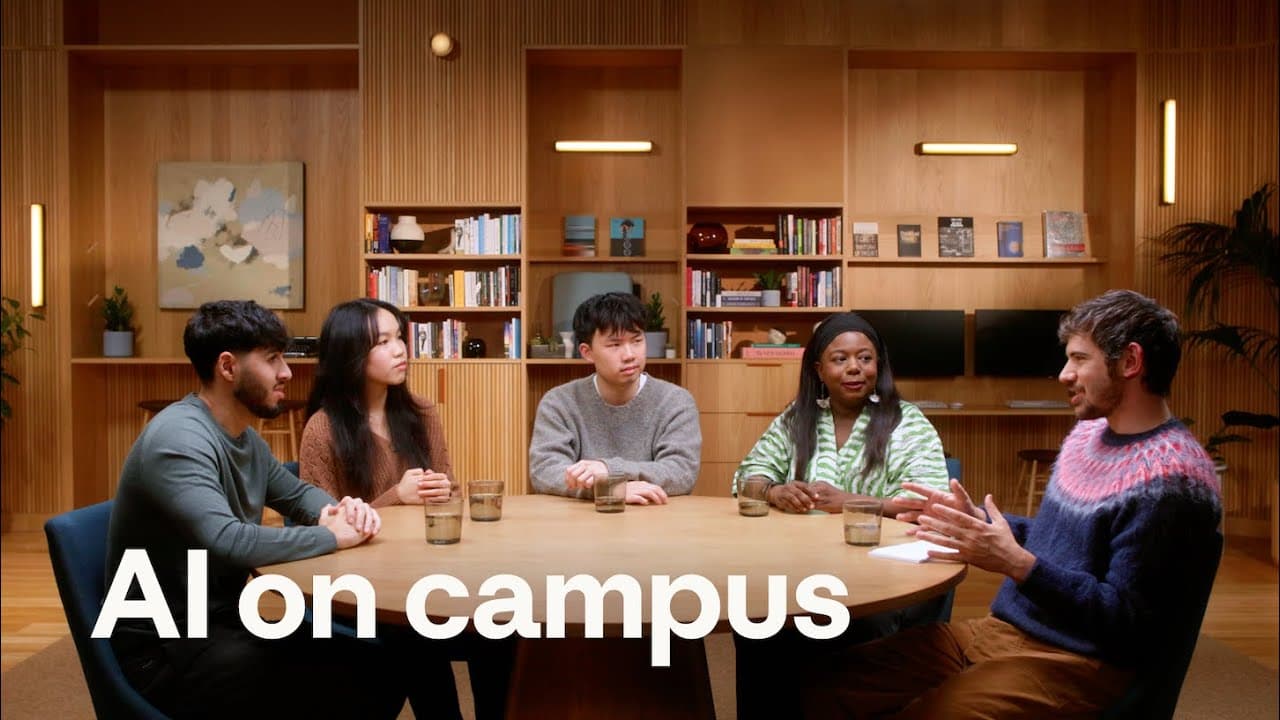
- I think AI and especially how students use AI, it's very telling of those motivations. You know, there are some students who are using it to complete work for them, you know, to do it on their behalf. And there are some students who, you know, are staying away from AI, or using it proactively. They're using it in ways that reinforce their learnin... Read More
Key Insights
- AI use is widespread among the students represented in the discussion, with one panelist reporting that 90% of surveyed students used it in daily workflows and others estimating that nearly everyone on their campuses used AI in some form.
- University AI policy is inconsistent across courses, since some instructors ban or discourage the technology while others encourage experimentation. This leaves students in a gray area where acceptable assistance and prohibited delegation may not always be clearly defined.
- AI can reinforce learning by summarizing lectures, answering questions, providing feedback on written assignments, adding missing context to slides, and supplying definitions. These uses help students engage with course material without necessarily replacing their own reasoning.
- AI can become a crutch when students use it to finish quizzes, solve assignments on their behalf, or avoid thinking. The panel connected this behavior to limited time, unclear boundaries, and the difficulty of maintaining personal accountability.
- AI coding assistance lowers the barrier to building software for students without traditional computer science backgrounds. Panelists described newcomers using terminals, creating websites, and developing working prototypes within days with tools such as Claude Code and developer documentation.
- Student-built AI projects often address immediate campus needs, including lecture-slide annotations, alerts when course seats become available, lists of free classrooms, and a gamified graduation bucket list. The examples began with practical or emotional insights rather than technical complexity.
- Attitudes toward AI differ by discipline, with some humanities students opting out because their work emphasizes close reading, while social science students are gradually experimenting. Engineering and computer science students may use AI outside class even when instructors discourage it during coursework.
- Responsible AI use is an individual responsibility as well as an institutional challenge. The panel argued that students should choose applications that advance their own goals and learning, particularly while professors and university administrations continue reconsidering classroom rules.
Install to Summarize YouTube Videos and Get Transcripts
Explore YouTube Video Summarizer or Get YouTube Transcript Extractor
Questions & Answers
Q: How are college students using AI in their studies?
College students described using AI to summarize lectures, answer questions, work through problem sets, analyze business cases, conduct market and financial research, and receive feedback on written assignments. One student also built a tool that adds professor-style annotations, definitions, and context beside lecture slides. These applications can support revision and understanding when students remain engaged with the material.
Q: When does AI become a crutch for students?
AI becomes a crutch when it completes work on a student's behalf and removes the thinking that the assignment was designed to develop. The panel mentioned students using AI to complete quizzes quickly, submit answers, or feed entire tasks into a chatbot. This is especially concerning in graduate education, where students are expected to strengthen critical thinking and decision-making.
Q: Why are university AI rules confusing for students?
University AI rules are confusing because policies differ between institutions, courses, and professors. Some courses ban AI, other courses encourage it, and some engineering or computer science classes block AI features even though students use coding assistants for projects outside class. This inconsistency leaves students uncertain about which uses count as legitimate support and which count as overreliance.
Q: How does AI help non-programmers build software?
AI coding tools make terminals, raw code, and software development more approachable for students without computer science backgrounds. The panel described students in psychology, political science, mathematics, and other fields moving from an idea to a working website or application within days. At LSE, student societies were also building more informative websites because Claude Code made development easier and friendlier.
Q: What AI projects are students building on campus?
Students are building tools around concrete academic and campus needs. Examples included a system that annotates lecture slides, an application that alerts students when a place opens in a full course, and a tool that identifies free classrooms. A Princeton team also created a gamified graduation bucket list with a leaderboard, using a shared student experience as its central idea.
Q: How do student attitudes toward AI differ by subject?
Student attitudes exist on a spectrum. The panel observed that some humanities students have opted out of AI, partly because their classes and research emphasize close reading. Some social science students are beginning to experiment with broader applications. Computer science and engineering students may use AI coding assistance for independent projects while avoiding it in classes where professors discourage its use.
Q: What is the responsible way for students to use AI?
Responsible AI use means selecting applications that reinforce learning and help achieve a student's own goals without outsourcing the essential intellectual work. The panel highlighted summarization, feedback, contextual explanations, research support, and project development as constructive possibilities. Students still need resilience and accountability, particularly when policies are unclear and submitting AI-produced answers would bypass critical-thinking practice.
Q: Are professors and universities keeping pace with student AI use?
The discussion portrays professors and administrations as still determining AI's classroom role. Students are already using chatbots across academic workflows, but institutional responses range from bans to encouragement. Some technical courses continue blocking AI features, while Stanford was cited as beginning a course about using AI tools in software development and engineering. The panel expected classroom practices to continue shifting.
Summary & Key Takeaways
-
AI use is already widespread across the campuses represented by the panel. Students described using chatbots to summarize lectures, answer questions, analyze business cases, conduct market and financial research, review assignments, and solve problem sets. However, courses and professors differ sharply, with some encouraging AI and others banning or discouraging it.
-
AI tools are making software creation more accessible to students without computer science backgrounds. Panelists described students becoming comfortable with terminals, building society websites, and moving from an idea to a working website or application within days. Their clubs have produced tools for studying, course registration alerts, campus activities, and locating free classrooms.
-
The panel distinguished between AI as a learning partner and AI as a substitute for effort. Useful applications provide context, anticipate questions, support research, and help students create projects. Harmful applications include submitting AI-generated quiz answers or delegating all thinking. Because formal guidance remains unsettled, students must actively protect their critical-thinking development.
Read in Other Languages (beta)
Share This Summary 📚
Summarize YouTube Videos and Get Video Transcripts with 1-Click
Try YouTube Summary with ChatGPT & Claude or YouTube Transcript Generator
Explore More Summaries from Anthropic 📚




Summarize YouTube Videos and Get Video Transcripts with 1-Click
Try YouTube Summary with ChatGPT & Claude or YouTube Transcript Generator