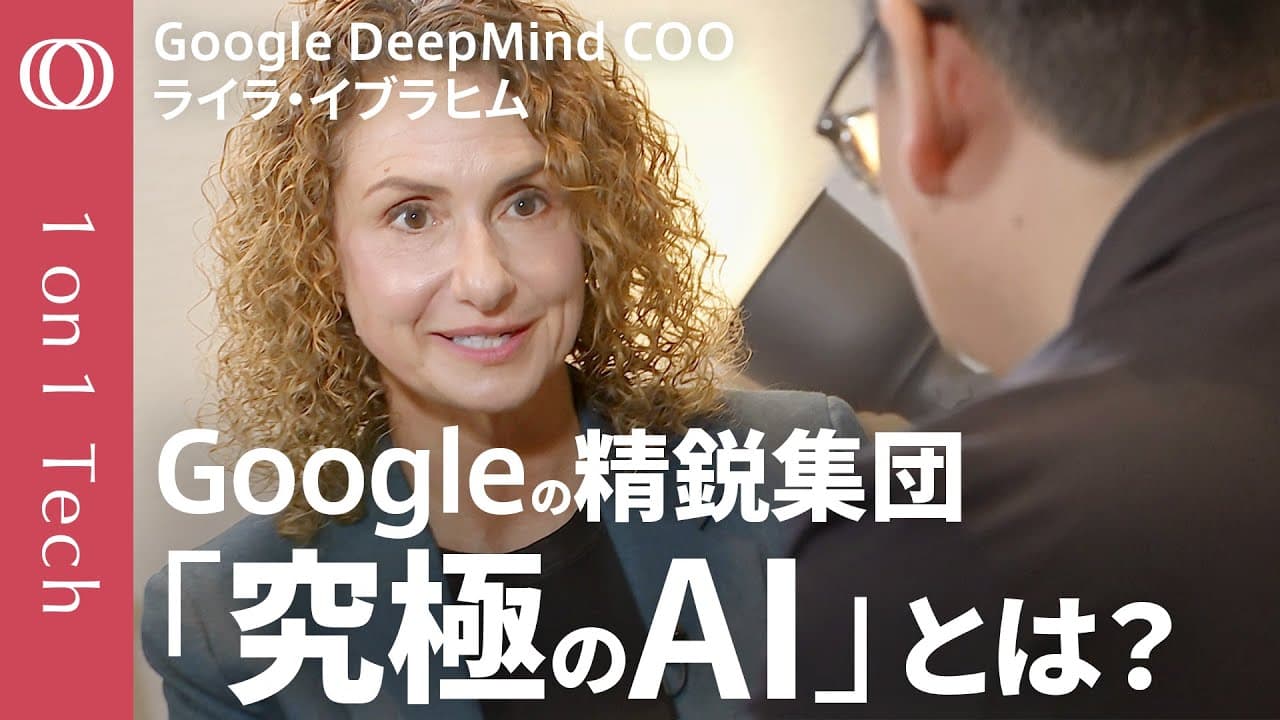
How Will Gemini Become a Universal AI Assistant?
TL;DR
Gemini is being developed as a multimodal, context-aware universal assistant that can understand language, images, video, audio, and code. Google DeepMind is prioritizing factuality, reasoning, memory, accessibility, and internationalization, while delaying broad release of agent capabilities until concerns about permission, privacy, and responsible action have been addressed carefully.
Transcript
One deep minds. So um our media we cover a lot about AI and our viewers is so excited to know where AI goes next or even especially where Gemini goes. goes next. So, how do you describe the current phase of Gemini and what do we expect on the road ahead? Yes. Uh, well, thank you for having me here today. Gemini is our most advanced AI large languag... Read More
Key Insights
- Gemini is Google DeepMind's most general and capable family of large language models, according to the interview. It was developed as a multimodal system from the beginning, allowing language, video, images, code, and audio to function as both inputs and outputs.
- A world model is the stated long-term ambition for Gemini. The goal is to understand surrounding context well enough to serve as a better universal assistant, although progress still depends on advances in memory, contextual understanding, reasoning, factuality, and internationalization.
- Continuous improvement is central to Gemini's development process. Google DeepMind learns from users, companies, academic institutions, and its own work, then uses those inputs to make the system more grounded in reality, more factual, and more responsibly managed.
- AI is already useful for ordinary productivity, creativity, and personalized support. Examples include brainstorming emails, outlining papers, creating birthday cards or books, answering questions from uploaded appliance manuals, and helping parents tailor explanations to children's different learning preferences and interests.
- Long context windows reduce barriers to interacting with AI. Users can provide extensive information in natural language, speak through audio, or submit a picture of a homework assignment, making carefully engineered prompts less necessary for many practical forms of assistance.
- AI agents work by taking permitted actions on a user's behalf. Early applications may include planning travel, making restaurant bookings, researching summer camps, and coordinating family schedules, particularly where people would otherwise spend many hours researching and arranging details.
- Responsible agent deployment requires explicit permission and privacy safeguards. Google DeepMind has shown demonstrations but has not broadly released the technology because action-taking systems create questions about authorization, data access, ethics, and coordination with experts across the wider industry.
- Google DeepMind's faster release pace rests on more than a decade of research and organizational preparation. The combination of maturing technology, interdisciplinary teams, long-term thinking, near-term execution, and the 2023 unification of DeepMind and Google Brain supports faster experimentation and iteration.
Install to Summarize YouTube Videos and Get Transcripts
Explore YouTube Video Summarizer or Get YouTube Transcript Extractor
Questions & Answers
Q: What is Google DeepMind's long-term goal for Gemini?
Google DeepMind wants Gemini to become more like a world model and a universal assistant. That means understanding the context surrounding people, rather than responding only to isolated prompts. Reaching that goal requires further breakthroughs in memory, contextual understanding, reasoning, factuality, and internationalization, even though the organization says the technology has already made substantial progress.
Q: Why was Gemini designed as a multimodal AI system?
Gemini was designed as a multimodal system because people naturally communicate through more than written text. The model can work with language, video, images, code, and audio as inputs and outputs. This design is intended to reduce technological barriers and let people interact with AI through formats that more closely resemble ordinary human communication and everyday problem-solving.
Q: How can people use Gemini and related AI tools in daily life?
People can use these tools to brainstorm emails, prepare outlines, create birthday cards, develop personal books, and receive help with practical household problems. One example involves uploading appliance manuals to NotebookLM and asking questions when a washing machine or dishwasher malfunctions. Parents can also request explanations tailored to a child's learning style, hobbies, and preferred media.
Q: How do long context windows make AI easier to use?
Long context windows allow users to provide much more information without compressing everything into a precisely engineered prompt. They can describe a problem naturally, communicate through audio, upload reference materials, or photograph a homework assignment. This flexibility lowers the interaction barrier because the system can consider a broader body of context before producing guidance or assistance.
Q: What tasks could Google DeepMind's AI agents handle first?
The first agent applications are expected to focus on relatively straightforward tasks performed with user permission. Examples include researching a trip, planning a restaurant visit, completing a booking, finding summer camps, and organizing a family's summer schedule. These tools could reduce hours of research and coordination while keeping the user involved in granting access and approving actions.
Q: Why has Google DeepMind not broadly released its AI agents?
Google DeepMind has limited the technology to demonstrations because agents can take actions, which raises important questions about privacy, access, permission, and user control. The organization says it has worked with ethics researchers and outside experts for years to identify and address these issues. Broad release therefore depends on careful safeguards, not only stronger technical capabilities.
Q: Why has Google DeepMind's AI development pace accelerated?
The recent pace reflects work accumulated over more than a decade, rather than a sudden change in purpose. Google DeepMind says its mission of building AI responsibly to benefit humanity has guided its work for 15 years. As the technology became stable enough for practical experimentation, teams could learn from usage, iterate more quickly, and release improvements at a faster rate.
Q: How did combining DeepMind and Google Brain affect AI research?
DeepMind and Google Brain were brought together organizationally in 2023 after their teams had already collaborated for years. They first joined efforts to develop Gemini, whose name refers to twins. The combined organization gained one mission and enough people to structure dedicated teams around Gemini, generative models, foundational research, frontier research, robotics, concepts, reasoning, and scientific work.
Summary & Key Takeaways
-
Gemini was designed as a general, multimodal model that accepts language, images, video, audio, and code as inputs and outputs. Google DeepMind wants it to evolve into a world model and universal assistant, but further advances in memory, contextual understanding, reasoning, factuality, and internationalization remain necessary.
-
People already use AI for practical and creative assistance, including brainstorming emails, outlining papers, creating personal projects, troubleshooting household equipment through uploaded manuals, and adapting lessons for children with different interests and learning styles. Long context windows and natural multimodal interaction reduce the need to construct precisely engineered prompts.
-
Google DeepMind expects agents to begin with bounded tasks such as researching trips, booking restaurants, and organizing family schedules. Broad deployment remains limited because action-taking systems require clear user authorization, privacy protections, and ethical safeguards. The organization combines long-term research, interdisciplinary collaboration, rapid iteration, and one shared responsible-AI mission.
Read in Other Languages (beta)
Share This Summary 📚
Summarize YouTube Videos and Get Video Transcripts with 1-Click
Try YouTube Summary with ChatGPT & Claude or YouTube Transcript Generator
Explore More Summaries from TBS CROSS DIG with Bloomberg 📚





Summarize YouTube Videos and Get Video Transcripts with 1-Click
Try YouTube Summary with ChatGPT & Claude or YouTube Transcript Generator