How to Turn Obstacles Into Paths to Success
TL;DR
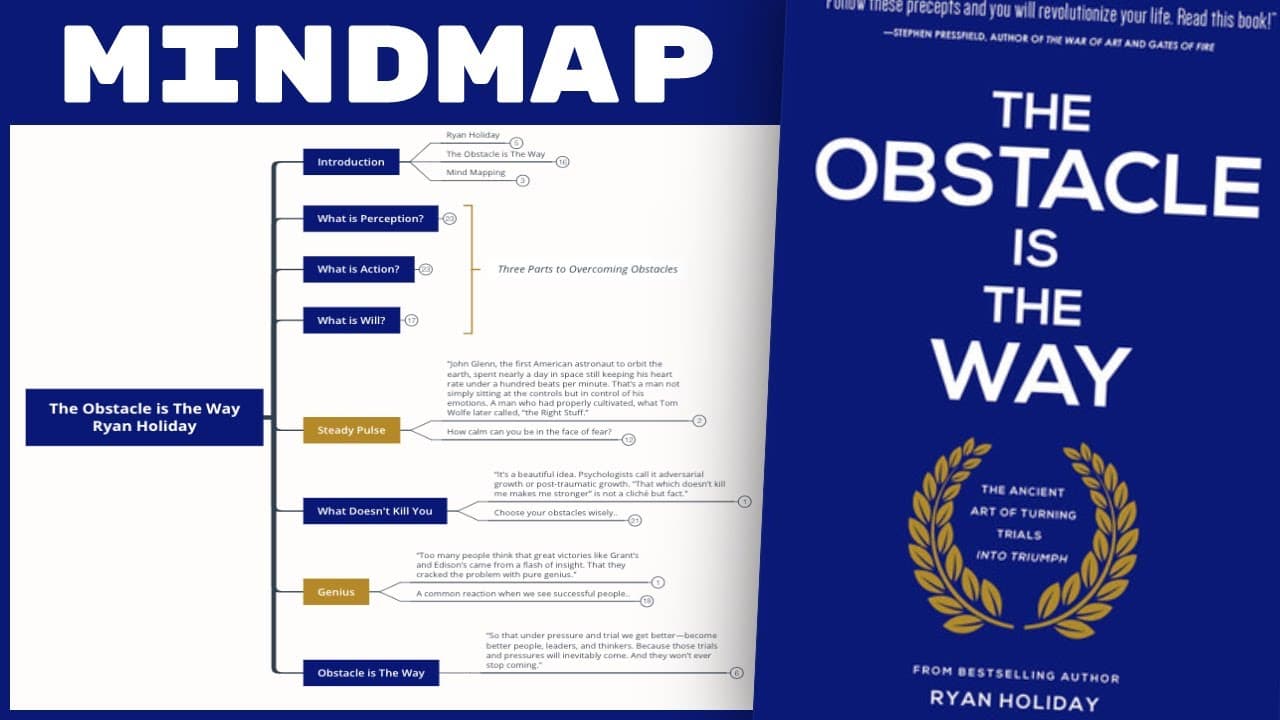
Treat obstacles as opportunities to strengthen your judgment, recommit to your goals, and take purposeful action. Progress depends less on avoiding adversity than on perceiving it calmly, separating facts from fear and prejudice, and responding with deliberate, bold, persistent steps that serve the larger objective instead of producing only short-term activity.
Transcript
hello mind mappers and welcome to the video today we're going to be going over the obstacle is the way by Ryan holiday one of my absolute favorite authors this book is going to be perfect for you if you are struggling with almost anything in your life whether you're struggling to get more into fitness whether you're struggling in business or whethe... Read More
Key Insights
- Obstacles are unavoidable tests that can become sources of improvement. The central choice is whether to remain blocked by adversity or advance through it, using each challenge to develop greater capability, commitment, and readiness for future difficulties.
- Success depends heavily on attitude toward obstacles, not only on aptitude. Even a highly capable person may fail to progress if they are unwilling to continue through repeated setbacks, while adversity can strengthen someone who responds with persistence and constructive effort.
- Perception is the meaning assigned to events occurring around us. When perception becomes emotional, subjective, fearful, or shortsighted, it adds difficulty, but disciplined observation can separate reliable facts from prejudice, expectations, and deceptive signals.
- Calm judgment is an advantage when facing difficulty. Seeing an event straightforwardly, without immediately labeling it good or bad, reduces the control of fear and excitement and creates room to identify practical options that emotional reactions may conceal.
- A useful response to an obstacle is to search for solutions instead of excuses. Asking how the problem may be less severe than it appears, how it might help, and how it can renew commitment shifts attention toward available action.
- An outside perspective can reveal opportunities hidden by personal involvement. Someone who has encountered similar obstacles may recognize possibilities that the person inside the problem cannot see because fear, assumptions, or frustration are shaping the interpretation.
- Effective action is deliberate, bold, persistent, flexible, and directed toward the larger goal. Activity alone is insufficient because busy work can consume effort without dismantling the actual obstacle or advancing the outcome that matters.
- Strategies protect long-term objectives, while tactics may offer faster but temporary results. Cold outreach can quickly produce an answer yet damage reputation, whereas building a trusted partnership and providing valuable material takes longer but supports credible positioning.
- Related book: The Obstacle Is the Way
- Export your Kindle highlights to Glasp: How to Download Highlights and Notes from Kindle
- More videos about this book:
- More videos with Ryan Holiday:
Install to Summarize YouTube Videos and Get Transcripts
Explore YouTube Video Summarizer or Get YouTube Transcript Extractor
Questions & Answers
Q: How can obstacles become a path to success?
Obstacles can become a path to success when they are treated as opportunities to improve judgment, persistence, and commitment. Instead of asking how to avoid every difficulty, ask what the situation can teach, how it might strengthen the goal, and which practical step would move progress forward. The challenge itself can leave a person better prepared than if no adversity had occurred.
Q: What does perception mean when facing an obstacle?
Perception is how a person sees, understands, and assigns meaning to events. It can become a source of strength or weakness. Emotional, subjective, fearful, or shortsighted interpretations add trouble to the original problem. A disciplined response filters out prejudice, expectations, and fear so the obstacle can be examined calmly and straightforwardly, without immediately judging it as good or bad.
Q: How can I change my perception of a difficult situation?
Begin by separating the observable facts from the assumptions and emotions attached to them. Ask how the obstacle may be less severe than it currently appears, how it might contain an opportunity, and how it could help renew commitment to the goal. Looking for solutions rather than excuses, or requesting an outside perspective, can expose options that fear or frustration concealed.
Q: Why is an outside perspective useful for solving problems?
An outside observer is less entangled in the emotions, expectations, and assumptions surrounding a problem. Someone who has encountered similar challenges may recognize an opportunity where the affected person sees only a barrier. Their perspective can help reframe the obstacle, uncover possible solutions, and show how moving through the difficulty may strengthen commitment to the original goal.
Q: What is the difference between action and effective action?
Action is simply doing something, while effective action is deliberately directed toward the larger objective. Productive action combines deliberation, boldness, persistence, flexibility, courage, and creative application. Mere activity can create busyness without progress. Effective action instead breaks the obstacle down step by step and ensures that each movement serves the whole goal rather than producing motion for its own sake.
Q: How should I take action when facing an obstacle?
Act through deliberate, bold, and persistent steps that directly serve the desired outcome. Remain flexible enough to change methods when brute force is ineffective, and use creativity rather than acting rashly. The purpose is not to perform random tasks or wait for the problem to disappear. It is to dismantle the obstacle through focused decisions and repeated, goal-aligned action.
Q: What is the difference between a strategy and a tactic?
A strategy is described as a time-tested, results-driven framework for action that does not sacrifice the long term for the short term. A tactic is a specific method that may produce quick results but can fade or leave lasting damage. Effective action uses tactics in service of a broader strategy, while protecting trust, reputation, and the larger objective.
Q: Why can cold calling be a risky business tactic?
Cold calling or cold emailing can quickly produce a yes or no from prospective clients, but its speed may come at the expense of tact and reputation. Repeatedly contacting an entire market without first offering value can cause people to remember the business mainly for unsolicited outreach. If conversions are weak, that damaged reputation may remain after the immediate campaign ends.
Summary & Key Takeaways
-
Obstacles are inevitable in business, fitness, careers, and everyday life, but they do not have to prevent progress. The central mindset is to view adversity as a route toward improvement. Challenges can reveal character, deepen commitment, and leave a person better prepared than if the difficulty had never appeared.
-
Perception determines how people interpret events and what meaning they assign to them. Emotional, subjective, fearful, or shortsighted judgments can make difficulties worse. Calmly filtering out prejudice, expectations, and fear helps expose the facts, making it easier to identify solutions, opportunities, and useful perspectives within an obstacle.
-
Effective action is directed toward the larger goal and differs from mere activity. Obstacles are dismantled through deliberate, bold, persistent steps combined with flexibility and creativity. Long-term, proven strategies should guide short-term tactics, because fast results can carry lasting costs, including damage to trust or reputation.
Read in Other Languages (beta)
Share This Summary 📚
Summarize YouTube Videos and Get Video Transcripts with 1-Click
Try YouTube Summary with ChatGPT & Claude or YouTube Transcript Generator
Explore More Summaries from Ethan Schwandt 📚
Summarize YouTube Videos and Get Video Transcripts with 1-Click
Try YouTube Summary with ChatGPT & Claude or YouTube Transcript Generator