How to Turn Obstacles Into Paths Forward
TL;DR
See obstacles clearly, extract the information they contain, and respond with intelligent, persistent action. Stoic resilience rests on three disciplines: perception removes fear-driven distortion, action adapts instead of relying on brute force, and will accepts the present as the only material available for moving forward.
Transcript
Marcus Aurelius ruled the most powerful empire on earth. He faced plague, war, and betrayal. And he left behind one line that changes how you see every problem you have. There is a moment somewhere in the middle of a life when everything stops making sense. Not dramatically, not all at once, just quietly. The way light fades before you notice it's ... Read More
Key Insights
- Perception is the discipline of seeing an obstacle without allowing fear, habit, or prior disappointment to define its meaning. It is not positive thinking or denial. It separates what is actually happening from the emotionally convincing story the mind rapidly builds around the event.
- The mind is highly skilled at turning an initial negative verdict into a larger narrative. It collects past failures and future fears as evidence, making interpretation feel like objective reality. Recognizing this process allows a person to look around the feeling instead of automatically following it.
- Self-watchfulness is the ongoing practice of noticing the mind's activity and declining to be swept away by it. The Stoics used this practice to distinguish emotional noise from useful information, even when the distortion felt completely true and the underlying situation remained genuinely serious.
- An obstacle seen clearly is a problem rather than a sentence. Removing emotional distortion does not make the problem unreal or insignificant. It changes the problem from a verdict about one's life into a specific situation that can be examined, understood, and navigated.
- Every obstacle contains information about the path, assumptions, or methods that produced the difficulty. A failed business can reveal a misread market, a collapsed relationship can expose repeated patterns, and a closed door can prompt reconsideration of whether that route was appropriate.
- Effective action is clarity in motion. It involves seeing the obstacle, understanding what it contains, and then moving deliberately. The quality of the response matters because accurate understanding alone produces little change unless it leads to suitable action in difficult, imperfect conditions.
- Direct force is often an inefficient response because a frontal assault can create more resistance and strengthen the obstacle. Sophisticated action adapts its route, applying intelligence and persistence instead of assuming that willpower and pressure must always overcome resistance.
- Love of fate is acceptance of the present moment as the only available material for action. It is not passive surrender. It prevents energy from being consumed by wishing circumstances were different, leaving that energy available for adapting, persisting, and finding a workable path.
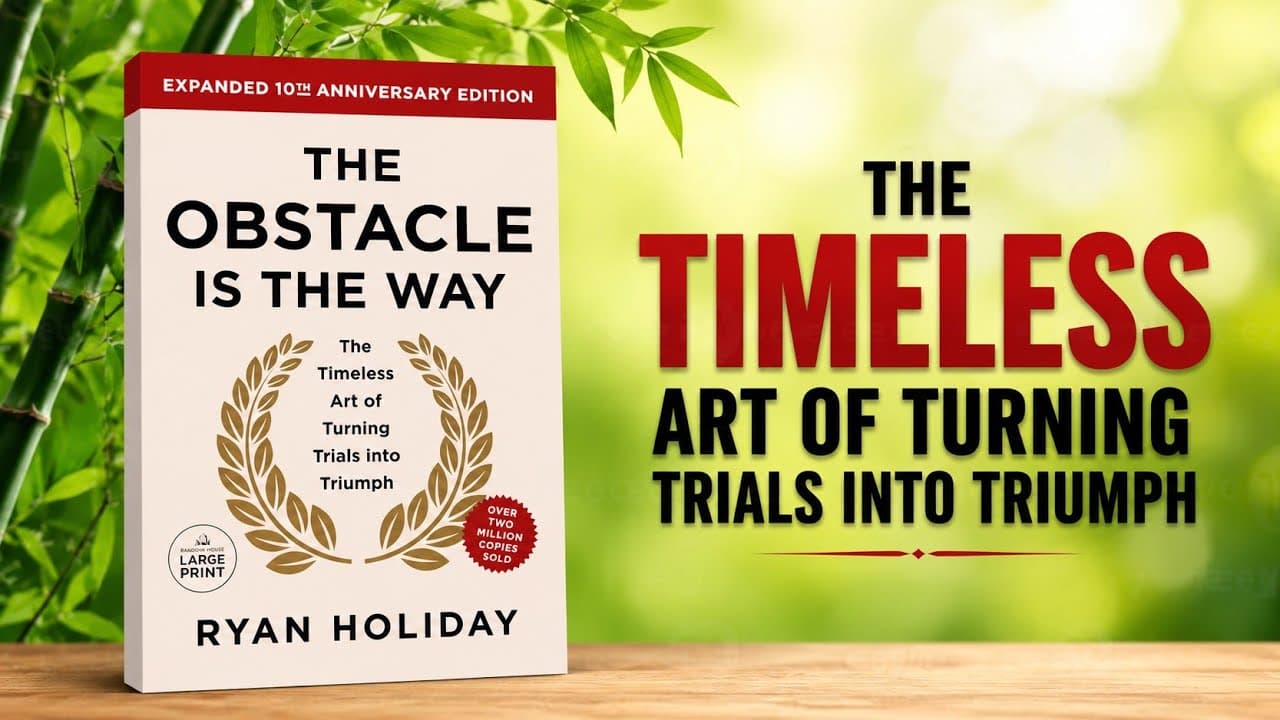
- Related book: The Obstacle Is the Way
- Export your Kindle highlights to Glasp: How to Download Highlights and Notes from Kindle
- More videos about this book:
- More videos with Ryan Holiday:
Install to Summarize YouTube Videos and Get Transcripts
Explore YouTube Video Summarizer or Get YouTube Transcript Extractor
Questions & Answers
Q: How can an obstacle become the way forward?
An obstacle can become the way forward when it is treated as part of the path rather than as proof that progress is impossible. Clear perception reveals what the obstacle says about previous assumptions or methods. Intelligent action then uses that information to change direction, improve the approach, or continue through another route. The response to the barrier becomes the next stage of progress.
Q: What are the three Stoic disciplines for handling difficulty?
The three disciplines presented are perception, action, and will. Perception means seeing events without fear-driven distortion. Action means responding through deliberate, adaptable movement rather than relying only on direct force. Will means accepting the difficult present as the material available for work, instead of wasting energy wishing that reality had unfolded differently.
Q: How does perception help overcome obstacles?
Perception helps by separating the facts of a situation from the story created by fear, habit, and previous disappointment. The mind may immediately label an event catastrophic and gather supporting evidence from past failures and imagined futures. By observing this process, a person can identify the actual problem, recognize the information it contains, and respond without treating emotion as a final verdict.
Q: What is Stoic self-watchfulness?
Stoic self-watchfulness is the continuous practice of observing what the mind is doing without automatically being carried along by it. It allows someone to notice panic, fear, and distorted interpretation as mental activity rather than unquestionable fact. Like a surgeon separating alarming noise from useful signals, the practitioner remains present enough to identify what is actually happening and what action is required.
Q: Why can direct force make an obstacle harder?
Direct force can make an obstacle harder because some forms of resistance grow stronger when attacked head-on. A frontal assault assumes the shortest visible line is also the fastest route, but pressure applied without intelligence may create additional resistance. Adaptable action instead looks for ways around, through, or beneath the barrier while maintaining steady movement toward the underlying objective.
Q: What does water teach about effective action?
Water illustrates action that combines flexibility with persistence. It parts when pushed and flows around an obstacle instead of wasting all its energy on immediate confrontation. Yet continued movement allows it to carve canyons and overcome granite over time. The lesson is that yielding and adapting are not the same as giving up when movement continues with patience and intelligence.
Q: How can failure provide useful information?
Failure can reveal errors in assumptions, patterns, and strategy that were previously hidden. A failed business may expose a market that was misread, while a collapsed relationship may uncover behavior that keeps repeating. Receiving this information requires enough calm to examine what happened before trying to escape the emotional discomfort. Otherwise, the lesson can be missed and the obstacle may return in another form.
Q: What does love of fate mean in Stoic practice?
Love of fate means recognizing that the present moment, including its unwanted difficulty, is the only material available for action. It does not mean approving of every event or refusing to change circumstances. It means ending the struggle against the fact that the moment exists, so energy can be directed toward navigating it, adapting the approach, and continuing to move.
Summary & Key Takeaways
-
Marcus Aurelius faced plague, war, betrayal, personal loss, and an unraveling empire while recording private reminders about how to endure. His central principle was that an impediment can advance action. What blocks progress is not necessarily separate from the path, because responding to it can itself become the path forward.
-
Perception is the discipline of separating observable reality from the frightening story the mind constructs around it. Through self-watchfulness, a person notices emotional distortion without treating it as fact. The obstacle then becomes a problem to navigate rather than a final judgment, revealing information about flawed assumptions, repeated patterns, or ineffective approaches.
-
Action turns clear perception into intelligent movement. Direct force and frontal attacks can intensify resistance, while adaptable persistence finds another route. The image of water captures this method: it yields, flows around barriers, and keeps moving until it reshapes even granite. Accepting present conditions preserves energy for navigating them effectively.
Read in Other Languages (beta)
Share This Summary 📚
Summarize YouTube Videos and Get Video Transcripts with 1-Click
Try YouTube Summary with ChatGPT & Claude or YouTube Transcript Generator