The *Many* Languages of INDIA!
TL;DR
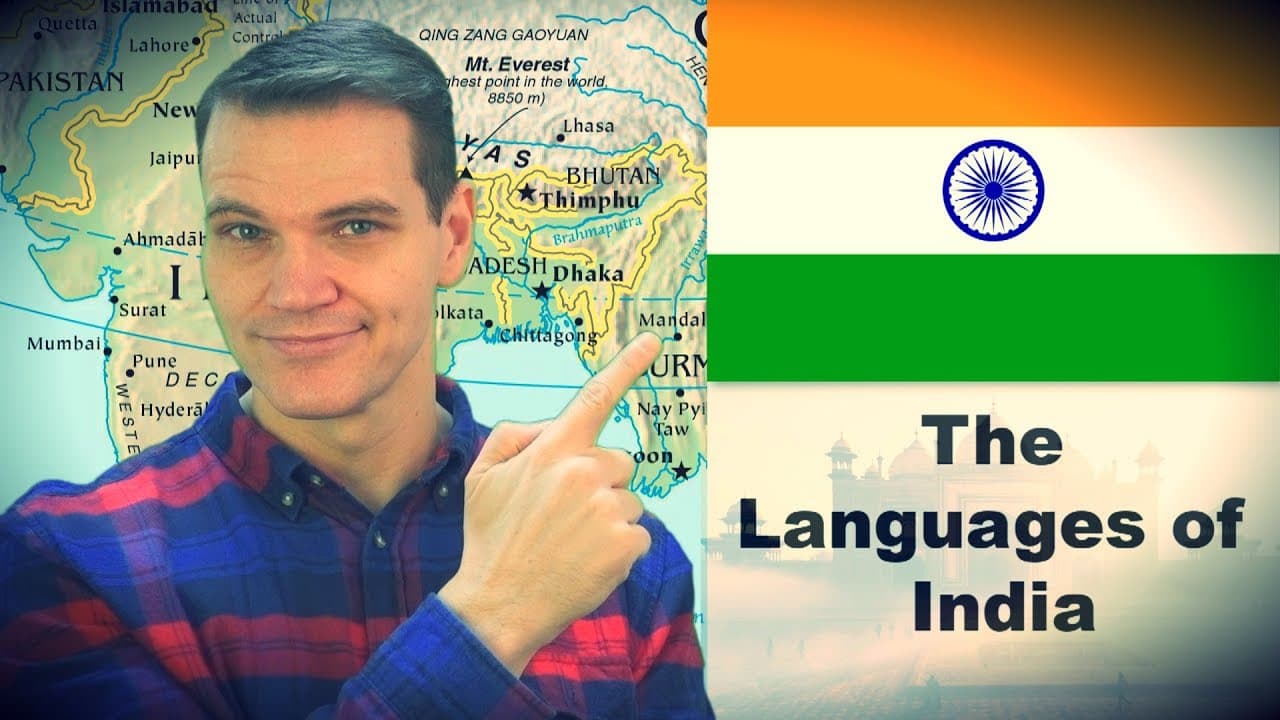
India is home to a vast array of languages and dialects.
Transcript
Hello everyone, welcome to the Langfocus channel and my name is Paul Today we're going to talk about one of the most linguistically diverse countries in the world. That country is India. The exact number of languages spoken among India's 1.3 billion people is hard to pinpoint exactly. Different sources give different numbers, and that's partly beca... Read More
Key Insights
- India is one of the most linguistically diverse countries, with estimates ranging from 448 to 780 languages, depending on classification criteria.
- The Indian Census reported 19,569 language names, later grouped into 1,369 mother tongues and then into 121 languages with over 10,000 speakers.
- India has two national official languages, Hindi and English, and 22 scheduled languages recognized by the government.
- The Indo-Aryan and Dravidian language families are predominant in India, with the former in the north and the latter in the south.
- Dravidian languages are agglutinative, with flexible word order, and have been influenced by Sanskrit, though not directly descended from it.
- The Indo-Aryan languages are descended from Sanskrit, which evolved into Prakrits and then into modern languages like Hindi and Bengali.
- Linguistic influence is mutual; Indo-Aryan languages have influenced Dravidian languages and vice versa, with shared vocabulary and phonetic features.
- Scripts in India are diverse, with each language often having its own script, complicating mutual intelligibility despite common linguistic roots.
Install to Summarize YouTube Videos and Get Transcripts
Explore YouTube Video Summarizer or Get YouTube Transcript Extractor
Questions & Answers
Q: How many languages are spoken in India according to different sources?
The number of languages spoken in India varies according to different sources. Ethnologue reports 448 languages, while the People's Linguistic Survey of India suggests 780 languages. The Indian Census data initially reported 19,569 language names, which were later categorized into 1,369 mother tongues and further grouped into 121 languages with over 10,000 speakers each.
Q: What are the official languages of India?
India has two official languages at the national level: Hindi and English. Additionally, there are 22 scheduled languages recognized and encouraged by the national government. These languages are used in various official capacities and are part of India's rich linguistic heritage.
Q: What is the relationship between the Indo-Aryan and Dravidian languages?
The Indo-Aryan languages, predominant in northern India, are directly descended from Sanskrit and have evolved through Prakrits into modern languages like Hindi and Bengali. Dravidian languages, found in southern India, are agglutinative and have been influenced by Sanskrit but are not directly descended from it. Both language families have influenced each other over time.
Q: What are some characteristics of Dravidian languages?
Dravidian languages are characterized by their agglutinative grammar, which involves adding affixes to a root word to express different grammatical categories. They typically follow a Subject-Object-Verb word order, although this is flexible. Dravidian languages have also been influenced by Sanskrit, particularly in vocabulary used in writing and educated speech.
Q: How has Persian influenced Indian languages?
Persian has had a significant influence on the Indo-Aryan languages, especially in northern India, due to historical Muslim rule. Many everyday words in Hindi have Persian origins. In Urdu, these words appear in their original Persian form due to the use of the Perso-Arabic script. The influence is less pronounced in Dravidian languages.
Q: How do Indians communicate across different language groups?
In India, communication across different language groups often involves the use of Hindi or English as lingua francas. Many Indians are multilingual, and exposure to different languages can lead to mutual intelligibility. In some regions, a local language may serve as the lingua franca. Additionally, social interactions often occur within the same linguistic community.
Q: What role do scripts play in India's linguistic diversity?
Scripts are a crucial aspect of India's linguistic diversity. Each language often has its own script, derived from a common source, yet distinct enough to require separate learning. This diversity adds a layer of complexity to mutual intelligibility among languages, even when they share linguistic roots.
Q: What is the significance of the Indo-Aryan and Dravidian language families in India?
The Indo-Aryan and Dravidian language families are the two major linguistic groups in India. Indo-Aryan languages, descended from Sanskrit, are predominant in northern India, while Dravidian languages are mainly spoken in the south. These families represent the cultural and historical influences that have shaped India's linguistic landscape over millennia.
Summary & Key Takeaways
-
India's linguistic diversity is unparalleled, with estimates of spoken languages varying due to different classification systems. The Indian Census groups languages into 121 with over 10,000 speakers each.
-
Hindi and English are the national official languages, while 22 scheduled languages receive government recognition. The Indo-Aryan languages dominate the north, while Dravidian languages are prevalent in the south.
-
Scripts in India are as diverse as the languages, with each region often having its own script. This diversity poses challenges for mutual intelligibility, despite some shared linguistic roots.
Read in Other Languages (beta)
Share This Summary 📚
Summarize YouTube Videos and Get Video Transcripts with 1-Click
Try YouTube Summary with ChatGPT & Claude or YouTube Transcript Generator
Explore More Summaries from Langfocus 📚



Summarize YouTube Videos and Get Video Transcripts with 1-Click
Try YouTube Summary with ChatGPT & Claude or YouTube Transcript Generator