Eventbrite CEO on the Future of Live Events with Guy Raz | How I Built This | NPR
TL;DR
Virtual events will complement returning small, hyperlocal gatherings by helping established creators preserve communities and reach people beyond local venues. Eventbrite processed more than 8 million virtual-event tickets in April, and 85% of buyers already knew the creator before Covid-19. Read on to see how Eventbrite responded to the pandemic and how Daybreaker reached 30,000 people across 85 countries.
Transcript
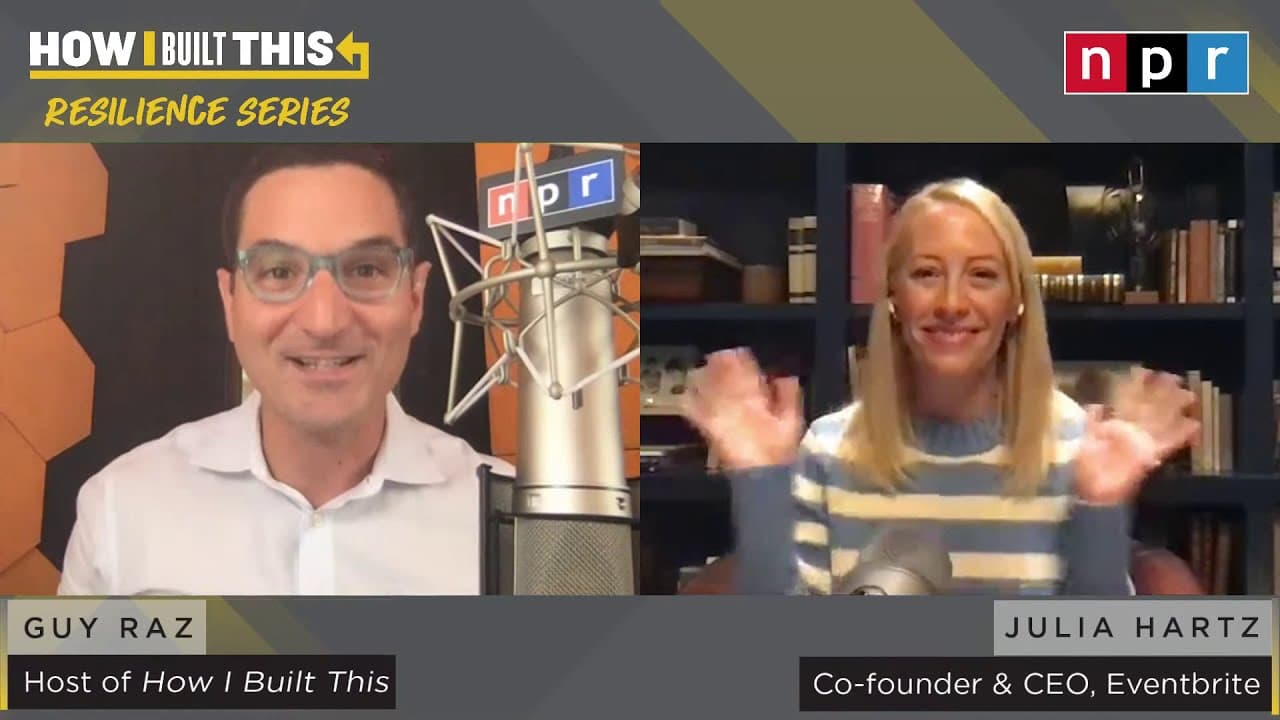
hello and welcome to how I built this resilience edition this is where we talk with founders and entrepreneurs about how they're thinking creatively about their businesses during this very challenging moment and in the box next to me am i pointing that in the right direction yes is Julia Hart she's a co-founder and CEO of Eventbrite Eventbrite mana... Read More
Key Insights
- Eventbrite is a platform that enables people to create in-person or virtual events and gather audiences around live experiences. More than one million creators used the platform, producing over 4.7 million events in the previous year and attracting hundreds of millions of people worldwide.
- Eventbrite’s pandemic response began in late February after two board members with deep business ties to China expressed serious concern. That warning prompted the company to examine how Covid-19 could affect the United States, where approximately two-thirds of its business was produced.
- The direct impact on Eventbrite became visible in the company’s results on March 5. Leadership connected that decline with growing American awareness of the virus, while its earlier preparations provided time to ready employees, creators, and consumers for widespread event disruption.
- Eventbrite’s initial priorities were protecting its team, preparing creators to cancel events, and warning consumers that planned gatherings might not happen. These actions felt unusual in early March, but they addressed the operational consequences that soon confronted the live-events industry.
- Eventbrite’s restructuring cut 45% of the company after leadership concluded that the pandemic would severely affect live events. Julia Hartz said acting decisively was the most humane approach because it allowed the company to support departing employees in seeking new jobs sooner.
- Virtual events grew by multiple thousands of percent on Eventbrite compared with the prior year. The company processed more than 8 million tickets for virtual experiences in April, even while many in-person events were unable to take place.
- Existing relationships were central to virtual-event participation, with 85% of ticket buyers already knowing the creator before Covid-19. This pattern suggests that online events often preserved established communities instead of depending entirely on unfamiliar audiences discovering new creators.
- Daybreaker expanded its dance gatherings through online Saturday-morning rituals, reaching 30,000 people across 85 countries. The example shows how moving an established experience online could extend its geographic reach beyond what a conventional local gathering could accommodate.
Install to Summarize YouTube Videos and Get Transcripts
Explore YouTube Video Summarizer or Get YouTube Transcript Extractor
Questions & Answers
Q: What is the future of live and virtual events?
The interview suggests that virtual experiences and smaller, hyperlocal gatherings can coexist. Online events continued to flourish while some local in-person events began returning, with creators developing the new models that Eventbrite aimed to support.
Q: What does Eventbrite do for event creators?
Eventbrite enables people to create events and gather audiences around live experiences, whether in person or virtual. More than one million creators produced over 4.7 million events on the platform during the previous year, attracting hundreds of millions of people worldwide.
Q: When did Covid-19 begin affecting Eventbrite’s business?
Eventbrite began preparing in late February after two board members with deep business ties to China expressed serious concern. The direct impact became visible in the company’s results on March 5, around the time Americans broadly recognized that the virus was already affecting them.
Q: How did Eventbrite initially respond to the pandemic?
Eventbrite first prepared employees around the world to work from home. It also helped creators prepare to cancel events and warned consumers that gatherings for which they had purchased tickets might not happen as planned.
Q: Why did Eventbrite cut 45% of its workforce?
Leadership concluded that the pandemic would severely affect live events and restructured the company for a worst-case scenario. Julia Hartz said acting decisively was the most humane approach because it enabled Eventbrite to help departing employees seek new jobs sooner.
Q: How much did virtual events grow on Eventbrite?
Virtual events grew by multiple thousands of percent compared with the prior year. Eventbrite processed more than 8 million tickets for virtual experiences in April while many in-person gatherings could not take place.
Q: Why did people buy tickets for virtual events?
Existing trust and community relationships played a central role: 85% of virtual-event ticket buyers already knew the creator before Covid-19. This allowed creators to bring established communities and business models online while continuing to generate revenue.
Q: How did Daybreaker expand its events online?
Daybreaker transformed its dance gatherings into online Saturday-morning rituals. The virtual format reached 30,000 people across 85 countries, extending the established experience far beyond a conventional local gathering.
Summary
In this video, Julia Hartz, co-founder and CEO of Eventbrite, discusses how her business has been impacted by the COVID-19 pandemic and how they have adapted to the new normal. She talks about the challenges they faced, making difficult decisions such as layoffs, and the increase in virtual events. She also shares her thoughts on the future of events and the importance of community and connectivity.
Questions & Answers
Q: How has the pandemic impacted Eventbrite?
The pandemic has had a significant impact on Eventbrite, as live events and gatherings have been heavily affected. They saw the impact early on and had to move quickly to prepare their team, creators, and consumers for the changes ahead. It has been a surreal and difficult time, but they have adapted by focusing on virtual events.
Q: How did Eventbrite handle layoffs?
Eventbrite had to make the difficult decision to do layoffs, which was heartbreaking for the company. They knew they needed to take their own destiny in their own hands and come out of this stronger. They moved quickly to ensure that affected employees had support in finding new jobs, showing their commitment to their team.
Q: Has there been an increase in virtual events on Eventbrite?
Yes, there has been a significant increase in virtual events on Eventbrite. They have seen a multiple thousand percentage increase compared to last year, and many creators have successfully pivoted from in-person events to online events. The continuity of relationships and the gathering of communities in virtual experiences have become more prevalent.
Q: Do free virtual events benefit Eventbrite?
Eventbrite has never charged for free events as they see it as a competitive advantage. It attracts more people to their platform, increases awareness, and eventually leads to some of those consumers becoming event creators. Free events generate awareness and act as a stepping stone to building a community on the platform.
Q: Can virtual events replicate the intimacy of in-person events?
While virtual events can provide connectivity and engage attendees through various platforms like Eventbrite's integration with Zoom and Facebook Live, they may not fully replicate the intimacy of in-person events. The energy and physical presence experienced at live events are difficult to replicate virtually. However, there is potential for innovation and finding new ways to connect in the virtual space.
Q: How has Julia evolved as a leader during this crisis?
Julia has learned to listen and lean on her team more during this crisis. She recognizes the strength and resilience of her team, and their support has been crucial. Slowing down and being more thoughtful has become an important aspect of her leadership, as well as the ability to have deep and meaningful conversations with business heroes and peers.
Q: What tips does Julia have for hosting successful virtual events?
Julia suggests keeping it simple and focusing on a killer concept that brings value to attendees. Marketing the event effectively and considering a global audience's needs and accessibility is also crucial. Turning attendees into promoters of the event helps build a community and generates more interest. Eventbrite's seamless integration with video platforms streamlines the ticketing and access process.
Q: How has Julia managed company finances during the economic downturn?
Julia focused on the decisions they had made in the past to preserve capital and run the company responsibly. Being in a strong position prior to the crisis was crucial. She also acknowledges the incredible support of their board members and team during these challenging times.
Q: What does Julia want to take from this time and apply to the company's future?
Julia wants to maintain the power of positivity and innovation that has emerged during this time. She aims to slow down, be more thoughtful, and build the best product and company for Eventbrite's community. She hopes for a deeper sense of humanity and unity as the world works together to overcome the pandemic.
Q: What does Julia think the future holds for live events?
Julia is confident that live events will re-emerge but in a different way. Smaller, more controlled gatherings will likely return first. New formats and innovations are also emerging, such as drive-in events. While virtual events are currently flourishing, the desire for human connection and live experiences will continue to drive the revival of in-person gatherings in the long term.
Q: How has Julia's perspective on busyness and leadership shifted during this time?
Julia has learned to slow down and be less transactional in life. The pandemic has allowed for reflection and a focus on the most important aspects of life: family, friends, and Eventbrite. She hopes to carry this mindset forward and be more thoughtful in her leadership. The accessibility of virtual communication has also opened doors to meaningful conversations with leaders and peers.
Takeaways
The COVID-19 pandemic has significantly impacted Eventbrite and the live events industry. Eventbrite had to make difficult decisions, including layoffs, to navigate through the crisis. However, they have seen a substantial increase in virtual events and have been focused on providing an effective platform for event creators. Julia Hartz has evolved as a leader by learning to listen, lean on her team, and be more thoughtful. She wants to take the power of positivity and innovation from this time and apply it to the future of Eventbrite. While virtual events have their benefits, live events are expected to return, albeit in a different way. The focus on community and human connection remains crucial for the success of events in both virtual and in-person formats.
Summary & Key Takeaways
-
Eventbrite enables creators to organize in-person or virtual experiences and attract audiences through its platform. Before the pandemic, more than one million creators produced over 4.7 million events in a year, drawing hundreds of millions of people worldwide. The company’s broad exposure made the collapse of live gatherings immediately consequential.
-
Eventbrite detected the pandemic’s business impact in early March after beginning preparations in late February. Leadership prioritized moving employees to remote work, helping creators cancel events, and preparing ticket buyers for disruptions. Anticipating a severe industry downturn, the company restructured quickly and cut 45% of its workforce.
-
Virtual events became a meaningful alternative as creators transferred established communities and business models online. Eventbrite processed more than 8 million tickets for virtual events in April, and 85% of buyers already knew the creator. Meanwhile, smaller hyperlocal gatherings started returning, suggesting that online and in-person formats could coexist.
Read in Other Languages (beta)
Share This Summary 📚
Summarize YouTube Videos and Get Video Transcripts with 1-Click
Try YouTube Summary with ChatGPT & Claude or YouTube Transcript Generator
Explore More Summaries from NPR 📚





Summarize YouTube Videos and Get Video Transcripts with 1-Click
Try YouTube Summary with ChatGPT & Claude or YouTube Transcript Generator