Canva Founder Melanie Perkins on WFH with Guy Raz | How I Built This | NPR
TL;DR
Canva moved its team online early, prioritizing employee safety and well-being while keeping office attendance optional for the rest of the year. Profitability, strong cash reserves, online workflows, and rising demand from students, teachers, and small businesses helped the company avoid layoffs, maintain its culture remotely, and continue growing during the pandemic.
Transcript
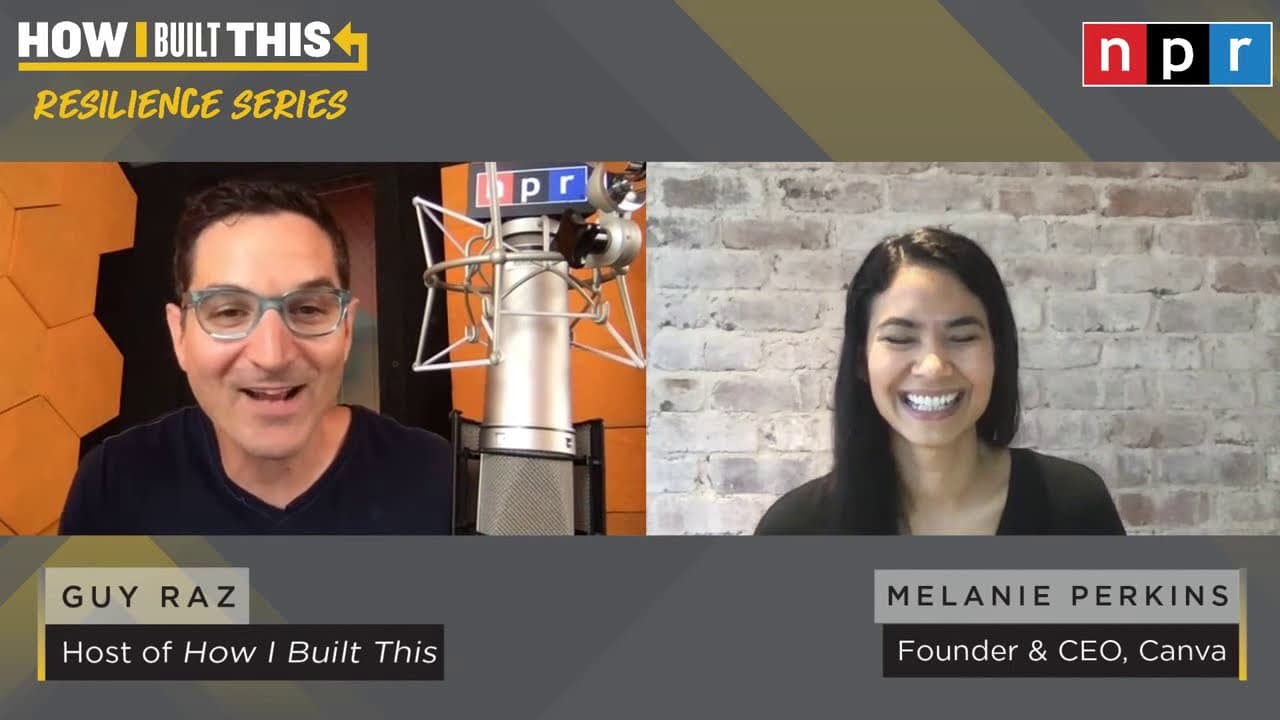
hello everyone and welcome to how I built this resilience Edition I am so excited to have Melanie Perkins the co-founder of canva with me live from Australia from Sydney and we're taking your questions right now on Twitter on Facebook and on YouTube Melanie as many of you know it's back on the show in January of 2019 I think such a cool story I thi... Read More
Key Insights
- Canva was profitable and held strong cash reserves when the pandemic disrupted workplaces. Because the platform continued growing rapidly, the company avoided layoffs and remained financially stable while its roughly 900 employees adjusted to working from home.
- Employee safety and well-being was Canva's highest priority during the pandemic. The company moved its team home in early March, before government recommendations, and organized decisions around three principles: protecting staff, supporting the wider community, and rallying together to grow.
- Remote work was relatively smooth because Canva already operated heavily online. The larger challenge was transferring a culture built around shared lunches, yoga classes, and other office experiences into formats that employees could participate in from home.
- Canva preserved company culture through more frequent online meetings, remote yoga classes, and virtual cooking lessons led by its chefs. These activities showed that important social and cultural practices could move from physical offices into an online setting.
- Office attendance was expected to remain optional for the rest of the year. Canva planned to let employees return when appropriate if they chose, while maintaining flexibility and reducing commuting and public transport use to help limit further spread.
- Demand for Canva increased among students, teachers, and small businesses moving online. The company responded by launching an education product and expanding worksheets, resources, and design education for people adapting to lessons and business activities conducted from home.
- Small businesses used Canva to create social media content and marketing materials during the rapid shift from offline operations to online activity. Perkins described a significant surge in usage across both education and small-business audiences during this transition.
- Canva's product goal was to remove friction between an idea and a finished design. Its paid offering included illustrations, videos, music, and 50 million images, while printing features allowed customers to turn designs into physical products such as T-shirts.
Install to Summarize YouTube Videos and Get Transcripts
Explore YouTube Video Summarizer or Get YouTube Transcript Extractor
Questions & Answers
Q: How did Canva respond to pandemic stay-at-home orders?
Canva moved its team to remote work in early March, before government recommendations, and made employee safety and well-being its highest priority. The company also committed to supporting its community and rallying together to grow. Employees could eventually return to the office if they chose, but office attendance was not expected to become compulsory for the rest of the year.
Q: Why was Canva able to avoid layoffs during the pandemic?
Canva avoided layoffs because it entered the disruption as a profitable company with strong cash reserves and continued to grow rapidly. Demand for online design remained strong as students, teachers, and small businesses needed digital materials. Perkins described Canva as a stable operation, although she also emphasized the company's responsibility to help communities facing much greater disruption.
Q: How did Canva maintain its company culture remotely?
Canva moved several office traditions into online formats. The company held meetings more regularly so that context could circulate across the organization, offered yoga classes employees could join from home, and had its chefs teach online cooking sessions because they could no longer prepare shared meals. These adaptations helped preserve connection while the entire team worked remotely.
Q: Did Canva plan to make remote work permanent?
Canva planned to offer flexibility rather than immediately impose a permanent arrangement. Employees would be allowed to return to the office when appropriate if they wanted, but working from the office was not expected to be compulsory for the rest of the year. Perkins said the company would continue evaluating how online work and office-based interaction supported collaboration and employee well-being.
Q: How did remote work support Canva's public health priorities?
Remote work supported Canva's safety priorities by keeping employees away from shared offices, commuting, and crowded public transport. The company adopted home working before it became a government recommendation and continued following guidance to work remotely wherever possible. Perkins viewed this approach as Canva's contribution to slowing the spread and reducing the risk of a second wave.
Q: Why did Canva usage grow among students and teachers?
Canva saw greater educational demand because 1 billion students were learning from home and needed ways to create lessons and express their creativity online. The company launched an education product and expanded its worksheets, resources, and design education. These efforts were intended to support students and teachers during the rapid transition from classrooms to home-based learning.
Q: How did Canva help small businesses move online?
Canva helped small businesses create social media content, digital advertisements, and marketing materials as they moved from offline operations to online activity. Perkins said this transition happened in a very short period and contributed to a surge in usage. The platform's broader aim was to let customers move from an idea to a finished design with minimal friction.
Q: What assets were included in Canva's paid product?
Canva's paid product included its combined content library at the same price point, covering illustrations, videos, music, and 50 million images. Perkins said this arrangement helped small businesses because they did not need to purchase additional assets separately. Canva also offered printing capabilities, allowing users to turn designs into physical products such as work-from-home T-shirts.
Summary
In this video, Guy Raz interviews Melanie Perkins, the co-founder of Canva, about how the company has navigated the challenges brought on by the COVID-19 pandemic. Melanie addresses topics such as remote work, supporting small businesses, the transition to online design, and the future of Canva.
Questions & Answers
Q: How has Canva been affected by the pandemic?
Canva has been fortunate to be in a position where they have experienced growth during the pandemic. With more small businesses transitioning online and an increased need for design, Canva has seen a surge in users and usage.
Q: Has Canva had to face layoffs?
No, Canva has not had to lay off any employees. They were in a financially stable position, and with the company's growth, they have been able to continue operating without significant disruptions.
Q: What is Canva's approach to remote work?
Currently, all Canva employees are working from home. Although there may be an option to return to the office in the future, Canva is focusing on providing flexibility to its employees and ensuring their safety and well-being.
Q: How has the transition to online work been for Canva?
Canva already had a strong online presence and culture prior to the pandemic, so the transition to remote work has been relatively smooth. However, the company is also aware of the challenges faced by its users, such as students and teachers, and is working to support them through this transition.
Q: Will Canva offer permanent remote work options like other companies?
Canva acknowledges that the world is changing and their approach to work will also evolve. While face-to-face interaction has been an important part of their culture, Canva has successfully brought much of their culture online during the pandemic. They will continue to prioritize their employees' well-being and provide flexibility in the future.
Q: Has Canva seen a growth in paying customers during the pandemic?
Yes, Canva has seen an increase in paying customers. The shift to online business and education has created a greater demand for design tools and Canva has been able to meet those needs.
Q: What can small businesses expect from Canva in terms of partnerships and features?
Canva recently expanded their library of images available in the paid version, offering more value to small businesses. They continue to work on improving the user experience and are planning exciting new features. Canva aims to make the design process smooth and seamless for users.
Q: How does Canva approach marketing during this time?
Canva focuses on providing value to its community by helping solve problems and offering resources. They have invested in design education and provide materials that are helpful and valuable to bloggers and small businesses. Canva believes in building relationships and providing solutions rather than just advertising.
Q: As an introverted CEO, what advice can Melanie Perkins give to introverted entrepreneurs who struggle to put themselves out there?
Melanie emphasizes the importance of having a goal and prioritizing it above all else. When there is a clear goal in mind, introversion takes a backseat and the focus shifts towards achieving that goal. Learning from experience and continuous learning are key in overcoming obstacles and achieving success.
Q: How has Melanie's leadership style evolved as Canva has grown?
Melanie believes that leadership is a continuous work in progress. With the growth of Canva, she has seen the company's culture thrive and the team come together during challenging times. Canva's mission to be a force for good has rallied the entire team, and the focus remains on supporting the community rather than just financial outcomes.
Q: How has the pandemic affected the way people design?
People have shifted their design needs from physical objects like business cards and flyers to digital assets for online platforms. The pandemic has brought about a significant change in the types of designs people are creating, with a focus on social media, e-commerce, online communications, presentations, and virtual celebrations.
Q: How does Canva monetize its free version?
Canva believes in providing value and accessibility to all users. The free version is funded by the revenue generated from the paid subscriptions. Canva's goal is to ensure that everyone, regardless of their financial situation, has access to great design tools.
Takeaways
The COVID-19 pandemic has presented challenges and opportunities for Canva. While the company has not faced layoffs and has experienced growth, their focus remains on supporting their community, including small businesses, students, and teachers. Canva has successfully transitioned to remote work and continues to provide value through design education and resources. The shift in design needs towards online platforms has influenced Canva's strategy, and they are committed to evolving with the changing world while prioritizing accessibility and innovation in design.
Summary & Key Takeaways
-
Canva entered the pandemic as a profitable company with strong cash reserves and continued rapid growth, so it did not need layoffs. Its team began working from home in early March, before government recommendations. Safety and well-being, community support, and collective growth became the three principles guiding company decisions.
-
Canva transferred important parts of its office culture into online formats. More frequent company meetings helped distribute context, yoga classes continued from home, and company chefs began teaching employees to cook online. Perkins said offices would eventually reopen, but working from the office would not immediately become compulsory.
-
Demand increased as students, teachers, and small businesses rapidly moved their activities online. Canva expanded educational resources and supported the creation of lessons, worksheets, social media content, and marketing materials. Its paid product also combined illustrations, videos, music, and 50 million images at the same price point.
-
Canva aimed to reduce friction between having an idea and turning it into a finished design. The platform supported digital outputs as well as printed products, including T-shirts. Perkins also emphasized that effective marketing should provide genuine value and solve problems instead of merely feeling like advertising.
Read in Other Languages (beta)
Share This Summary 📚
Summarize YouTube Videos and Get Video Transcripts with 1-Click
Try YouTube Summary with ChatGPT & Claude or YouTube Transcript Generator
Explore More Summaries from NPR 📚


Summarize YouTube Videos and Get Video Transcripts with 1-Click
Try YouTube Summary with ChatGPT & Claude or YouTube Transcript Generator