What Happens When You Change an Animal's Size?
TL;DR
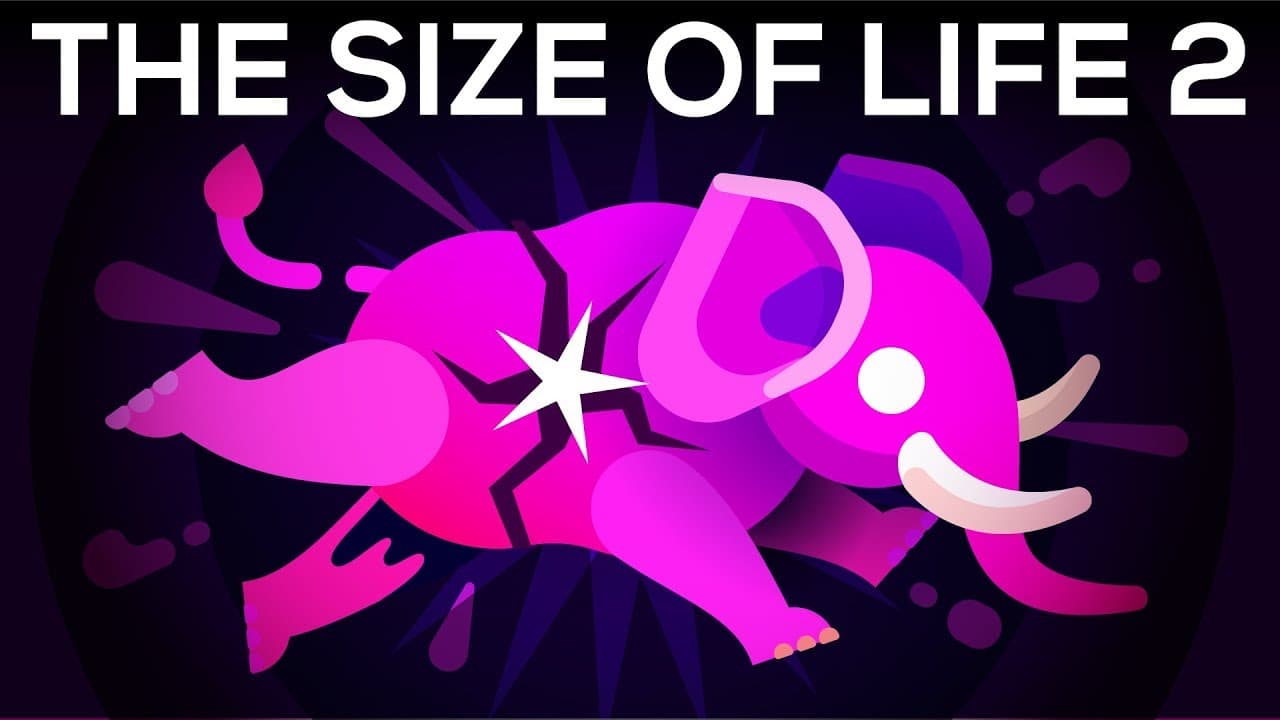
Changing an animal's size drastically affects its survival due to metabolic rates and heat generation. For instance, a giant mouse would explode from overheating because its cells produce excessive heat without enough surface area to dissipate it. In contrast, larger animals like elephants have slower metabolism and specialized adaptations that allow them to regulate heat effectively.
Transcript
Let's shrink an elephant to the size of a mouse and enlarge a mouse, and make it the size of an elephant, because this is our video, and we want to see what happens. First: our now tiny elephant, stumbles around and then drops dead. Tiny elephant buddy is very cold; frozen to death in minutes. Our giant mouse looks very uncomfortable for a moment, ... Read More
Key Insights
- 🥵 Animal cells determine metabolic rates and heat generation based on size.
- 🥵 Larger animals have evolved mechanisms to regulate heat and maintain energy balance.
- ☠️ Small mammals like the Etruscan Shrew exhibit extreme metabolic rates to stay warm.
- ❓ Animals adapt their metabolic activity to their size for survival.
- ❓ Scaling affects not only animal survival but also individual development.
- 🥵 Heat dissipation and energy needs vary with the size of the organism.
- 🥵 The Square Cube Law explains heat dissipation challenges in scaling animals.
Install to Summarize YouTube Videos and Get Transcripts
Explore YouTube Video Summarizer or Get YouTube Transcript Extractor
Questions & Answers
Q: Why do animals die when their size is altered dramatically?
Animals have evolved to function optimally at a particular size, with changes leading to imbalances in heat regulation and metabolism, resulting in death.
Q: How do elephants manage to survive despite their large size?
Elephants have slower cell activity and a regulated metabolism to prevent excessive heat generation, with adaptations like large ears for heat dissipation.
Q: What is the significance of metabolic rates in scaling animals?
Metabolic rates determine an animal's energy needs and heat production, influencing survival strategies and biological functions at varying sizes.
Q: How does the concept of scaling apply to human development?
Human development involves changes in metabolism and cellular activity, with infants adapting rapidly after birth to function independently.
Summary & Key Takeaways
-
Cells in animals are similar in size but differ in quantity, creating varied metabolic rates.
-
Size affects how animals regulate heat, with larger animals having evolved strategies to dissipate it.
-
Metabolism and heat production scale with the size of the organism, influencing survival and energy needs.
Read in Other Languages (beta)
Share This Summary 📚
Summarize YouTube Videos and Get Video Transcripts with 1-Click
Try YouTube Summary with ChatGPT & Claude or YouTube Transcript Generator
Explore More Summaries from Kurzgesagt – In a Nutshell 📚

Summarize YouTube Videos and Get Video Transcripts with 1-Click
Try YouTube Summary with ChatGPT & Claude or YouTube Transcript Generator