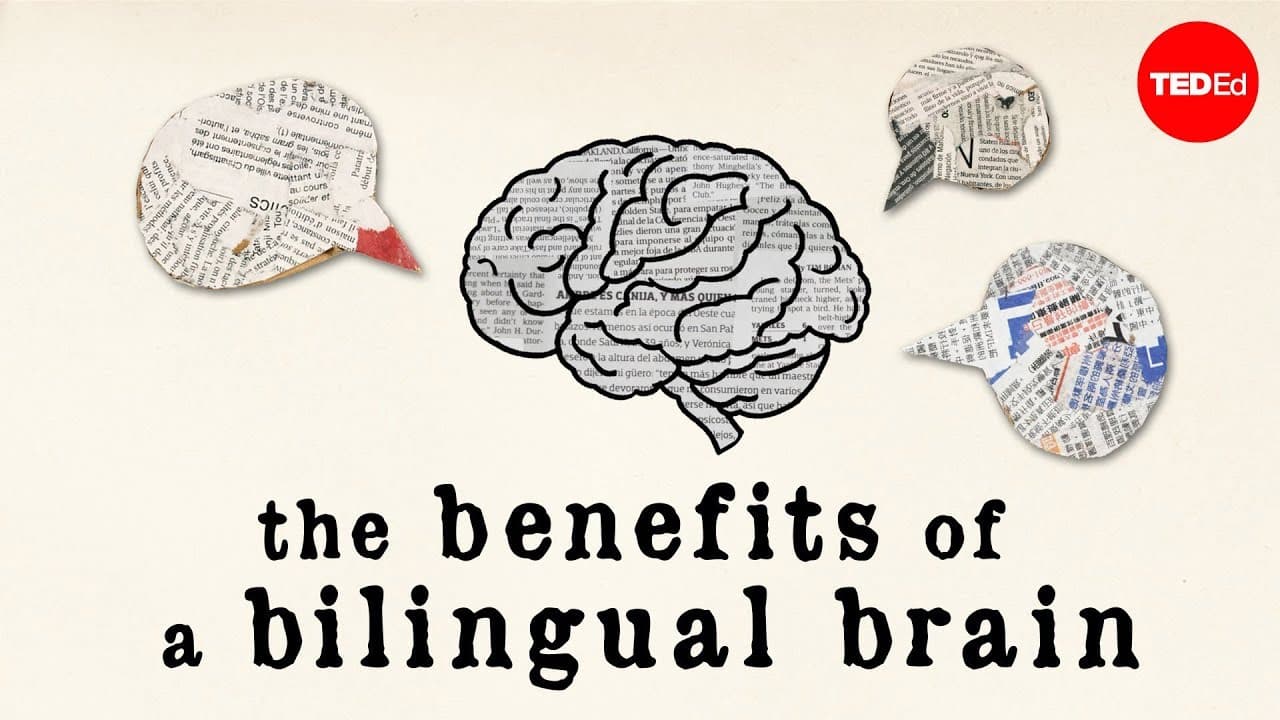
The benefits of a bilingual brain - Mia Nacamulli
TL;DR
Being bilingual enhances brain function and structure, leading to increased grey matter density and delayed onset of cognitive diseases like Alzheimer's. It allows for more complex processing and rational thinking, especially for those who learn a second language in adulthood. Overall, bilingualism promotes a healthier, more engaged brain, regardless of when the language was acquired.
Transcript
¿Hablas español? Parlez-vous français? 你会说中文吗? If you answered, "sí," "oui," or "会" and you're watching this in English, chances are you belong to the world's bilingual and multilingual majority. And besides having an easier time traveling or watching movies without subtitles, knowing two or more languages means that your brain may actually look ... Read More
Key Insights
- 👂 Language ability includes speaking, writing, listening, and reading.
- ⚾ Bilinguals can be classified into compound, coordinate, and subordinate categories based on language acquisition.
- 🛀 Brain imaging shows that language involvement utilizes both hemispheres and influences lateralization.
- 🤔 Learning a second language in adulthood can enhance rational thinking and reduce emotional bias.
- 🚄 Bilingualism results in higher density of grey matter and delays the onset of neurodegenerative diseases.
- ❓ Bilingualism was previously misunderstood but is now recognized for its cognitive benefits.
- 🧠 Being bilingual involves complex brain activity, including executive function and problem-solving.
Install to Summarize YouTube Videos and Get Transcripts
Explore YouTube Video Summarizer or Get YouTube Transcript Extractor
Questions & Answers
Q: What are the different types of bilinguals?
Compound bilinguals develop two linguistic codes simultaneously, coordinate bilinguals work with two sets of concepts, and subordinate bilinguals learn a secondary language through their primary language.
Q: How does language acquisition differ between children and adults?
Children benefit from the plasticity of their developing brain, allowing for a holistic grasp of a language's social and emotional contexts. Adults may exhibit less emotional bias and a more rational approach when learning a second language.
Q: What advantages does being bilingual provide to the brain?
Bilingual individuals have a higher density of grey matter, increased brain activity in specific regions, and a delay in the onset of neurodegenerative diseases like Alzheimer's and dementia.
Q: Was bilingualism previously considered a disadvantage?
Yes, before the 1960s, bilingualism was wrongly believed to slow a child's development. However, recent research refutes this and highlights the cognitive benefits of bilingualism.
Key Insights:
- Language ability includes speaking, writing, listening, and reading.
- Bilinguals can be classified into compound, coordinate, and subordinate categories based on language acquisition.
- Brain imaging shows that language involvement utilizes both hemispheres and influences lateralization.
- Learning a second language in adulthood can enhance rational thinking and reduce emotional bias.
- Bilingualism results in higher density of grey matter and delays the onset of neurodegenerative diseases.
- Bilingualism was previously misunderstood but is now recognized for its cognitive benefits.
- Being bilingual involves complex brain activity, including executive function and problem-solving.
- It is never too late to learn a second language and reap the cognitive benefits.
Summary
Being bilingual or multilingual means that your brain may look and work differently than those of monolinguals. Language ability is typically measured in speaking, writing, listening, and reading. Bilinguals can be classified into three general types: compound bilinguals, coordinate bilinguals, and subordinate bilinguals. Recent advances in brain imaging technology have given insight into how language learning affects the bilingual brain. Children learn languages more easily due to the plasticity of their developing brains, while adults who learn a second language in adulthood exhibit less emotional bias and a more rational approach. Being multilingual has advantages such as a higher density of grey matter, delayed onset of diseases like Alzheimer's, and increased activity in certain brain regions. Bilingualism was once considered a handicap, but it has been shown to strengthen executive function and problem-solving abilities. Bilingualism makes the brain more healthy, complex, and engaged. It's never too late to learn a second language and reap the benefits.
Questions & Answers
Q: How is language ability typically measured?
Language ability is typically measured in two active parts, speaking and writing, and two passive parts, listening and reading. Bilinguals may have varying abilities in each of these areas.
Q: What are the three general types of bilinguals?
Bilinguals can be classified into three general types: compound bilinguals, coordinate bilinguals, and subordinate bilinguals. Compound bilinguals develop two linguistic codes simultaneously, coordinate bilinguals work with two sets of concepts, and subordinate bilinguals learn a secondary language through their primary language.
Q: How does language learning affect the bilingual brain?
Recent advances in brain imaging technology have shown that different aspects of language learning impact the bilingual brain. Children use both hemispheres in language acquisition, while in most adults, language is lateralized to one hemisphere, usually the left. Learning a language in childhood may provide a more holistic grasp of its social and emotional contexts. Adults who learn a second language in adulthood exhibit less emotional bias and a more rational approach in the second language.
Q: What advantages does being multilingual offer to the brain?
Being multilingual offers several advantages to the brain. Bilinguals have a higher density of grey matter, which contains most of the brain's neurons and synapses. They also display more activity in certain brain regions when engaging in a second language. Additionally, being bilingual can help delay the onset of diseases like Alzheimer's and dementia by as much as five years.
Q: How was bilingualism once viewed?
Before the 1960s, bilingualism was considered a handicap that slowed a child's development. This view was based largely on flawed studies. However, more recent research has shown the cognitive benefits of bilingualism.
Q: Does bilingualism make a person smarter?
Bilingualism may not necessarily make a person smarter in terms of general intelligence, but it does have cognitive benefits. Bilingualism strengthens executive function, problem-solving abilities, switching between tasks, and focusing while filtering out irrelevant information.
Q: What are the visible effects of being bilingual?
Bilinguals have a higher density of grey matter in their brains, which contains most of the brain's neurons and synapses. They also exhibit more activity in certain brain regions when engaging in a second language.
Q: How does bilingualism impact the onset of diseases like Alzheimer's?
Bilingualism can help delay the onset of diseases like Alzheimer's and dementia by as much as five years. The heightened cognitive workout that a bilingual brain receives throughout life contributes to this delay.
Q: How does learning a second language in adulthood affect emotional bias?
Adults who learn a second language in adulthood exhibit less emotional bias and a more rational approach when confronting problems in the second language compared to their native language.
Q: Is it ever too late to learn a second language?
It's never too late to learn a second language. Even if someone didn't have the opportunity to learn a second language as a child, they can still benefit from learning one in adulthood. The brain can still experience positive changes and improved cognitive abilities with language learning.
Takeaways
Being bilingual or multilingual has significant advantages for the brain. Not only does it make the brain more healthy, complex, and actively engaged, but it can also delay the onset of diseases like Alzheimer's and dementia. Bilingualism strengthens executive function and problem-solving abilities, as well as the ability to switch between tasks and filter out irrelevant information. Regardless of age, it's never too late to learn a second language and benefit from the cognitive advantages it offers. Language learning provides a mental workout that can go a long way in improving brain health and cognitive abilities.
Summary & Key Takeaways
-
Bilingualism involves speaking, writing, listening, and reading in two languages, with varying proficiency levels.
-
Different types of bilinguals exist, including compound bilinguals, coordinate bilinguals, and subordinate bilinguals, based on how they acquire and use languages.
-
Brain imaging studies show that language acquisition in childhood utilizes both hemispheres, while learning a second language in adulthood can enhance rational thinking and reduce emotional bias.
Read in Other Languages (beta)
Share This Summary 📚
Summarize YouTube Videos and Get Video Transcripts with 1-Click
Try YouTube Summary with ChatGPT & Claude or YouTube Transcript Generator
Explore More Summaries from TED-Ed 📚






Summarize YouTube Videos and Get Video Transcripts with 1-Click
Try YouTube Summary with ChatGPT & Claude or YouTube Transcript Generator