How to restart coding journey with Python and projects
TL;DR
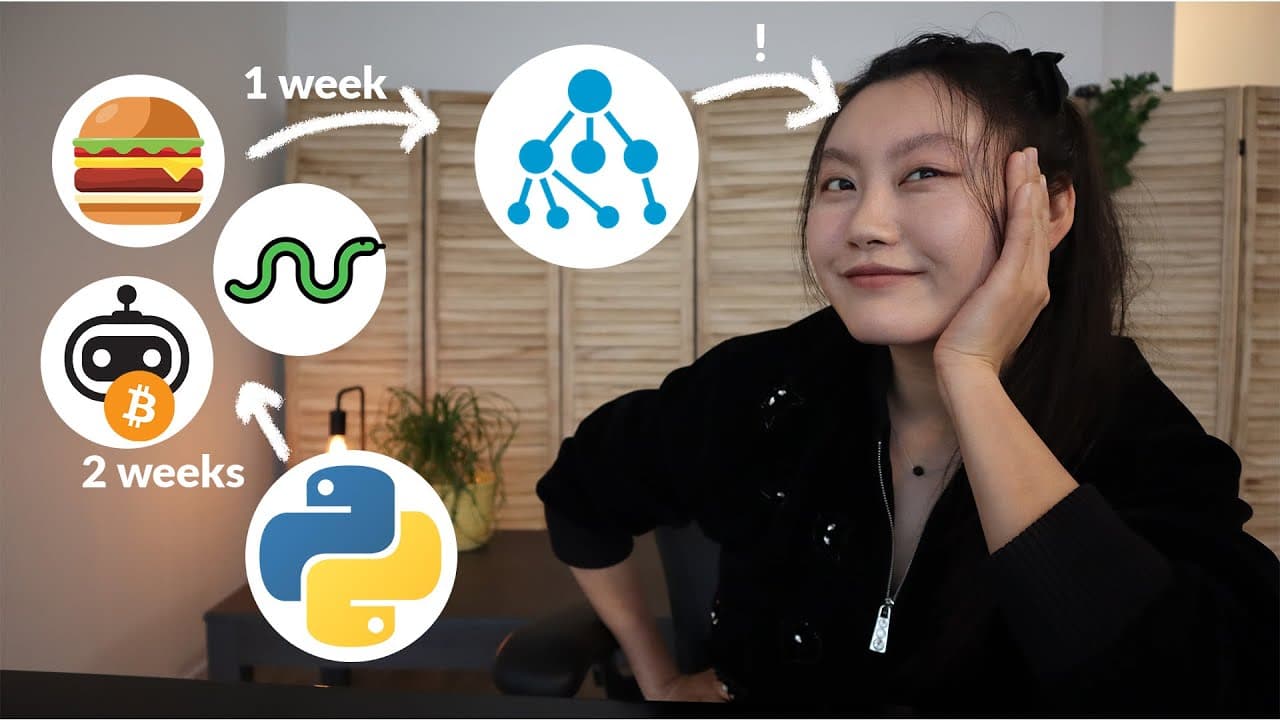
The answer is to start with Python as a beginner friendly language, learn basics quickly, then build small projects to solidify concepts. Focus on applying what you learn, experiment beyond instructions, and progressively tackle more complex topics like data structures, APIs, and algorithms. The timeline suggests two weeks for basics and a week for your first project when dedicating about four hours daily.
Transcript
Hey guys, how's it going? So, I've been coding for 5 years now. So, there were things that I did right from the very beginning, but there were also a lot of things that I didn't do correct and I had to like kind of figure it out. So, this is the video that I wish that I had when I was starting off and how I would learn coding if I were to do it all... Read More
Key Insights
- Python is recommended as a beginner friendly language due to its versatility and simple syntax.
- Learning through hands on practice provides instant feedback and solidifies concepts.
- Start with basics like variables, data types, loops, functions, and then object oriented programming.
- Interactive platforms like freeCodeCamp and Codecademy support quick setup and feedback.
- Dedicating around four hours a day can cover basics in about two weeks.
- After basics, begin your first project and then gradually add complexity with APIs and data structures.
- Projects should be small, useful, and interesting, and you can iterate on them as you learn.
- Reading documentation and experimenting beyond stated tasks accelerates learning.
- More videos from this channel:
- More from this channel: Tina Huang
Install to Summarize YouTube Videos and Get Transcripts
Explore YouTube Video Summarizer or Get YouTube Transcript Extractor
Questions & Answers
Q: What language does the speaker recommend starting with and why?
The speaker recommends starting with Python because it is beginner friendly, versatile, has simple syntax, and strong documentation. This makes it easier to get help and build confidence quickly. The language also supports a wide range of applications, which helps new learners stay motivated as they progress.
Q: How long does the speaker say it takes to cover the basics with four hours of study per day?
If you dedicate around four proper hours per day, the basics can be covered in roughly two weeks. This timeline is presented to help beginners avoid overloading on details and to emphasize rapid, practical progress through hands on practice and quick feedback.
Q: What is the first major project type suggested for beginners to practice?
Beginners are encouraged to start with simple projects such as a random food recommendation system or basic games like blackjack or tic tac toe. These projects help practice core concepts, provide visual or interactive feedback, and demonstrate how programs can be extended later with more advanced features.
Q: Why is practicing beyond the exact instructions recommended?
Practicing beyond the exact instructions helps solidify understanding of data types, functions, and how different data types interact. It also demonstrates how to transform data types, handle errors, and adapt code to different inputs, which are essential skills for becoming a proficient coder.
Q: What mindset change does the speaker emphasize for learning to code effectively?
The speaker emphasizes adopting a hands on, exploratory mindset. This includes experimenting with code, trying variations beyond the given tasks, and focusing on understanding fundamental concepts rather than memorizing syntax. This approach accelerates learning and helps develop problem solving skills.
Q: What role do projects play in learning to code according to the video?
Projects play a central role as they apply learned concepts to real problems. The speaker suggests starting small, choosing interesting and useful projects, and iterating to add features. This practical application reinforces knowledge, demonstrates progress, and gradually introduces topics like APIs and data structures.
Q: How should learners approach learning resources like videos or books?
Learners should combine resources with steady practice, ensuring they implement what they learn rather than just consuming information. They should explore beyond the given tasks, test new ideas, and verify outcomes to deepen understanding and retention.
Q: What topics are recommended to study after completing basics and a first project?
After basics and a first project, learners should study algorithms and data structures such as dictionaries, linked lists, queues, heaps, trees, and graphs. They are also advised to learn how APIs work and how to read documentation to understand how different software pieces interact, enabling more advanced projects.
Summary & Key Takeaways
-
The video advocates starting with Python due to its beginner friendliness and strong community support. It emphasizes learning through practice and exploration rather than passively reading or watching. A concrete timeline is offered: roughly two weeks for basics and about a week to complete the first project if you study four hours daily.
-
The recommended approach includes choosing practical, interesting projects, iterating on them, and gradually adding complexity such as data structures and APIs. It also highlights the importance of reading documentation and understanding how different software systems interact.
-
The speaker stresses the right mindset for learning code, encourages experimentation, and advises against overemphasis on syntax details early on. The overall message is a growth-oriented pathway from fundamentals to higher level topics and real-world projects.
Read in Other Languages (beta)
Share This Summary 📚
Summarize YouTube Videos and Get Video Transcripts with 1-Click
Try YouTube Summary with ChatGPT & Claude or YouTube Transcript Generator
Explore More Summaries from Tina Huang 📚




Summarize YouTube Videos and Get Video Transcripts with 1-Click
Try YouTube Summary with ChatGPT & Claude or YouTube Transcript Generator