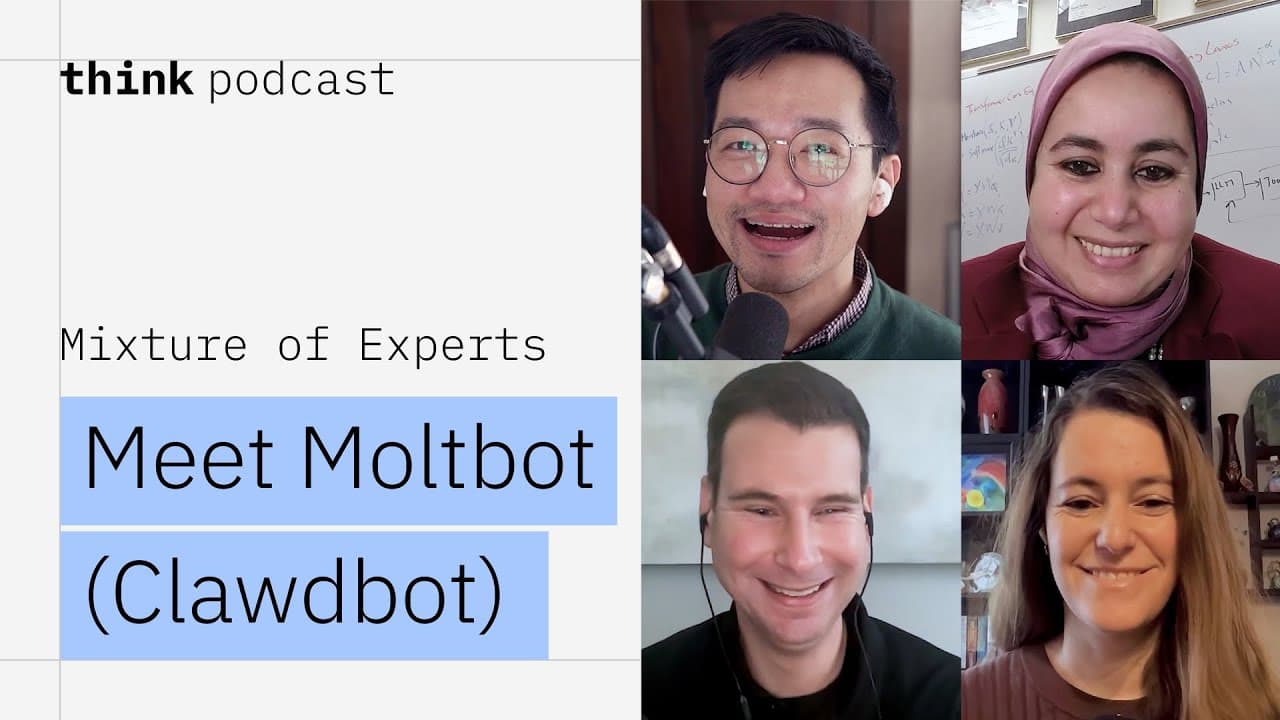
Why Open-Source AI Agents Are Going Mainstream
TL;DR
Open-source AI agents are gaining traction because practical integrations let people automate personal workflows with local or proprietary models. Moltbot, formerly Clawdbot, shows how community-built tools, local execution, memory, and cross-app connections can make agents useful, but limited guardrails, dependency risks, and rapid competition could prevent any single framework from remaining dominant.
Transcript
I do wonder if it's just a fad, right? If this is just a fad that's going to go away soon because it seems like these types of systems pop pop up and go, especially around agents, you know, but but then I looked and you know this, you know, cloudbot, mult, you know, it it is real and meaningful. All that and more on today's mixture of experts. [sno... Read More
Key Insights
- Moltbot is an open-source AI agent that can connect with both local models and proprietary models from providers mentioned in the discussion. Its accessible architecture lets individuals experiment with agent workflows on personal hardware rather than limiting agent development to large enterprises.
- Practical integrations are a major reason Moltbot captured attention. Connections to messaging services and other everyday tools make the agent relevant to personal-assistant tasks, life hacking, and get-things-done workflows that users can understand and customize for themselves.
- Simple agent tasks can deliver meaningful value without requiring a highly ambitious autonomous system. The panel observes that many popular projects are straightforward personal automations, suggesting that expectations for agents should focus on useful execution rather than complexity for its own sake.
- Moltbot works as a Node.js application that can run on a laptop or a small dedicated computer. It supports local model execution while also connecting to other models and applications, giving users flexibility in how they configure their agent environment.
- Open-source communities can accelerate agent adoption by developing integrations for their own needs. Moltbot demonstrates that autonomy, execution, and workflow connections can be community-driven, especially when a focused group of users actively builds around a shared set of personal productivity goals.
- Horizontal and vertical agent designs offer different strengths. Horizontal agents provide broader autonomy and execution, while vertical agents offer specialized, context-rich automation. The panel suggests hybrid systems may combine modular open platforms with deep integration where particular tasks require it.
- Full system access can make an agent more capable, but it also increases trust and security concerns. Some users reportedly purchase separate Mac minis so the agent can operate freely without receiving access to the machine that contains their personal data and daily work.
- Moltbot may be meaningful today without remaining the dominant open-source agent framework. Rapid innovation, architectural specificity, dependency risks, limited multimodal integration, missing dynamic plugins, and insufficient guardrails create room for competing projects to offer safer or more flexible alternatives.
Install to Summarize YouTube Videos and Get Transcripts
Explore YouTube Video Summarizer or Get YouTube Transcript Extractor
Questions & Answers
Q: Why did Moltbot become popular among AI users?
Moltbot became popular because it addresses a practical need through numerous integrations and an accessible open-source design. It appeals especially to get-things-done, life-hacking, and personalization communities that want personal-assistant workflows. Users can create both practical and playful automations, connect different applications, and choose between local and proprietary models instead of relying on one closed system.
Q: What is Moltbot, formerly known as Clawdbot?
Moltbot is an open-source AI agent project that was previously called Clawdbot. It is described as a Node.js application that can run on a laptop, connect to local or proprietary models, and integrate with external tools such as WhatsApp. Its combination of memory, execution, application synchronization, and community-built integrations supports personalized automation across different workflows.
Q: How can Moltbot run AI models locally?
Moltbot can operate as an application on a laptop and use a small model running locally. It can also connect to proprietary models, allowing users to choose an arrangement that fits their tasks. The discussion highlights Mac minis as popular dedicated machines because users can let the agent work across the system without granting the same access to their primary personal computer.
Q: Why are integrations important for open-source AI agents?
Integrations turn an agent from a model interface into a system that can act within real workflows. Moltbot connects with applications and communication tools, which supports personal-assistant tasks, memory, execution, and synchronization across apps. The open-source community can add integrations for its own priorities, helping a focused user group make the platform useful without depending entirely on one vendor's roadmap.
Q: Do useful AI agents need many tools?
The panel does not treat tool quantity as the only measure of agent success. Real-world usefulness depends on the task, the available context, and how well the agent connects with relevant workflows. Broad modular plugins can support general autonomy, while deeper specialized integrations can provide context-rich automation. A hybrid platform may therefore use flexible tools broadly and integrate deeply only where needed.
Q: What is the difference between horizontal and vertical AI agents?
Horizontal agents are described as providing general autonomy and execution across domains, while vertical agents provide specialized, context-rich automation. Moltbot challenges the idea that the model, operating system, and hardware must always function as one vertically integrated system. The panel suggests that successful systems may be hybrids, remaining modular and locally deployable while supporting deep integration for particular tasks.
Q: Why are users running AI agents on separate Mac minis?
Users want the strongest results by giving the agent extensive access to a machine, but they may not trust it with their primary computer. A separate Mac mini creates a dedicated environment where the agent can operate without roaming through the user's main personal system. The reported purchasing trend therefore reflects both enthusiasm for autonomous execution and continuing concern about safety and control.
Q: What could prevent Moltbot from remaining the dominant agent framework?
Moltbot faces rapid innovation, competitive pressure, dependency risks, and limitations tied to its specific architecture and user experience. The panel also identifies room for stronger multimodal integration, dynamic plugins, personalization, and guardrails. Another project could replace it by reducing these risks or serving a broader group, even though Moltbot currently meets a real need and benefits from an active open-source community.
Summary & Key Takeaways
-
Moltbot, previously called Clawdbot, became popular by combining an open-source agent framework with integrations that support practical personal-assistant workflows. It can run as a Node.js application on a laptop, connect to local or proprietary models, and interact with tools such as WhatsApp, making experimentation accessible to individual users.
-
The panel connects Moltbot's appeal to the get-things-done and life-hacking communities. Users can create practical or playful automations without demanding that agents solve extremely complex problems. Its success suggests that useful integrations, memory, execution, and synchronization across applications may matter more than pursuing ambitious but poorly grounded demonstrations of autonomy.
-
Moltbot also exposes unresolved tradeoffs in open agent systems. Full system access can produce more capable results, but it creates trust and security concerns that lead some users to dedicate separate Mac minis to their agents. The panel expects hybrid platforms combining modular openness with deeper, task-specific integration to become strong contenders.
Read in Other Languages (beta)
Share This Summary 📚
Summarize YouTube Videos and Get Video Transcripts with 1-Click
Try YouTube Summary with ChatGPT & Claude or YouTube Transcript Generator
Explore More Summaries from IBM Technology 📚
Summarize YouTube Videos and Get Video Transcripts with 1-Click
Try YouTube Summary with ChatGPT & Claude or YouTube Transcript Generator