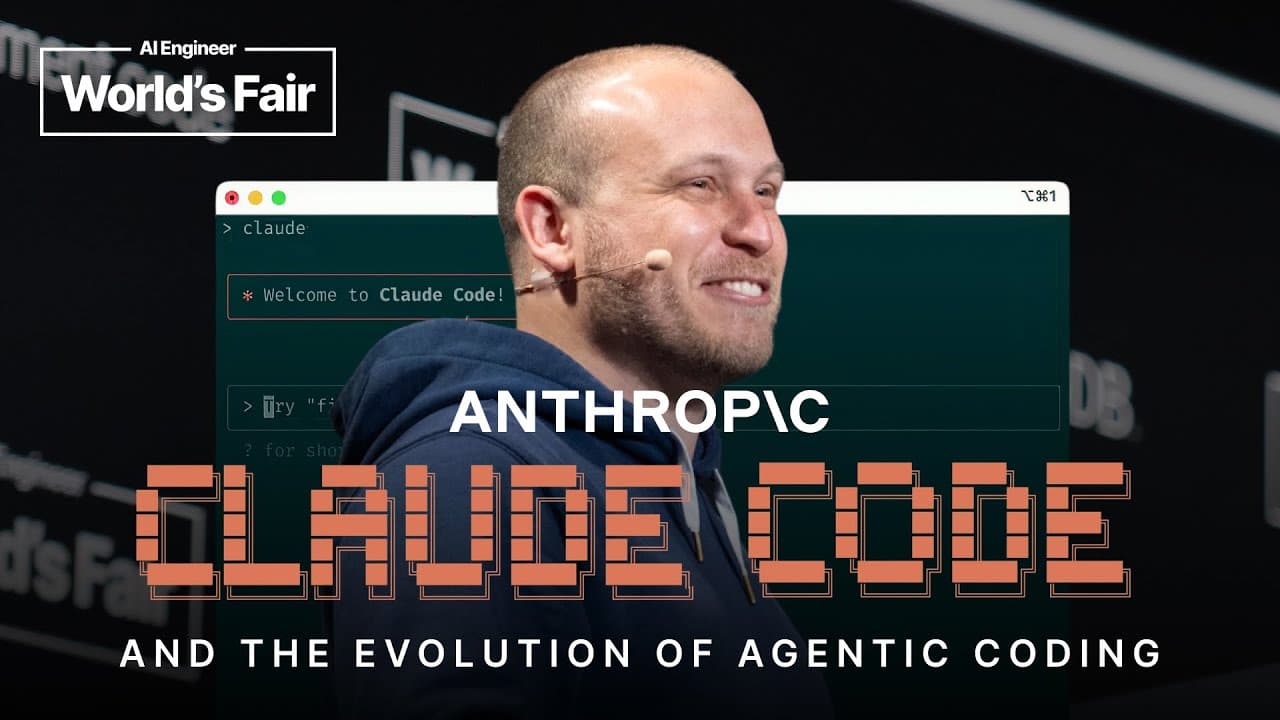
How Is Claude Code Evolving Agentic Coding?, Boris Cherny, Anthropic
TL;DR
Claude Code transforms programming UX by giving developers a simple, terminal-based interface to a coding model that is improving faster than the product around it. Boris Cherny of Anthropic explains why the team keeps Claude Code deliberately unopinionated and builds only the bare minimum while users explore effective workflows. Read on to understand this strategy through the history of programming languages, editors, and graphical coding tools.
Transcript
hello this awesome this is a big crowd who here has used quad code before jesus awesome that's what I like to see cool so my name is Boris i'm a member of technical staff at Enthropic and creator of Quad Code and um I was struggling with what to talk about for audience that already knows quad code already knows AI and all the coding tools and agent... Read More
Key Insights
- Claude Code evolves rapidly, improving coding capabilities exponentially.
- The product remains unopinionated to allow user-driven UX development.
- Programming has shifted from hardware-based to software-based approaches.
- Text editors and IDEs have revolutionized coding interactions over decades.
- Verification methods have advanced from manual to probabilistic techniques.
- Claude Code offers a terminal-based approach for low-level model access.
- The model's generality and capability growth outpace product development.
- Users can integrate Claude Code into any terminal, enhancing flexibility.
Install to Summarize YouTube Videos and Get Transcripts
Explore YouTube Video Summarizer or Get YouTube Transcript Extractor
Questions & Answers
Q: How does Claude Code transform programming UX?
Claude Code provides a flexible, terminal-based way to work with a rapidly improving coding model. The team keeps the product deliberately unopinionated because it does not yet know what the best interface for such a capable model should look like.
Q: Why is Claude Code intentionally unopinionated?
Boris Cherny says the team does not know what the ideal product for a fast-improving coding model should look like. By building the bare minimum and avoiding a rigid workflow, it leaves room for users to experiment with different ways of working.
Q: Why is the Claude Code product struggling to keep up with the model?
The model is getting better at coding very quickly, while product design cannot advance at the same pace. Cherny says many more products could be built for models this capable, so Claude Code currently focuses on a minimal foundation.
Q: How can developers add Claude Code to their existing workflows?
Claude Code runs in a terminal, allowing developers to use it within their established setups. The transcript says it can be installed from the Claude Code page or through npm, and it supports the Claude Pro and Claude Max plans.
Q: How does Claude Code fit into the evolution of programming?
Cherny frames Claude Code as another stage in programming’s movement toward higher levels of abstraction and new interfaces. Programming progressed from physical switchboards and punch cards to software languages, text editors, graphical tools, and now agentic coding systems.
Q: How have programming languages changed over time?
Programming moved from hardware and punch cards to assembly and then higher-level languages. The talk mentions COBOL, typed languages, C++, Haskell, JavaScript, Java, Python, TypeScript, Rust, Swift, and Go, while arguing that modern language abstractions have begun to converge.
Q: What milestones shaped the user experience of programming?
The talk traces programming UX from punch-card machines to Ed, Vim, Emacs, Smalltalk-80, Visual Basic, and Eclipse. Each introduced new ways to interact with software, including text editing, graphical interfaces, live reload, graphical coding, and type-ahead based on static analysis.
Q: Why does Boris Cherny compare Claude Code with early text editors?
The comparison shows how programming interfaces evolve alongside the technology they serve. Ed was designed for teletype machines without cursors or scrollback, while Claude Code uses the terminal as a simple interface for a rapidly advancing coding model.
Summary & Key Takeaways
-
Claude Code rapidly enhances coding capabilities, operating on an exponential improvement curve. It offers an unopinionated approach, allowing developers to experiment with UX and integrate the tool seamlessly into their existing workflows.
-
Programming has evolved from hardware-based methods to sophisticated software tools, with text editors and IDEs playing a significant role in this transformation. Claude Code continues this evolution by providing a flexible, terminal-based interface.
-
Verification methods in programming have advanced significantly, moving from manual debugging to probabilistic techniques. Claude Code supports this evolution by allowing developers to integrate the model into various workflows, enhancing productivity and efficiency.
Read in Other Languages (beta)
Share This Summary 📚
Summarize YouTube Videos and Get Video Transcripts with 1-Click
Try YouTube Summary with ChatGPT & Claude or YouTube Transcript Generator
Explore More Summaries from AI Engineer 📚




Summarize YouTube Videos and Get Video Transcripts with 1-Click
Try YouTube Summary with ChatGPT & Claude or YouTube Transcript Generator