How did Europe carve up Africa so quickly and map it
TL;DR
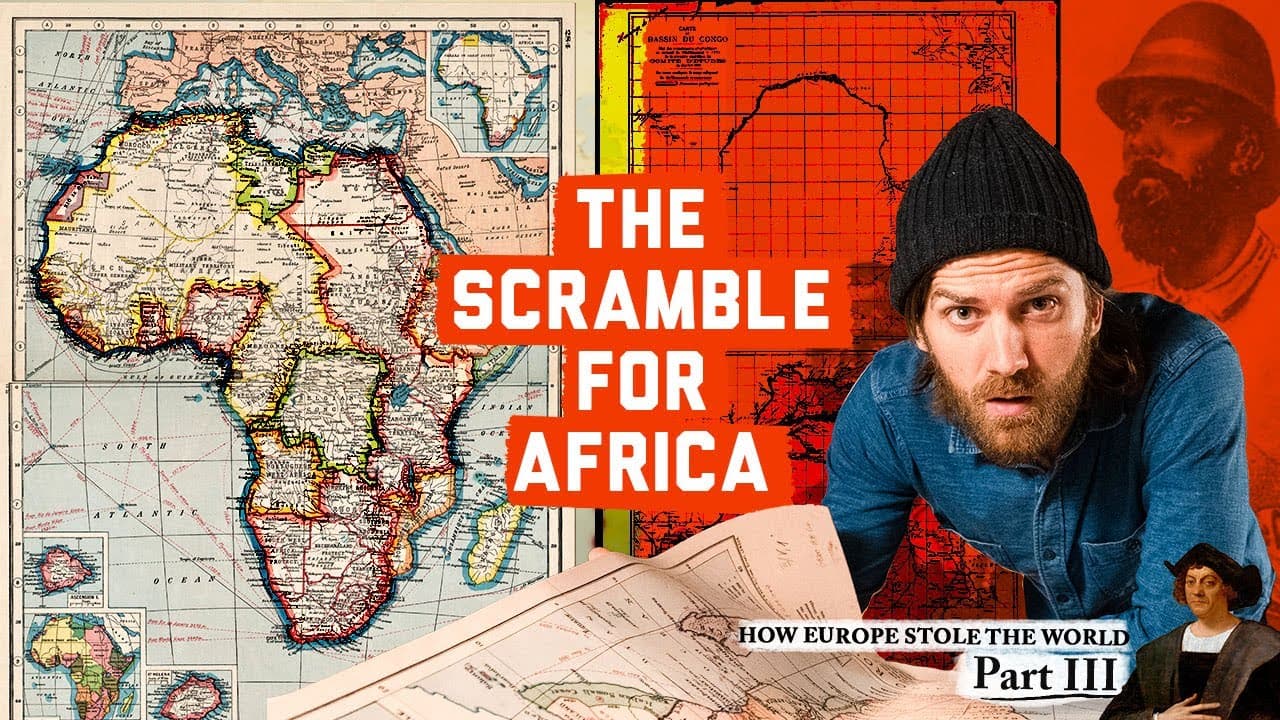
Industrial imperialism and a Berlin Conference sparked the scramble for Africa. Quinine enabled Europeans to survive tropical interiors, while King Leopold II sparked Belgian colonialism in the center of the continent. The 1884 Berlin Conference coordinated claims, leading to rapid partition by European powers and the creation of vast colonial empires in Africa.
Transcript
(light orchestral music) - We need to look at something astounding that happened over the course of like a hundred years. This is the final chapter, and what I think is the most mind-boggling chapter, in the story of how Europe took over the world. The reason why it's so mind-boggling is because this is the part of the story where the map goes from... Read More
Key Insights
- Africa’s interior was largely unknown to Europeans in 1800, making it a blank map for colonizers.
- Quinine, discovered by Europeans, provided a white man’s shield against malaria enabling deeper African exploration.
- Leopold II used the interior of Africa as a blank canvas to claim a vast colony for Belgium.
- The Scramble for Africa accelerated once technology and naval power made distant conquest feasible.
- The Berlin Conference of 1884 organized claims and prevented open conflict by drawing boundaries and rules.
- European powers coordinated rather than fought openly to seize African territories under a new imperial framework.
- Industrial capitalism and the need for resources and markets drove rapid imperial expansion.
- Mapmaking and cartography were central to displaying and legitimizing imperial claims in Africa.
- More videos from this channel:
- More from this channel: Johnny Harris
Install to Summarize YouTube Videos and Get Transcripts
Explore YouTube Video Summarizer or Get YouTube Transcript Extractor
Questions & Answers
Q: How did the Berlin Conference influence Africa's colonization?
The Berlin Conference established formal rules for how European powers could claim African territories, moving beyond ad hoc expansion to a coordinated, multi-country division of the continent. It dictated that control, not merely claims on a map, was necessary to occupy land, which accelerated the scramble and reduced inter-imperial conflict as powers agreed on spheres of influence.
Q: What role did quinine play in European expansion into Africa?
Quinine provided Europeans with protection against malaria, effectively giving them a shield against the White Man's Grave and enabling long expeditions into Africa's interior. This medical breakthrough reduced disease risk, allowing explorers and colonizers to travel further, establish outposts, and secure claims that would later become formal colonies.
Q: Who stirred the idea of a central Belgian colony in Africa and why?
King Leopold II sought to join the major imperial powers by acquiring land in Africa. With European powers reluctant to cede land, Leopold pursued the interior of Africa as a blank canvas for a personal colonial project. This action helped catalyze Belgian involvement and contributed to the broader scramble for Africa by asserting Belgian claims in the center of the continent.
Q: Why is the interior of Africa described as unknown in early maps, and what changed?
Early maps labeled the interior as largely unknown due to a lack of exploration and the high mortality from diseases that prevented many expeditions from returning. The perception changed after technological and medical advances, including quinine protection, allowed deeper exploration, mapping, and eventual colonization by multiple European powers.
Q: What does the term Imperialism 2.0 imply in the video, and how did it differ from earlier imperialism?
Imperialism 2.0 implies a coordinated, technologically aided, and commercially driven form of domination that relied on shared European interests rather than overt, single-country conquest. It represents a more networked approach, with collaboration among empires, trade incentives, and a focus on leveraging global markets and industrial capacity to extract value across larger swathes of territory.
Q: How did the scramble for Africa affect European politics at home?
The scramble created pressure on European states to protect their own interests and deter rivals, prompting diplomatic coordination like the Berlin Conference. It also helped European powers maintain prestige and economic vitality by securing resources, markets, and strategic positions abroad, even as revolution and nationalist movements challenged empire-building at home.
Q: What was the strategic importance of Africa to European powers in this period?
Africa represented a vast frontier rich in resources and strategic locations, offering new markets and raw materials essential for industrial growth. Control over African territories also allowed European powers to project power globally, secure sea routes, and create advantageous incentives for shareholders, reinforcing the capitalist system that underpinned imperial expansion.
Q: How did maps function as tools of imperialism in this episode?
Maps served as visual evidence of claims, enabling authorities to show control and influence over territories. They recorded what Europeans knew and did not know about Africa, guiding expansion, legitimizing acquisitions, and shaping public perception at home about the extent of imperial reach, while also influencing negotiations and the division of land at conferences.
Summary & Key Takeaways
-
The rise of a new imperial frontier after revolutionary pressure pushed Europe to cooperate rather than fight, accelerating Africa’s partition. Rapid mapmaking and territorial claims followed, driven by technological advances and shared European interests.
-
European powers used medical breakthroughs and firearms to push into previously unknown interior regions, transforming how Africa was controlled and mapped.
-
The Berlin Conference formalized a system for dividing Africa among European powers, ending the era of ambiguous claims and starting a period of rapid imperial expansion across the continent.
Read in Other Languages (beta)
Share This Summary 📚
Summarize YouTube Videos and Get Video Transcripts with 1-Click
Try YouTube Summary with ChatGPT & Claude or YouTube Transcript Generator
Explore More Summaries from Johnny Harris 📚



Summarize YouTube Videos and Get Video Transcripts with 1-Click
Try YouTube Summary with ChatGPT & Claude or YouTube Transcript Generator