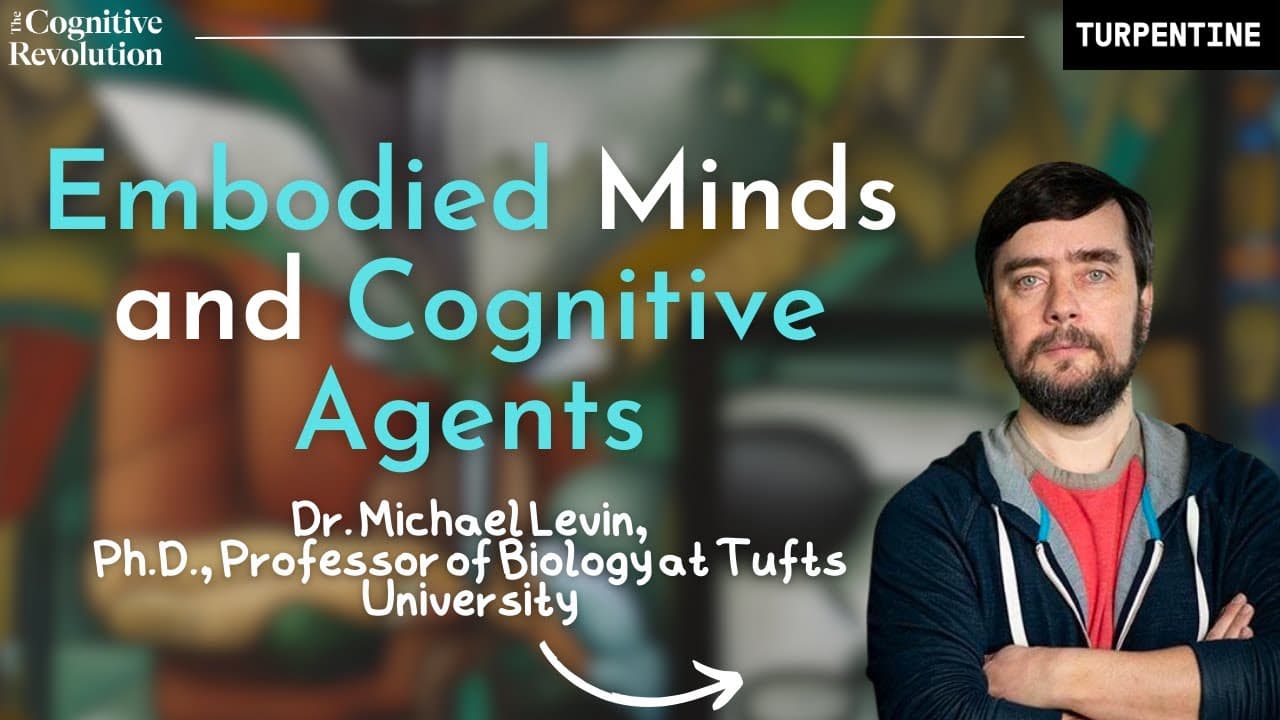
What Are Embodied Minds and Cognitive Agents? Dr. Michael Levin Explains
TL;DR
Embodied minds are cognitive agents operating within physical systems, including cells, organs, tissues, chimeras, cyborgs, and hybrids. Dr. Michael Levin examines collective cellular intelligence in development and regeneration, bioelectric control in cancer research, and the collapse of binary distinctions such as living thing versus machine. Read on to understand cognitive light cones, biological programming, and what diverse intelligence could mean for AI.
Transcript
everything we do is around this notion of embodied minds and what it means to be a cognitive agent in this physical universe and so we think about things like the collective intelligence of cells during embryonic development during regeneration and so on we've had projects in cancer where we uh can detect and normalize cancer by controlling its bi ... Read More
Key Insights
- Embodied minds are cognitive agents within physical systems, challenging traditional life and machine distinctions.
- Collective intelligence is observed in cells during development and regeneration, showing cognitive-like behaviors.
- Bioelectric memory in cells can be rewritten, affecting regeneration outcomes like head and tail formation in flatworms.
- AI systems defy binary categories, requiring new frameworks to understand emergent properties and intelligence.
- Understanding diverse intelligence in biology can inform AI development, emphasizing unexpected capabilities.
- The cognitive light cone concept describes the size of goals an agent can pursue, applicable to both biological and AI systems.
- Perturbative experiments are crucial for identifying goals and intelligence in systems, beyond mere observation.
- Emergent goals in AI systems necessitate a science of understanding novel goal formation and ethical interactions.
Install to Summarize YouTube Videos and Get Transcripts
Explore YouTube Video Summarizer or Get YouTube Transcript Extractor
Questions & Answers
Q: What are embodied minds and cognitive agents?
Embodied minds are cognitive agents operating within physical systems. Dr. Michael Levin studies this idea across cells, organs, tissues, chimeras, cyborgs, hybrids, and other forms of diverse intelligence rather than treating cognition as an exclusively human property.
Q: How does Dr. Michael Levin study collective intelligence in cells?
Levin examines how cells coordinate during embryonic development and regeneration. His projects also investigate cancer by controlling bioelectric connections between cells and the larger cellular network to detect and normalize it.
Q: Why does Levin reject binary categories such as living thing and machine?
Levin argues that terms such as machine, human, robot, living, and emergent become misleading when treated as binary categories. He instead describes a spectrum of diverse intelligence spanning cells, organs, tissues, chimeras, cyborgs, hybrids, and other combinations.
Q: What is a cognitive light cone?
The cognitive light cone describes the scale of goals or concerns available to an agent. Levin contrasts what can matter to a bacterium, a dog, and a human, then asks whether a being could care about all living beings on Earth.
Q: How could a cognitive light cone be enlarged?
Levin suggests that improvements to cognition and embodiment could enlarge an agent’s cognitive light cone. Such changes could expand the range of things that matter to the agent and help it do better than humans currently do.
Q: What do xenobot and anthrobot projects reveal about biological systems?
The discussion presents xenobot and anthrobot projects as examples of placing biological systems far outside their usual conditions. These experiments reveal surprising latent capabilities that might otherwise remain undiscovered.
Q: What can biological research contribute to understanding AI?
Biological experiments show that familiar distinctions between living things and machines are collapsing while unexpected capabilities can appear in simple systems. The conversation uses these findings to encourage humility and open-minded experimentation when evaluating AI systems that do not share humanity’s evolutionary history.
Q: Why does Levin emphasize experimentation and epistemic modesty?
Many capabilities found in biological systems could have been dismissed as impossible before experiments demonstrated them. Levin therefore favors open-minded testing over fixed philosophical commitments, especially when studying unfamiliar biological or AI systems.
Summary & Key Takeaways
-
Embodied minds are cognitive agents within physical systems, as explored through research on bioelectric memory and collective intelligence. These studies challenge traditional distinctions between life and machines, highlighting emergent properties and intelligence in unexpected areas. Dr. Michael Levin's work demonstrates how cells exhibit cognitive-like behaviors, with implications for understanding AI and biological systems.
-
Research on bioelectric memory shows that cells can store and rewrite information, affecting regeneration outcomes in organisms like flatworms. This challenges the notion of fixed biological processes and suggests that cells possess cognitive-like capabilities. Understanding these processes can inform AI development, emphasizing the potential for emergent intelligence in diverse systems.
-
AI systems defy binary categories, requiring new frameworks to understand emergent properties and intelligence. The concept of the cognitive light cone describes the size of goals an agent can pursue, applicable to both biological and AI systems. Perturbative experiments are crucial for identifying goals and intelligence, highlighting the need for a science of novel goal formation and ethical interactions.
Read in Other Languages (beta)
Share This Summary 📚
Summarize YouTube Videos and Get Video Transcripts with 1-Click
Try YouTube Summary with ChatGPT & Claude or YouTube Transcript Generator
Explore More Summaries from Cognitive Revolution "How AI Changes Everything" 📚





Summarize YouTube Videos and Get Video Transcripts with 1-Click
Try YouTube Summary with ChatGPT & Claude or YouTube Transcript Generator