What Are the Latest Techniques in LLM Post-Training?
TL;DR
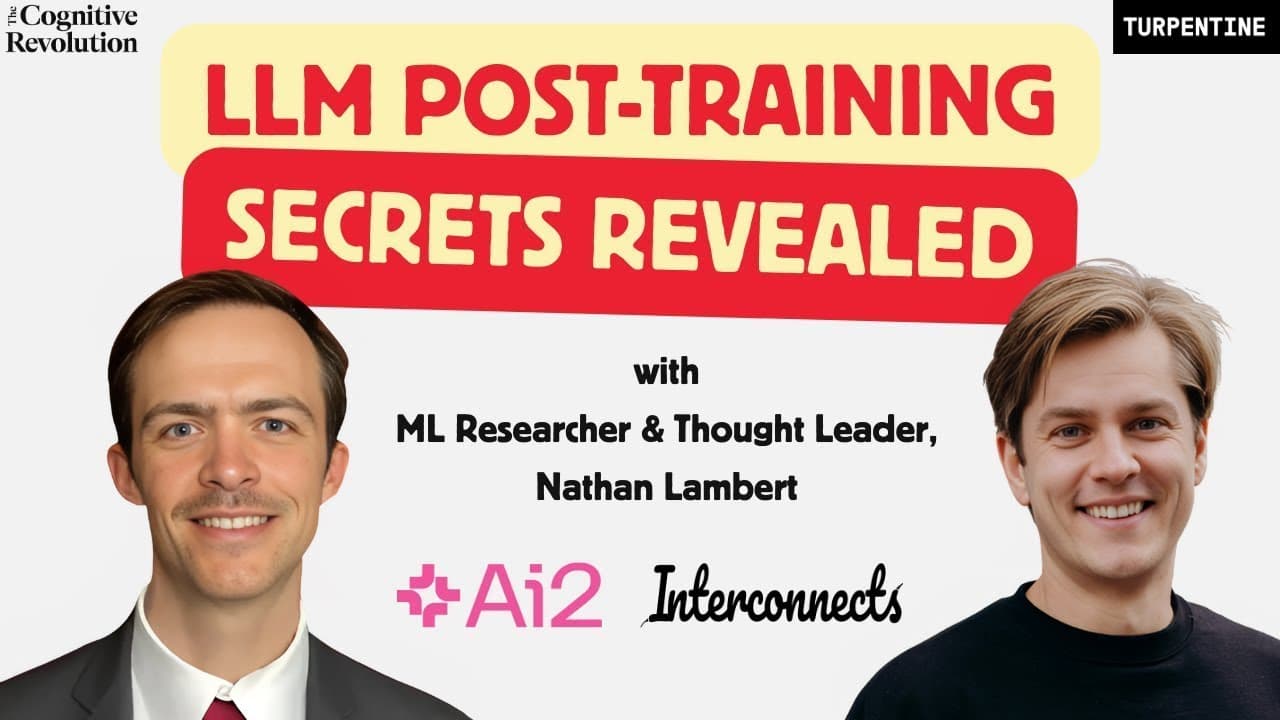
The latest techniques in large language model post-training include supervised fine-tuning, preference-based reinforcement learning, and a novel approach called reinforcement learning from verifiable rewards. These methods have allowed projects like Tulu 3 to match Meta's Llama model performance, demonstrating the importance of high-quality data curation and the potential of small academic teams in advancing AI capabilities.
Transcript
it's probably not worth the effort to spend all your time on preference tuning when you can just be making better data and better pipelines which is what to three is about inspired by the transition we're seeing with the Llama Report with trap bot arena is like turned into a hockey stick again where we have this incremental scores and the open Ai a... Read More
Key Insights
- Post-training techniques can significantly enhance LLM performance, as demonstrated by the Tulu 3 project, which matches Meta's Llama model performance.
- Supervised fine-tuning, preference-based reinforcement learning, and reinforcement learning from verifiable reward are key stages in LLM post-training.
- Quality data is more crucial than the choice of algorithm in post-training, with data curation yielding substantial performance improvements.
- LLMs as judges for preference data can be cost-effective, though the nuances of human versus AI preference data remain underexplored.
- The Allen Institute's small team of 10-15 people achieved significant advancements in LLM post-training, showcasing the potential of focused academic efforts.
- Emergent behaviors, such as self-checking reasoning, can arise during reinforcement learning, hinting at evolving model capabilities.
- Compute requirements for post-training vary, with supervised fine-tuning being the most resource-intensive compared to preference tuning stages.
- Open-source efforts in LLM development offer transparency and community collaboration, contrasting with closed industry approaches.
Install to Summarize YouTube Videos and Get Transcripts
Explore YouTube Video Summarizer or Get YouTube Transcript Extractor
Questions & Answers
Q: What are the main stages of LLM post-training discussed in the episode?
The main stages of LLM post-training discussed include supervised fine-tuning, preference-based reinforcement learning, and reinforcement learning from verifiable reward. Each stage contributes to enhancing the model's performance, with data quality being a key factor in achieving significant improvements.
Q: How does the Allen Institute's approach differ from closed industry models?
The Allen Institute's approach focuses on open-source efforts, transparency, and community collaboration. While closed industry models often rely on proprietary data and methods, the Institute shares its findings and data publicly, allowing others to build upon their work and fostering a collaborative research environment.
Q: What role does data quality play in LLM post-training?
Data quality is crucial in LLM post-training, often outweighing the choice of algorithm. High-quality, well-curated data can lead to significant performance improvements, as demonstrated by the Tulu 3 project. The focus is on creating specific data sets that target desired capabilities and evaluations.
Q: What are the compute requirements for LLM post-training?
Compute requirements vary across post-training stages. Supervised fine-tuning is the most resource-intensive, while preference tuning stages require less compute. For example, training an 8B model using 32 H100 GPUs takes about 24 hours for supervised fine-tuning, with subsequent stages requiring less time and resources.
Q: How is reinforcement learning from verifiable reward applied in LLM post-training?
Reinforcement learning from verifiable reward involves using verifiable outputs, such as correct math answers, to guide the training process. This technique helps improve specific capabilities, such as reasoning and problem-solving, by providing clear feedback on the model's performance.
Q: What are the benefits and limitations of using LLMs as judges for preference data?
Using LLMs as judges for preference data is cost-effective compared to human annotations. However, the nuances of human versus AI preference data are not fully understood, and further research is needed to explore potential biases and limitations in this approach.
Q: What emergent behaviors were observed during the reinforcement learning stage?
During reinforcement learning, emergent behaviors such as self-checking reasoning were observed. These behaviors indicate the model's evolving capabilities and suggest that reinforcement learning can lead to complex, unexpected outcomes in LLMs, highlighting the potential for further exploration in this area.
Q: What advice does Nathan Lambert offer for practitioners working on task-specific LLM models?
For task-specific LLM models, practitioners should focus on high-quality data and consider the trade-offs between general and task-specific models. Depending on the application, creating separate models for each task or a general model with task-specific fine-tuning may be appropriate. Iterative experimentation and evaluation are key to optimizing performance.
Summary & Key Takeaways
-
The episode explores frontier post-training techniques for large language models with Nathan Lambert from the Allen Institute for AI. The discussion focuses on the Tulu 3 release, which matches Meta's post-training performance using the Llama base model.
-
Key topics include supervised fine-tuning, preference-based reinforcement learning, and reinforcement learning from verifiable reward. Nathan provides insights into model development, compute requirements, and data generation strategies.
-
The conversation reveals the practical aspects of LLM development achieved by a small team, shedding light on previously opaque areas of AI model advancement. This discussion is one of the most detailed on state-of-the-art AI model development.
Read in Other Languages (beta)
Share This Summary 📚
Summarize YouTube Videos and Get Video Transcripts with 1-Click
Try YouTube Summary with ChatGPT & Claude or YouTube Transcript Generator
Explore More Summaries from Cognitive Revolution "How AI Changes Everything" 📚



Summarize YouTube Videos and Get Video Transcripts with 1-Click
Try YouTube Summary with ChatGPT & Claude or YouTube Transcript Generator