How to Use ChatGPT Codex for Software Engineering
TL;DR
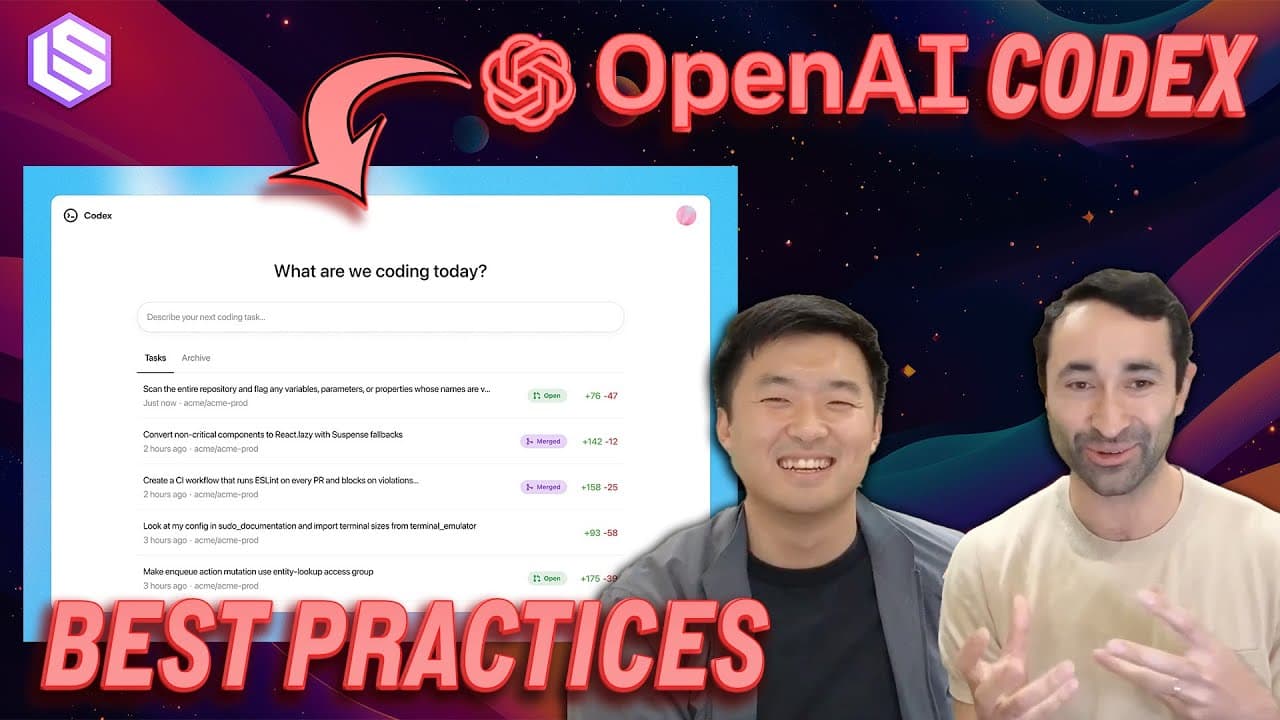
ChatGPT Codex is OpenAI's cloud-hosted autonomous software engineering agent designed to assist developers by performing coding tasks independently. It excels in understanding code style, writing concise PR descriptions, and testing code changes. Users are encouraged to delegate tasks freely, benefiting from the tool's capacity to run multiple tasks in parallel, significantly enhancing productivity.
Transcript
Hey everyone, welcome to the latest in space podcast. This is Allesio, partner and CTO at Decible and I'm joined by my co-host Wix, founder of Small AI. Hello. Hello. Calling in from Singapore here, but we are in the remote studio because uh the opening team keeps shipping and today they just uh live streamed and released tragic codeex. Welcome uh ... Read More
Key Insights
- ChatGPT Codex is an autonomous software engineering agent hosted in the cloud by OpenAI.
- The agent excels at understanding and adhering to existing code styles and writing concise PR descriptions.
- It can perform independent software engineering tasks, including testing code changes and suggesting improvements.
- Users are encouraged to delegate tasks freely, as Codex can handle multiple tasks in parallel efficiently.
- Codex has a responsive web interface that is also accessible on mobile devices, promoting ease of use.
- The tool is designed to work with existing development environments, supporting various customization options.
- Codex's development focuses on long-term improvements, including better multimodal inputs and environment customization.
- The research preview allows OpenAI to gather user feedback and iterate on the product before a full release.
Install to Summarize YouTube Videos and Get Transcripts
Explore YouTube Video Summarizer or Get YouTube Transcript Extractor
Questions & Answers
Q: How does ChatGPT Codex assist in software engineering?
ChatGPT Codex assists in software engineering by acting as an autonomous agent that can perform coding tasks independently. It excels in understanding and adhering to existing code styles, writing concise PR descriptions, and testing code changes. Developers can delegate tasks to Codex, allowing it to handle multiple tasks in parallel, significantly enhancing productivity and freeing up developers' time for more creative tasks.
Q: What are the best practices for using ChatGPT Codex?
Best practices for using ChatGPT Codex include maintaining a modular and testable codebase, using TypeScript or similar languages for better type safety, and setting up basic linting and formatting tools. Developers should also utilize the agents.md file to provide the agent with specific instructions and leverage the tool's capacity to run multiple tasks in parallel by adopting an abundance mindset.
Q: How does ChatGPT Codex handle multiple tasks?
ChatGPT Codex is designed to handle multiple tasks in parallel efficiently. Users can delegate tasks without spending much time crafting prompts, as the tool is capable of running up to 60 tasks per hour. This capacity allows developers to maximize productivity by offloading routine coding tasks to Codex while focusing on more complex and creative work.
Q: What are the future improvements planned for ChatGPT Codex?
Future improvements for ChatGPT Codex include better support for multimodal inputs, enhanced environment customization options, and potentially providing limited network access for the agent. OpenAI aims to integrate Codex more closely with developers' existing tools and environments, ensuring a seamless experience. These improvements will be guided by user feedback gathered during the research preview phase.
Q: How does ChatGPT Codex integrate with existing development environments?
ChatGPT Codex integrates with existing development environments by allowing developers to customize the agent's environment setup through scripts and configurations. It supports various tools and dependencies, enabling it to work effectively within different codebases. OpenAI is exploring ways to enhance this integration further, including support for Docker images and dev containers, to provide a more seamless developer experience.
Q: What is the significance of the agents.md file in ChatGPT Codex?
The agents.md file in ChatGPT Codex is crucial for providing the agent with specific instructions tailored to a project's needs. It helps the agent understand the codebase's structure, coding conventions, and any particular requirements or constraints. This file allows developers to compress the exploration time required by the agent, enabling it to perform tasks more efficiently and accurately.
Q: How does OpenAI ensure the safety and security of ChatGPT Codex?
OpenAI ensures the safety and security of ChatGPT Codex by implementing sandboxing measures and limiting the agent's access to the network during task execution. These precautions prevent unauthorized data access and exfiltration attempts. OpenAI continuously monitors and evaluates the agent's behavior to identify potential risks and improve security protocols, aiming to expand the agent's capabilities safely.
Q: What role does user feedback play in the development of ChatGPT Codex?
User feedback plays a critical role in the development of ChatGPT Codex by providing insights into how the tool is used in real-world scenarios. OpenAI uses this feedback to identify areas for improvement, refine the user experience, and prioritize feature development. The research preview phase is designed to gather extensive user input, which will guide the tool's evolution and ensure it meets developers' needs effectively.
Summary & Key Takeaways
-
ChatGPT Codex is OpenAI's cloud-hosted agent designed to automate software engineering tasks. It can independently understand code styles, write PR descriptions, and test changes, allowing developers to delegate tasks freely. Codex supports multiple tasks in parallel, enhancing productivity.
-
The tool is accessible via a responsive web interface and is designed to integrate with existing development environments. OpenAI plans to improve Codex with multimodal inputs and better environment customization based on user feedback.
-
Codex's development is part of OpenAI's broader vision to create AGI tools that benefit various functions beyond software engineering. The research preview phase allows OpenAI to refine the product before a full release, focusing on user experience and value delivery.
Read in Other Languages (beta)
Share This Summary 📚
Summarize YouTube Videos and Get Video Transcripts with 1-Click
Try YouTube Summary with ChatGPT & Claude or YouTube Transcript Generator
Explore More Summaries from Latent Space 📚




Summarize YouTube Videos and Get Video Transcripts with 1-Click
Try YouTube Summary with ChatGPT & Claude or YouTube Transcript Generator