What Is Computer Organization and Architecture Syllabus?
TL;DR
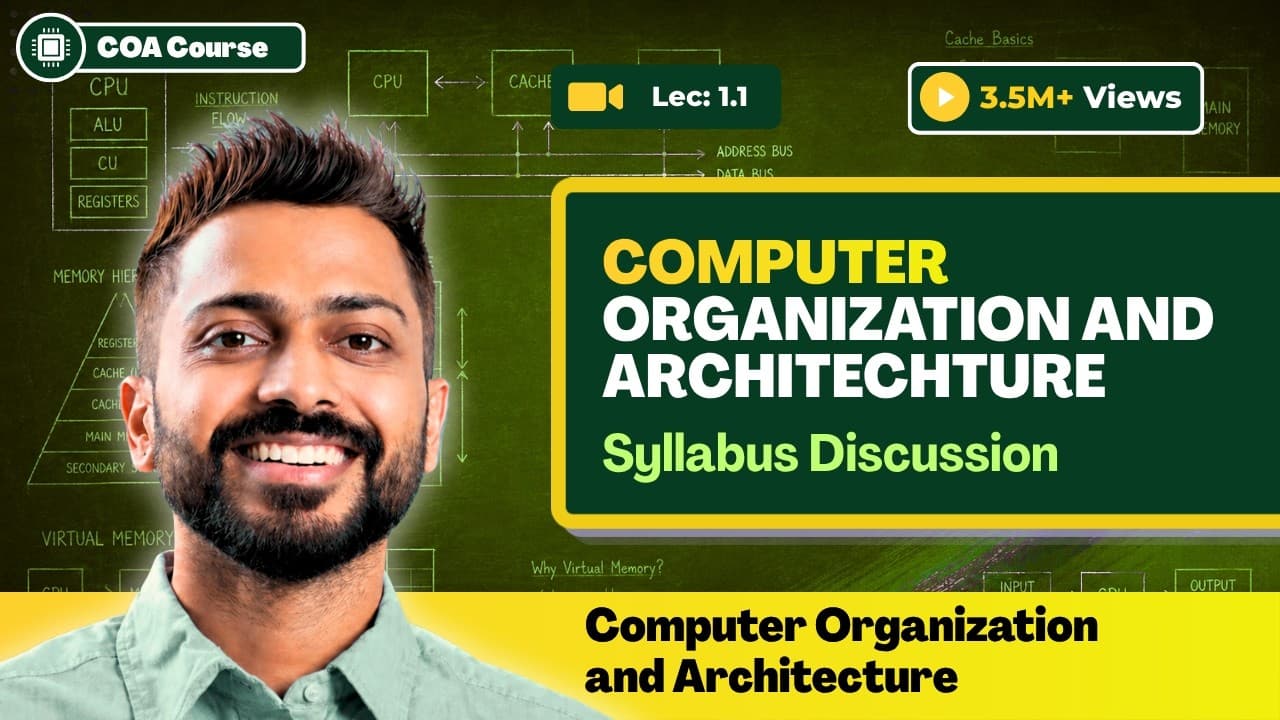
Computer Organization and Architecture carries 8 to 11 marks in GATE and UGC-NET, making it one of the highest-weightage subjects. It splits into Architecture (the abstract "what to do" design, like choosing memory, ALU, and control unit) and Organization (the "how to do" instruction-based execution). Memory Interfacing is the single most important topic at 3 to 4 marks.
Transcript
Hello friends! Welcome to Gate Smashers. Today, in this video, we are going to discuss, Introduction To Computer Organisation And Architecture, and along with that, if you are preparing for GATE, UGC- NET or any other competitive exam. Or even if you are preparing for your college or university level exams. Then what are all the topics in Computer... Read More
Key Insights
- Computer Organization and Architecture carries a weightage of 8 to 11 marks in GATE and UGC-NET, which makes the complete subject very important and impossible to ignore for anyone preparing for competitive or college-level exams.
- The subject is considered tough by the majority of students because its syllabus is based on hardware as well as software, unlike subjects that stay on one side of that line.
- Architecture means abstract or logical thinking, the "what to do" side: deciding what is needed, such as memory types (cache, RAM, registers), an ALU for arithmetic and logic, and a control unit to control them, without specifying how the task is performed.
- Organization means "how to do", the builder taking the architect's design and executing it. The whole of Computer Organization is based on the instruction set, where instruction means the way the task will be performed.
- Memory Interfacing is the most important topic in the whole of Computer Organization and also the easiest, carrying 3 to 4 marks in exams including GATE, UGC-NET, ISRO, and college-level papers. Only a fixed type of numerical comes from it.
- Cache Mapping, including direct cache mapping and set associative mapping, is the most important part of cache memory, alongside memory hierarchy, replacement algorithms for pages and frames, and secondary memory architecture with tracks and sectors.
- I/O Interface is the second most important topic after Memory Interfacing, with a weightage of near about 2 to 3 marks. It covers memory mapped and isolated methods, programmed I/O, interrupt driven transfer, DMA, synchronous and asynchronous modes, and series versus parallel.
- Addressing modes number near about 8 to 9 methods, including direct and indirect, all of them simple, and at least one question from them appears in any Computer Science competitive exam such as GATE or NET.
Install to Summarize YouTube Videos and Get Transcripts
Explore YouTube Video Summarizer or Get YouTube Transcript Extractor
Questions & Answers
Q: What is the weightage of Computer Organization and Architecture in GATE and UGC-NET?
Computer Organization and Architecture carries a weightage of 8 to 11 marks in GATE and UGC-NET. That makes the complete subject very important for anyone taking these exams. Within the subject, Memory Interfacing has the highest priority at 3 to 4 marks, followed by I/O Interface at near about 2 to 3 marks. Addressing modes are also worth covering because at least one question from them appears in any competitive exam that covers Computer Science, including GATE, NET, and ISRO.
Q: What is the difference between computer architecture and computer organization?
Architecture means abstract, that is logical thinking, and it answers "what to do". Using the house analogy, the architect is given a design or map stating what is wanted. For a computer task such as multiplying 2 with 3, architecture covers what is needed: hardware and memory, including cache memory, RAM and registers, an ALU for the multiplication, and a control unit to control these. Organization is the contractor or builder taking that design and answering "how to do", meaning how the task is actually performed, and it is based entirely on the instruction set.
Q: Why do students find Computer Organization and Architecture difficult?
The majority of students find this subject a little tricky because its syllabus is based on hardware as well as software, so both must be studied together. The video illustrates this with a C program containing printf("Hello World!"). Running it uses peripheral input devices such as the keyboard and mouse, software in the form of the operating system, and hardware in the form of the CPU, whose control unit creates the instructions and tells the monitor to print the output. Control Unit Design is specifically named as where most students face difficulty.
Q: Which books are best for Computer Organization and Architecture preparation?
The book by Morris Mano is described as the best standard book for GATE, NET, and college or university level exams. Among Indian writers, Pal Choudhary, a professor at IIT, has the best book. Other books exist, such as one by William Stallings, but the recurring problem with them is wording. For getting the entire syllabus collected in one place with usable wording, those two books, Morris Mano and Pal Choudhary, are the recommended choices.
Q: Why is Memory Interfacing the most important topic in COA?
Memory Interfacing is called the most important topic of the whole of Computer Organization because of its weightage of 3 to 4 marks, the highest priority in GATE, UGC-NET, ISRO, other competitive exams, and college or university exams. It is also described as the easiest topic, and only a fixed type of numerical comes from it. Many students push it to the end of their preparation, assuming the subject is tricky, but it should never be ignored. It covers memory hierarchy, cache memory, cache mapping, replacement, and secondary memory.
Q: What topics are covered under Memory Interfacing?
Memory Interfacing covers memory hierarchy, meaning the different kinds of memory available: cache, different types of registers, RAM, and secondary memory, along with 2-level and 3-level arrangements. The CPU is first connected to cache, and cache then connects to RAM, so how these connect, hierarchically or otherwise, is discussed. The main focus is cache memory, and within it cache mapping, including direct cache mapping and set associative mapping, plus replacement algorithms for pages and frames, and secondary memory architecture covering tracks and sectors.
Q: What is covered in the I/O Interface topic?
I/O Interface is the second most important topic in COA after Memory Interfacing, with a weightage of near about 2 to 3 marks. It exists because a running program may need help from an input or output device, such as when it demands a file while the CPU is executing. It covers two methods, memory mapped and isolated, plus data transfer modes: programmed I/O, interrupt driven, and DMA. Synchronous and asynchronous transfer modes are also discussed, as are series and parallel transfer.
Q: What is covered under Control Unit Design and ALU and Data Path?
Control Unit Design is about computer hardware and is where most students face difficulty. It covers hardwired and micro programmed control, timing signals, and micro instruction format, and doing these concepts is described as more than sufficient. ALU and Data Path also concerns hardware: the Arithmetical and Logical Unit, and how data flows between the many registers, such as input registers, output registers, and the program counter. It also covers how an instruction is fetched, decoded, and executed, the available execution methods, and write-back methods.
Summary & Key Takeaways
-
Computer Organization and Architecture carries a weightage of 8 to 11 marks in GATE and UGC-NET, covering both hardware and software. A simple C program printing "Hello World!" uses peripheral input devices, the operating system as software, and the CPU with its control unit as hardware, which is why the subject spans both domains and feels tricky to most students.
-
The subject splits into two parts using a house-building analogy. Architecture is abstract, logical thinking about "what to do": deciding which hardware is needed, such as cache memory, RAM, registers, an ALU for multiplication, and a control unit. Organization is the builder's side, "how to do" the task, and the whole of it rests on the instruction set.
-
Recommended standard books are Morris Mano, and among Indian writers, Pal Choudhary, an IIT professor. William Stallings and others exist, but wording is the usual problem, so those two books best gather the full syllabus in one place. The topics listed in the video come from analyzing which topics appear most frequently in previous year papers.
Read in Other Languages (beta)
Share This Summary 📚
Summarize YouTube Videos and Get Video Transcripts with 1-Click
Try YouTube Summary with ChatGPT & Claude or YouTube Transcript Generator
Explore More Summaries from Gate Smashers 📚






Summarize YouTube Videos and Get Video Transcripts with 1-Click
Try YouTube Summary with ChatGPT & Claude or YouTube Transcript Generator