How to Fix the 6 Most Common ChatGPT Prompt Problems
TL;DR
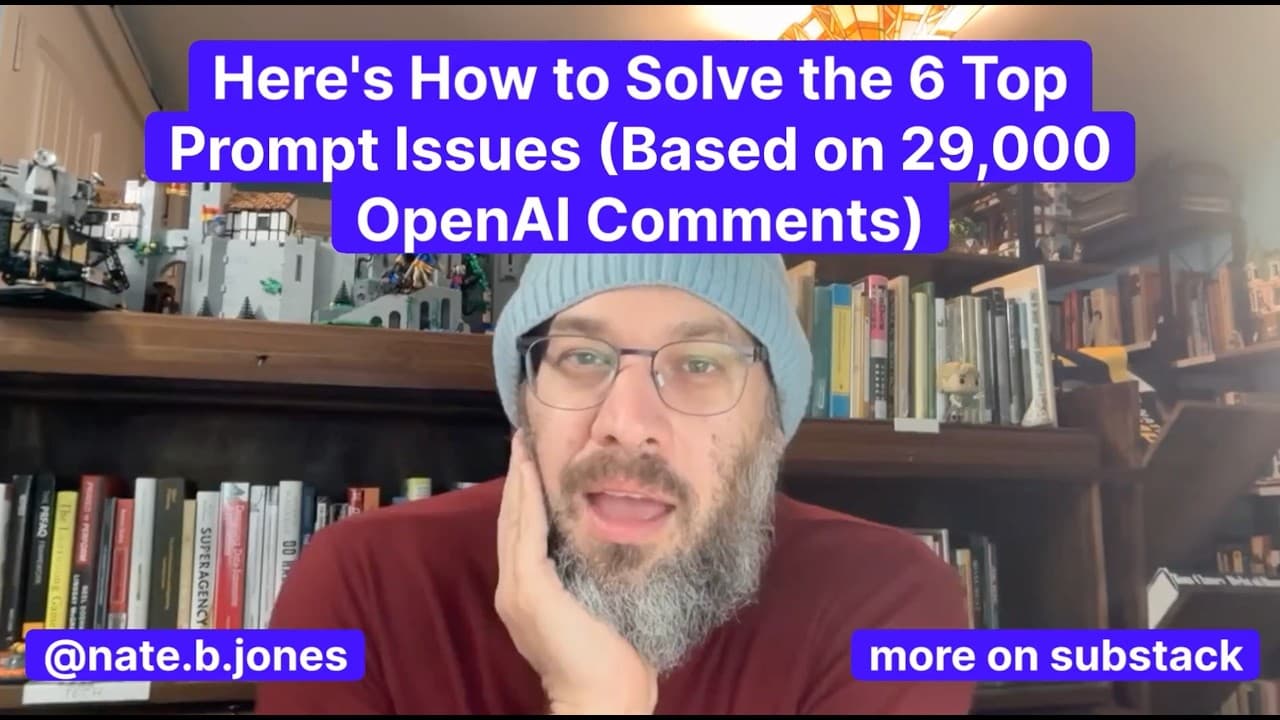
Most AI failures are design errors in how people prompt, not model failures. Six recurring issues, projection, revision loops, planning illusion, confidence illusion, drift, and context overload, each have a fix rooted in specifying output schemas, making surgical edits, staging tasks, requiring confidence labels, tightening constraints, and loading only the context you actually need.
Transcript
I spent the last few months running informal office hours with Fortune 500 product teams, with technical writers, with consultants. I keep coming up against the same six problems when people use AI. So, I'm calling this video chat GPT office hours. We're going to go through each of the six problems that I come across over and over again, and I'm go... Read More
Key Insights
- The projection trap happens when you assume the model has capabilities or context it lacks, often through underspecified prompts. The fix is not longer prompts but schema-first prompting: define the output you want and hand that map to the AI.
- Schema-first prompting means flipping your thinking from 'compose a prompt' to 'I want an output that looks like this.' You apply it when responses routinely break, not on every single prompt.
- The revision loop occurs when you ask for a small fix and the model rewrites everything. The fix is to be surgical: quote the exact snippet that is wrong and request only that patched section back.
- As an advanced revision fix, label outputs with a schema and instruct the model to touch only one field while freezing the others. Models respect labels because they are trained to respect schemas.
- The planning illusion is when complex tasks collapse into a single shallow pass that skips analysis. The fix is breaking the task into stages with explicit outputs and validation gates, forcing step-by-step progression.
- The confidence illusion, or hallucination, produces fluent answers with mismatched or non-existent citations. Permit the model to say 'I don't know,' require confidence labels, and ask for a claims-to-verify list.
- The drift problem is inconsistent outputs from the same inputs. Turn model temperature down in the API, set absolute constraints, and remove all ambiguity so the model has no room for creativity or invented steps.
- The cognitive bandwidth trap is that too much context can make outputs worse. Treat context as something you clean for, not accumulate, and default to the smallest slice needed to complete the task.
Install to Summarize YouTube Videos and Get Transcripts
Explore YouTube Video Summarizer or Get YouTube Transcript Extractor
Questions & Answers
Q: What is schema-first prompting and when should you use it?
Schema-first prompting means instead of composing a prompt forward in your head, you flip it around and say 'I want an output that looks like this,' then give that structure to the AI as a map. It fixes the projection trap, where you project capabilities or context onto the model it does not have. You use it when you are routinely getting incorrect responses, not on every prompt, because these are fixes for when things break.
Q: How do you stop ChatGPT from rewriting everything when you ask for a small fix?
This is the revision or regeneration loop, where you ask for a tiny fix and the model touches things you did not want changed. Be absolutely surgical about what you want changed. Ideally quote the exact snippet you want changed, say what is wrong, and request only that patched section back. As an advanced fix, if you keep a schema, tell the model to touch only one named field and freeze all the others.
Q: Why do complex tasks produce shallow, weak plans from AI?
This is the planning illusion, where complex tasks collapse into one shot and the model skips crucial steps in analysis or planning, doing a single blob pass with shallow causes. The problem is usually not model quality but how you handle the planning step. Break the challenge into stages with explicit outputs and validation gates at each stage, forcing a step-by-step progression rather than letting the model walk off on a weak single pass.
Q: How can you reduce hallucinations and fake citations in AI responses?
Hallucination is the confidence illusion: fluent answers with mismatched or non-existent citations. The simplest fix is to permit the model to say 'I don't know' and require confidence labels where it names its level of confidence. You can ask for a claims-to-verify list, or use a verification fields array in a schema giving a statement, confidence level, source, and verification status. Be extremely unambiguous about what high confidence means, since even small ambiguity invites hallucination.
Q: What causes AI to give different outputs for the same inputs?
This is the drift problem, or consistency issues, where the same inputs produce different outputs, tags drift across runs, or selection criteria are applied inconsistently. The baseline fix in the API is to turn the model temperature down and set absolute constraints. In chat, be obsessive about token-level clarity and specific about the sequence of steps, removing all ambiguity and opportunity for creativity so the model cannot make up steps that invite drift.
Q: Does giving AI more context always improve its answers?
No. This is the cognitive bandwidth trap: more context can make outputs worse, even though people assume they can throw everything into a million-token context window. The fix is clean context loading. In the API you can specify required versus optional context. Otherwise, default to as little context as humanly possible, for example pasting the two relevant pages of a twenty-page brief rather than the whole thing. Treat context as something you clean for, not accumulate.
Q: Are prompt problems different for developers versus non-developers?
No. A core belief the speaker holds is that developers and non-developers are not that different because everyone is using the same models. The projection trap, revision loops, planning illusion, and other issues affect both groups. Fixes like schemas, surgical edits, staged planning, and tool contracts can be done technically in the API or in plain English in the chat. Even non-technical schemas like labeling a title and author tend to be respected because models are trained to respect labeling.
Q: How many problems does the speaker identify and where do they come from?
The speaker identifies six top prompt problems: the projection trap, the revision loop, the planning illusion, the confidence illusion, the drift problem, and the cognitive bandwidth trap. They come from months of informal office hours with Fortune 500 product teams, technical writers, and consultants, where the same six problems kept recurring. To check for a sampling issue, he also combed through the OpenAI forums and confirmed he sees the same problems appearing there over and over.
Summary & Key Takeaways
-
After running informal office hours with Fortune 500 product teams, technical writers, and consultants, the speaker identified six recurring AI problems. He stresses that developers and non-developers face the same issues because everyone uses the same models, and these fixes are for when things break, not routine use.
-
The first three problems are the projection trap (fixed with schema-first prompting), the revision loop (fixed by quoting the exact snippet and requesting only that patch), and the planning illusion (fixed by staging tasks with explicit outputs, validation gates, and defined tools and contracts).
-
The remaining three are the confidence illusion or hallucination (fixed by permitting 'I don't know,' requiring confidence labels and verification fields), the drift problem (fixed by lowering temperature and removing ambiguity), and the cognitive bandwidth trap (fixed by loading minimal, clean context). He confirms these patterns appear repeatedly in the OpenAI forums too.
Read in Other Languages (beta)
Share This Summary 📚
Summarize YouTube Videos and Get Video Transcripts with 1-Click
Try YouTube Summary with ChatGPT & Claude or YouTube Transcript Generator
Explore More Summaries from AI News & Strategy Daily | Nate B Jones 📚






Summarize YouTube Videos and Get Video Transcripts with 1-Click
Try YouTube Summary with ChatGPT & Claude or YouTube Transcript Generator