How Does Python Compile and Interpret Code?
TL;DR
Python is both compiled and interpreted, making it a hybrid language. Its compiler converts source code from a .py file into .pyc bytecode, which the interpreter inside the Python Virtual Machine processes to generate machine code on the fly. Ordinary execution hides this compilation stage, but the py_compile module can expose the bytecode file. Read on for the full translation flow and the steps to find generated bytecode.
Transcript
foreign tations we have learned what is a compiler and what is an interpreter now we are ready to address this question is python compiled or interpreted so without any further delay let's get started the first topic of this presentation is is python compiled or interpreted the second topic is demo of how to see the byte code first we will address ... Read More
Key Insights
- Python is both a compiled and interpreted language because its translation process uses a compiler followed by an interpreter. This makes Python a hybrid language rather than exclusively compiled or exclusively interpreted, according to the explanation presented in the lesson.
- Python source code is stored in files with the .py extension. The compiler accepts this source code and translates it into bytecode, which uses the .pyc extension and serves as intermediate code for the next stage of execution.
- Python bytecode is processed by the Python Virtual Machine, also called the PVM. The interpreter is built into the PVM, which can be viewed as a package containing the interpreter together with other useful components.
- The Python interpreter generates machine code on the fly from bytecode. The generated machine code is not presented as a separate executable that the user can run or inspect, but its execution produces the program's visible output.
- Running a .py file normally performs both compilation and interpretation even when no bytecode file is visible in the source folder. The compilation stage is hidden during ordinary execution, so the absence of a displayed .pyc file does not mean compilation was skipped.
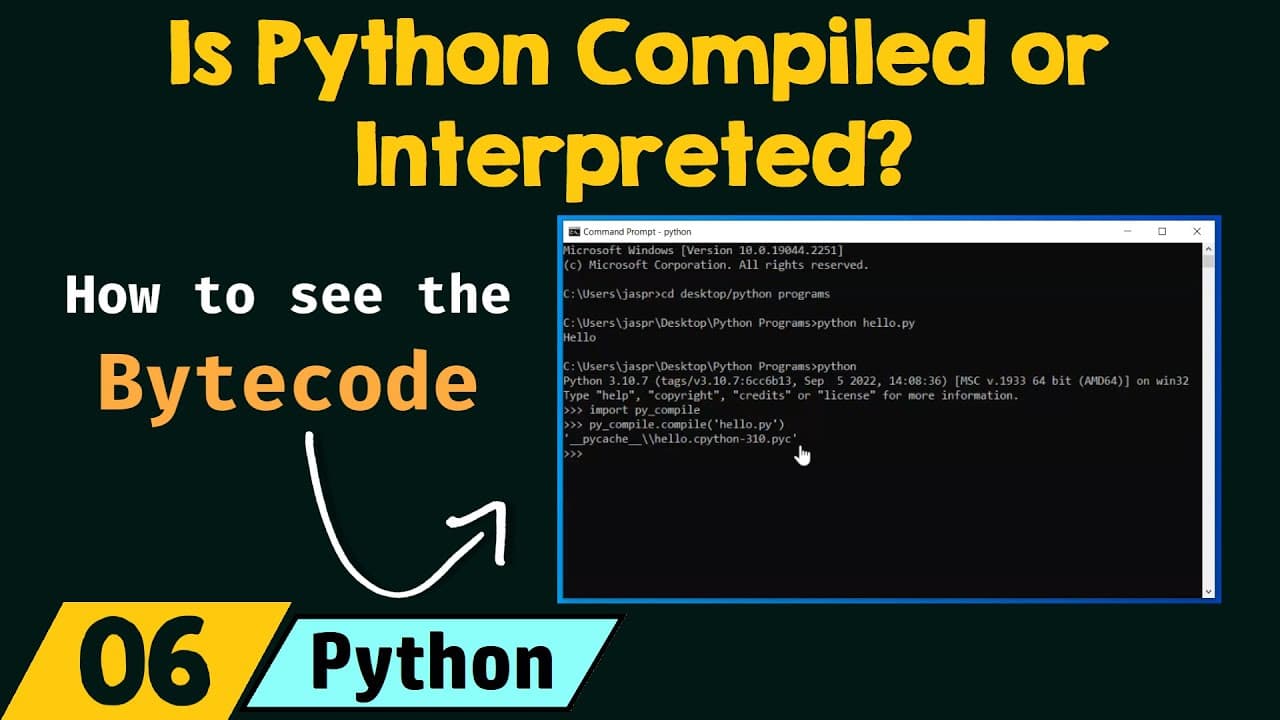
- The py_compile module provides a compile function that can compile a Python source file without carrying out the normal interpretation step. It can be imported in Python's interactive shell and called with the desired .py filename.
- Compiled bytecode is placed in a pycache folder created within the Python program directory. In the demonstration, compiling Hello.py produces a file named Hello.cpython-310.pyc, whose .pyc extension identifies it as compiled Python bytecode.
- Python bytecode is not understandable when opened as ordinary text in Notepad. It is intended for the interpreter inside the Python Virtual Machine, which can understand the bytecode and generate the corresponding program output on a machine where the required Python environment is installed.
Install to Summarize YouTube Videos and Get Transcripts
Explore YouTube Video Summarizer or Get YouTube Transcript Extractor
Questions & Answers
Q: Is Python compiled or interpreted?
Python is both compiled and interpreted, so the lesson describes it as a hybrid language. A compiler first converts .py source code into .pyc bytecode, and the interpreter inside the Python Virtual Machine then processes that bytecode.
Q: How does Python compile and interpret code?
The compiler accepts Python source code from a .py file and produces intermediate bytecode with a .pyc extension. The Python Virtual Machine then uses its built-in interpreter to generate machine code on the fly and produce the program output.
Q: What is Python bytecode?
Python bytecode is the intermediate code produced by the compiler from .py source code. It uses the .pyc extension and is designed to be processed by the Python Virtual Machine rather than read as ordinary text.
Q: What does the Python Virtual Machine do?
The Python Virtual Machine, or PVM, accepts bytecode and processes it using its built-in interpreter. It generates machine code on the fly, while the user sees the program output rather than that machine code.
Q: Why is Python considered a hybrid language?
Python is considered hybrid because its translation process uses both a compiler and an interpreter. The compiler creates bytecode, and the interpreter inside the PVM processes that bytecode to produce output.
Q: Why is no .pyc file visible when Python code runs normally?
Ordinary execution performs both compilation and interpretation while hiding the generated bytecode from the user. Therefore, not seeing a separate .pyc file does not mean that the compilation stage was skipped.
Q: How can you generate a visible Python bytecode file?
Open Python's interactive shell, import the py_compile module, and call py_compile.compile with the source filename, such as Hello.py. The compiled .pyc file will then appear inside a pycache folder.
Q: Where does Python store explicitly compiled bytecode?
The demonstration places explicitly compiled bytecode in a pycache folder within the Python program directory. Compiling Hello.py produces a file named Hello.cpython-310.pyc, whose .pyc extension identifies it as Python bytecode.
Summary & Key Takeaways
-
Python uses a hybrid translation process involving both compilation and interpretation. Its compiler accepts source code stored in a .py file and produces intermediate bytecode with a .pyc extension. That bytecode is then passed to the Python Virtual Machine, whose built-in interpreter generates machine code on the fly and produces the program output.
-
Running a Python source file normally performs compilation and interpretation while hiding the generated bytecode from the user. In the demonstration, a file named Hello.py contains a print function that displays hello. Executing it from the command prompt with the Python command produces the expected output without displaying a separate bytecode file.
-
Python bytecode can be generated visibly by opening the interactive shell, importing the py_compile module, and calling py_compile.compile with the source filename. The resulting .pyc file appears inside a pycache folder. Its contents are not understandable in Notepad, but the Python Virtual Machine can interpret the file and generate output.
Read in Other Languages (beta)
Share This Summary 📚
Summarize YouTube Videos and Get Video Transcripts with 1-Click
Try YouTube Summary with ChatGPT & Claude or YouTube Transcript Generator
Explore More Summaries from Neso Academy 📚




Summarize YouTube Videos and Get Video Transcripts with 1-Click
Try YouTube Summary with ChatGPT & Claude or YouTube Transcript Generator