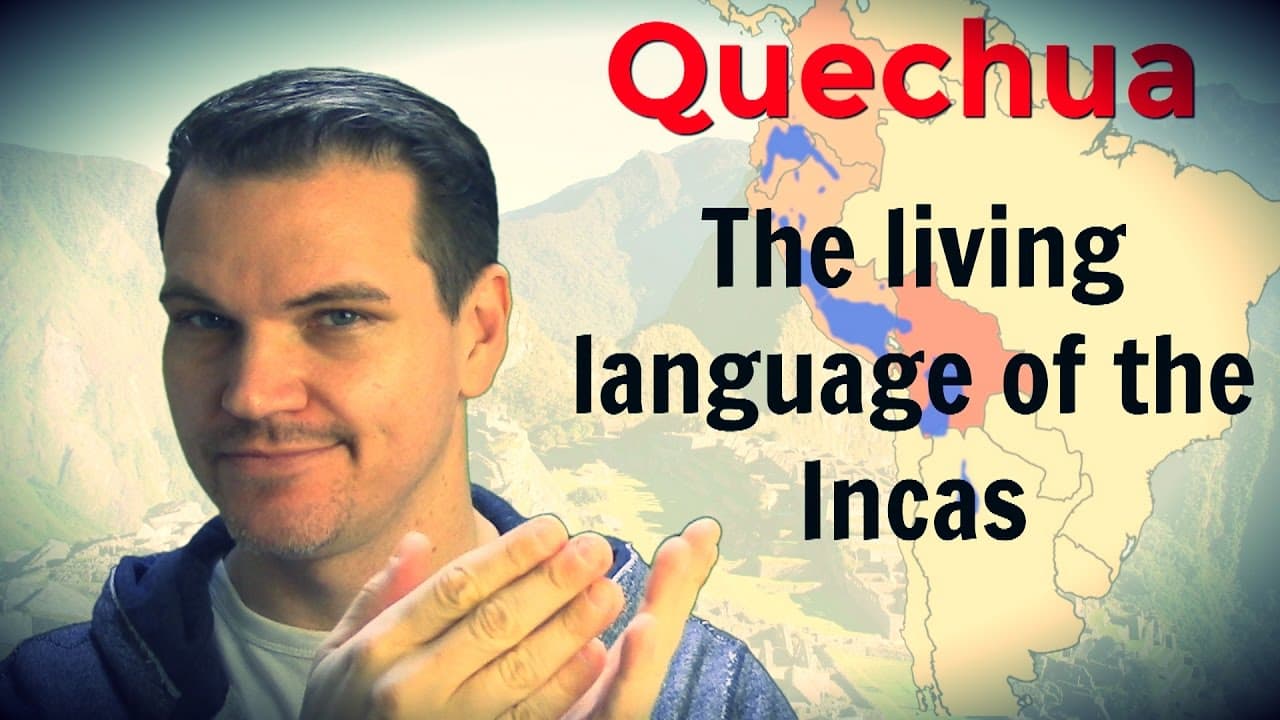
Quechua - The Living Language of the Incas
TL;DR
Quechua is a widely spoken native South American language.
Transcript
Follow Langfocus on Facebook, Twitter and Instagram. Hello everyone. Welcome to Langfocus channel and my name is Paul. Today's topic is a language that some of you have probably never heard up but it's a fascinating topic and one that definitely worth a look. The topic is Quechua. And in Quechua, the language that sometimes is referred to as "Runa ... Read More
Key Insights
- Quechua, also known as Runa Simi, is the most widely spoken native language in South America, with 8-10 million speakers across Peru, Bolivia, Ecuador, northern Argentina, and southern Colombia.
- The Inca Empire's expansion helped spread Quechua as a lingua franca, but it was not a written language until after the Spanish conquest in the 16th century.
- Quechua's decline is attributed to the dominance of Spanish in education, media, and urban areas, leading to its perception as a low-prestige language.
- Quechua is divided into two major dialect categories: Quechua I and Quechua II, with significant differences in vocabulary, morphology, and pronunciation.
- Quechua is an agglutinative language, using suffixes to modify words and convey complex meanings, as demonstrated with examples like 'Mishiykikunawan' (with your cats).
- The language features topic and focus markers to highlight new or presupposed information, and evidential markers to indicate the source of information.
- Quechua has borrowed extensively from Spanish, with some dialects incorporating up to one-third of their vocabulary from Spanish.
- Efforts to preserve Quechua include bilingual education and promoting literacy in the language, as its decline would signify a cultural loss.
Install to Summarize YouTube Videos and Get Transcripts
Explore YouTube Video Summarizer or Get YouTube Transcript Extractor
Questions & Answers
Q: What is the significance of Quechua in South American history?
Quechua holds significant historical importance as it was the language of the Inca Empire, the largest empire in pre-colonial America. It served as a lingua franca across the regions under Inca control, facilitating communication and administration. Even after the Spanish conquest, Quechua remained influential, used by the Catholic Church in conversion efforts.
Q: Why has Quechua declined in use and prestige?
Quechua's decline is primarily due to the dominance of Spanish, which became the language of education, media, and economic opportunity. As urbanization increased, Spanish became necessary for communication in cities, leading to Quechua being perceived as low-prestige. Many Quechua-speaking parents chose to speak Spanish with their children, furthering its decline.
Q: How is Quechua structured linguistically?
Quechua is an agglutinative language, meaning it uses suffixes to modify words and convey complex meanings. It follows a subject-object-verb (SOV) syntax. The language also features topic and focus markers to highlight information and evidential markers to indicate the source of information. These linguistic features make Quechua unique among world languages.
Q: What are some challenges in standardizing Quechua?
Standardizing Quechua is challenging due to its division into two major dialect categories, Quechua I and Quechua II, each with distinct vocabulary and pronunciation. Additionally, there is no widely accepted standard written form, and Quechua dialects are spoken differently across regions, complicating efforts to unify them under a single standard language.
Q: What role did the Spanish conquest play in the history of Quechua?
The Spanish conquest played a pivotal role in Quechua's history by introducing written forms of the language. Although Quechua was initially oral, the Spanish used it for religious conversion, producing written records. However, after the Tupac Amaru rebellion, colonial powers banned Quechua in public use, contributing to its decline in prestige and use.
Q: How do Quechua speakers use evidential markers?
Quechua speakers use evidential markers to indicate the source of information. For example, the marker 'mi' shows direct evidence, 'cha' indicates inference, and 'shi' denotes hearsay. These markers help convey the speaker's certainty and the basis of their statements, adding a layer of meaning that is not present in many other languages.
Q: What efforts are being made to preserve Quechua?
Efforts to preserve Quechua include promoting bilingual education and increasing literacy in the language. Recognizing Quechua as an official language in countries like Peru and Bolivia has also helped. These efforts aim to raise the language's prestige and encourage its use alongside Spanish, preventing further decline and loss of cultural heritage.
Q: How has Spanish influenced Quechua vocabulary?
Spanish has significantly influenced Quechua vocabulary, with some dialects incorporating up to one-third of their words from Spanish. Common loanwords include 'sirbisa' (from 'cerveza'), 'chufir' (from 'chofer'), 'escuela' (school), and 'libro' (book). This influence reflects the historical and ongoing interaction between Quechua-speaking communities and Spanish-speaking societies.
Summary & Key Takeaways
-
Quechua, also known as Runa Simi, is the most widely spoken native language in South America, with 8-10 million speakers across several countries. It served as the lingua franca of the Inca Empire. Despite its historical significance, Quechua has declined due to the dominance of Spanish.
-
The language is divided into two major dialect categories: Quechua I and Quechua II, with differences in vocabulary and pronunciation. Quechua is agglutinative, using suffixes to modify words, and features topic, focus, and evidential markers. Spanish loanwords are prevalent in Quechua.
-
Efforts to preserve Quechua include promoting bilingual education and literacy. The language's decline is attributed to Spanish's dominance in education and urban areas, leading to its perception as low-prestige. The loss of Quechua would be a significant cultural loss.
Read in Other Languages (beta)
Share This Summary 📚
Summarize YouTube Videos and Get Video Transcripts with 1-Click
Try YouTube Summary with ChatGPT & Claude or YouTube Transcript Generator
Explore More Summaries from Langfocus 📚




Summarize YouTube Videos and Get Video Transcripts with 1-Click
Try YouTube Summary with ChatGPT & Claude or YouTube Transcript Generator