Arabic and its Huge Impact on Indonesian & Malay!
TL;DR
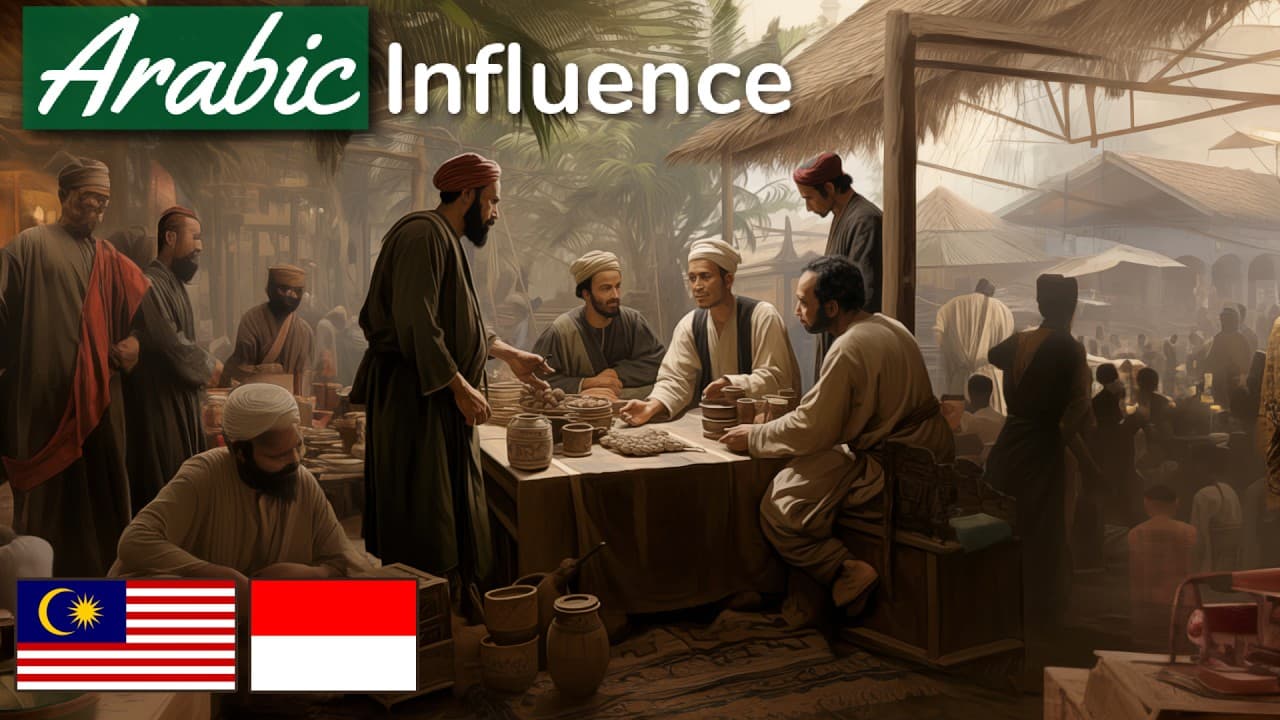
Arabic significantly impacted Malay and Indonesian languages through trade and religion.
Transcript
Indonesian and Malay which are basically two varieties of the same language are members of the austronesian language family but due to contact with other cultures through trade religion and colonialism they've been influenced to a great extent by other languages their major influences include Dutch and English depending on who colonized the area Sa... Read More
Key Insights
- Indonesian and Malay, part of the Austronesian language family, have been influenced by Dutch, English, Sanskrit, Persian, and notably Arabic due to historical trade and religious interactions.
- Arabic loanwords in these languages are not limited to religious contexts but extend to everyday vocabulary, including words for time, greetings, and common objects.
- The spread of Islam in Southeast Asia, particularly during the Malacca Sultanate, facilitated the integration of Arabic vocabulary into Malay and Indonesian.
- Arabic words often retain their original meanings in religious contexts but may acquire new meanings in everyday usage, reflecting cultural adaptations.
- Malay and Indonesian languages frequently use Arabic roots combined with local affixes to form new words, showcasing linguistic adaptability.
- Transitional words and adverbials in Malay and Indonesian often derive from Arabic, aiding in conversation flow and clarity.
- Despite comprising only a small percentage of the total vocabulary, Arabic loanwords in Malay and Indonesian are essential for both formal and informal communication.
- The integration of Arabic vocabulary into Malay and Indonesian highlights the historical and ongoing intercultural connections between Southeast Asia and the Arabic-speaking world.
Install to Summarize YouTube Videos and Get Transcripts
Explore YouTube Video Summarizer or Get YouTube Transcript Extractor
Questions & Answers
Q: How did Arabic influence Malay and Indonesian languages?
Arabic influenced Malay and Indonesian through centuries of trade and religious interactions. Muslim Arab traders and missionaries introduced Arabic vocabulary as early as the 7th century. The spread of Islam, particularly during the Malacca Sultanate, further accelerated this influence, integrating Arabic words into both religious and everyday language.
Q: What types of Arabic words are commonly used in Malay and Indonesian?
Arabic words in Malay and Indonesian are used in both religious and everyday contexts. They include terms for God, mosque, faith, and worship, as well as common words for time, greetings, and objects. This reflects the historical spread of Islam and the cultural exchanges between Southeast Asia and the Middle East.
Q: Why are Arabic roots combined with Malay affixes in these languages?
Combining Arabic roots with Malay affixes in Indonesian and Malay demonstrates linguistic adaptability and creativity. This process allows the integration of foreign vocabulary while maintaining the grammatical structure of the local languages. It also facilitates the creation of new words that are relevant to the cultural and social context of the speakers.
Q: How do transitional words from Arabic function in Malay and Indonesian?
Transitional words borrowed from Arabic in Malay and Indonesian serve to clarify meaning, indicate cause and effect, and enhance conversational flow. These words, often combined with local suffixes, help speakers articulate thoughts more coherently and connect ideas smoothly, reflecting the nuanced influence of Arabic on these languages.
Q: What is the significance of Arabic loanwords in Malay and Indonesian news media?
Arabic loanwords in Malay and Indonesian news media highlight the enduring influence of Arabic on formal communication. These words are used to convey complex ideas, ensuring clarity and precision in news reporting. Their presence underscores the historical intercultural connections and the role of Arabic in shaping modern language use in these regions.
Q: How prevalent are Arabic loanwords in Malay and Indonesian dictionaries?
Arabic loanwords constitute a small but significant portion of Malay and Indonesian vocabularies. In the Kamus Dewan dictionary, they make up about 6.25% of entries, with 3.5% being commonly used words. These words are essential for both formal and informal communication, illustrating the historical impact of Arabic on these languages.
Q: Are there any controversies related to the use of Arabic words in Malay and Indonesian?
One notable controversy involves the use of the word 'Allah' in Malaysia, where it is used by both Muslims and Christians to refer to God. This has sparked debates about religious identity and language rights, reflecting the complex interplay of language, religion, and cultural identity in the region.
Q: What historical events facilitated the Arabic influence on Malay and Indonesian?
The Arabic influence on Malay and Indonesian was facilitated by trade and the spread of Islam. The Malacca Sultanate played a crucial role in this process, as it was a major hub for international trade and cultural exchange. Arab traders and missionaries introduced Arabic vocabulary, which was further disseminated through religious conversion and intermarriage.
Summary & Key Takeaways
-
Indonesian and Malay languages, part of the Austronesian family, have been significantly influenced by Arabic due to centuries of trade and religious interactions. Arabic loanwords permeate both formal and informal vocabulary, reflecting the historical spread of Islam and cultural exchanges between Southeast Asia and the Middle East.
-
Arabic's influence on Malay and Indonesian is evident in religious terminology, everyday vocabulary, and linguistic structures. The integration of Arabic roots with local affixes demonstrates the adaptability of these languages, while transitional words and adverbials borrowed from Arabic enhance conversational flow.
-
The presence of Arabic loanwords in Malay and Indonesian underscores the historical intercultural connections facilitated by trade and religion. Although they constitute a small portion of the vocabulary, these words are crucial for effective communication, highlighting the enduring impact of Arabic on these languages.
Read in Other Languages (beta)
Share This Summary 📚
Summarize YouTube Videos and Get Video Transcripts with 1-Click
Try YouTube Summary with ChatGPT & Claude or YouTube Transcript Generator
Explore More Summaries from Langfocus 📚





Summarize YouTube Videos and Get Video Transcripts with 1-Click
Try YouTube Summary with ChatGPT & Claude or YouTube Transcript Generator