How AI Accelerators Boost Model Efficiency?
TL;DR
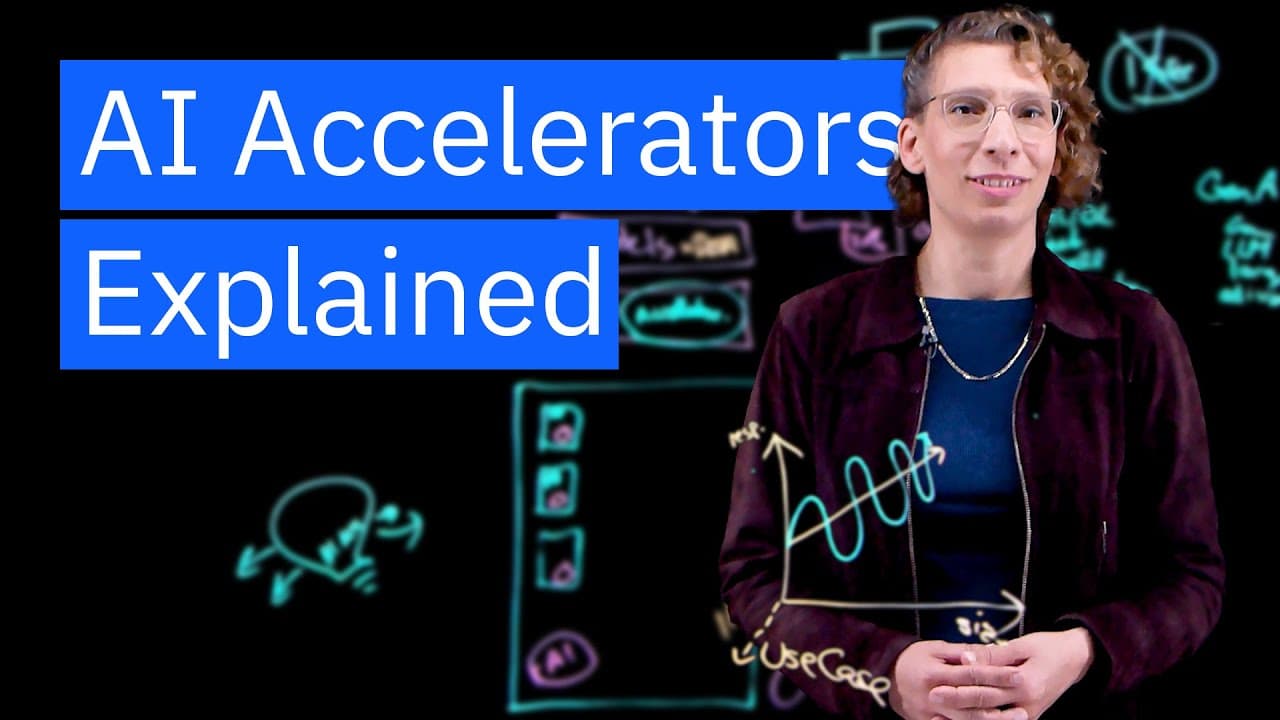
AI accelerators speed up AI workloads by providing purpose-built hardware that reduces latency and power use, and they enable right sized models for different use cases. They fit into heterogeneous systems and support scalable, cost effective AI across deep learning and generative models. This enables more efficient inference and better resource utilization in real world deployments.
Transcript
AI has captured the world's imagination. The landscape is evolving rapidly as enterprises begin to leverage the technology's potential for real-world business applications. Ideas in the space for creating and improving applications are expanding in every direction, and at the heart of these ideas are AI accelerators, hardware accelerators, which is... Read More
Key Insights
- AI accelerators are purpose built hardware optimized for high compute matrix mathematics used in AI tasks.
- The hardware aims to reduce latency and power consumption while shrinking physical footprint compared to general purpose hardware.
- A heterogeneous system of accelerators allows different workloads to run with specialized designs across a server or box.
- Model size should be matched to the task to optimize accuracy, latency, and cost in real time.
- Generative AI models are larger and more resource intensive, but traditional models still hold value for cost and efficiency.
- Right sizing involves balancing model complexity, response time, and risk tolerance for a given use case.
- Data movement and memory bandwidth are critical factors in accelerator performance and efficiency.
- Placing accelerators on-die or externally within a system enables flexible deployment and scalability for AI workloads.
Install to Summarize YouTube Videos and Get Transcripts
Explore YouTube Video Summarizer or Get YouTube Transcript Extractor
Questions & Answers
Q: How do AI accelerators improve inference latency and power efficiency?
AI accelerators are specialized hardware engines optimized for the matrix math and tensor operations central to AI workloads. By specializing silicon for these tasks, they reduce the number of cycles required to compute results and minimize energy per operation. This combination lowers latency and power use compared to general purpose CPUs or GPUs, enabling faster and more energy efficient inference across a range of AI tasks.
Q: What is meant by a heterogeneous accelerator system and why is it useful?
A heterogeneous accelerator system uses different accelerator designs within the same hardware platform to optimize for diverse workloads. This is useful because various AI tasks have different compute patterns and memory access needs. By matching workloads to the most suitable accelerator design, overall performance improves, resource utilization increases, and scale is achieved without overprovisioning a single type of hardware.
Q: How does model size influence the choice of hardware for AI tasks?
Model size directly affects both compute needs and latency. Smaller models can run quickly on on chip accelerators close to the compute engine, delivering fast responses, while larger models may require more memory bandwidth or external accelerators. Choosing the right model size helps balance accuracy, risk, latency, and power consumption for the task.
Q: Why is right sizing important for AI in business applications?
Right sizing ensures the model used matches the task requirements and constraints such as latency, accuracy, and cost. Overly large models can waste compute resources and slow response times, while too small models may produce inaccurate results or fail to meet risk thresholds. Proper sizing improves reliability and efficiency in production systems.
Q: What role does memory bandwidth play in accelerator performance?
Memory bandwidth determines how quickly data can move between the accelerator and its memory, which affects sustained throughput and latency. High bandwidth reduces stalls and keeps the compute units fed with data, improving overall efficiency for large models and complex tasks where data movement becomes a bottleneck.
Q: How can accelerators be deployed within a server or mainframe for AI tasks?
Accelerators can be placed on the processor chip, attached to compute engines elsewhere in the system, or connected externally with their own compute and memory. This flexibility allows designers to bring compute closer to data, minimize data transfer, and tailor the configuration to workload profiles, thereby enhancing performance and scalability.
Q: What is the difference between traditional AI models and generative AI models in terms of hardware needs?
Traditional AI models are generally smaller and faster, making them suitable for on chip or nearby accelerators with low latency needs. Generative AI models tend to be larger and more compute intensive, requiring more memory and potentially external accelerators. The key is to align model size with available hardware to achieve desired performance and cost goals.
Q: How does governance and security integrate with AI accelerators in the stack?
Governance and security layers manage how AI models operate, access data, and ensure privacy and compliance. While accelerators handle the compute, software layers oversee task management, governance policies, and security controls to protect data in motion and at rest. This integration helps maintain trust and safety in AI deployments.
Summary & Key Takeaways
-
The video explains that hardware accelerators are specialized silicon designed to run AI workloads faster and with lower power than general purpose hardware. It emphasizes reduced footprint and the ability to tailor accelerators to task types for scalability.
-
It discusses the AI stack from infrastructure, models, and software governance to show how accelerators fit within a system, enabling efficient management and security in AI deployments.
-
It uses the fraud detection example to illustrate right sizing models and placing accelerators close to compute to minimize latency and improve decision quality.
Read in Other Languages (beta)
Share This Summary 📚
Summarize YouTube Videos and Get Video Transcripts with 1-Click
Try YouTube Summary with ChatGPT & Claude or YouTube Transcript Generator
Explore More Summaries from IBM Technology 📚




Summarize YouTube Videos and Get Video Transcripts with 1-Click
Try YouTube Summary with ChatGPT & Claude or YouTube Transcript Generator